

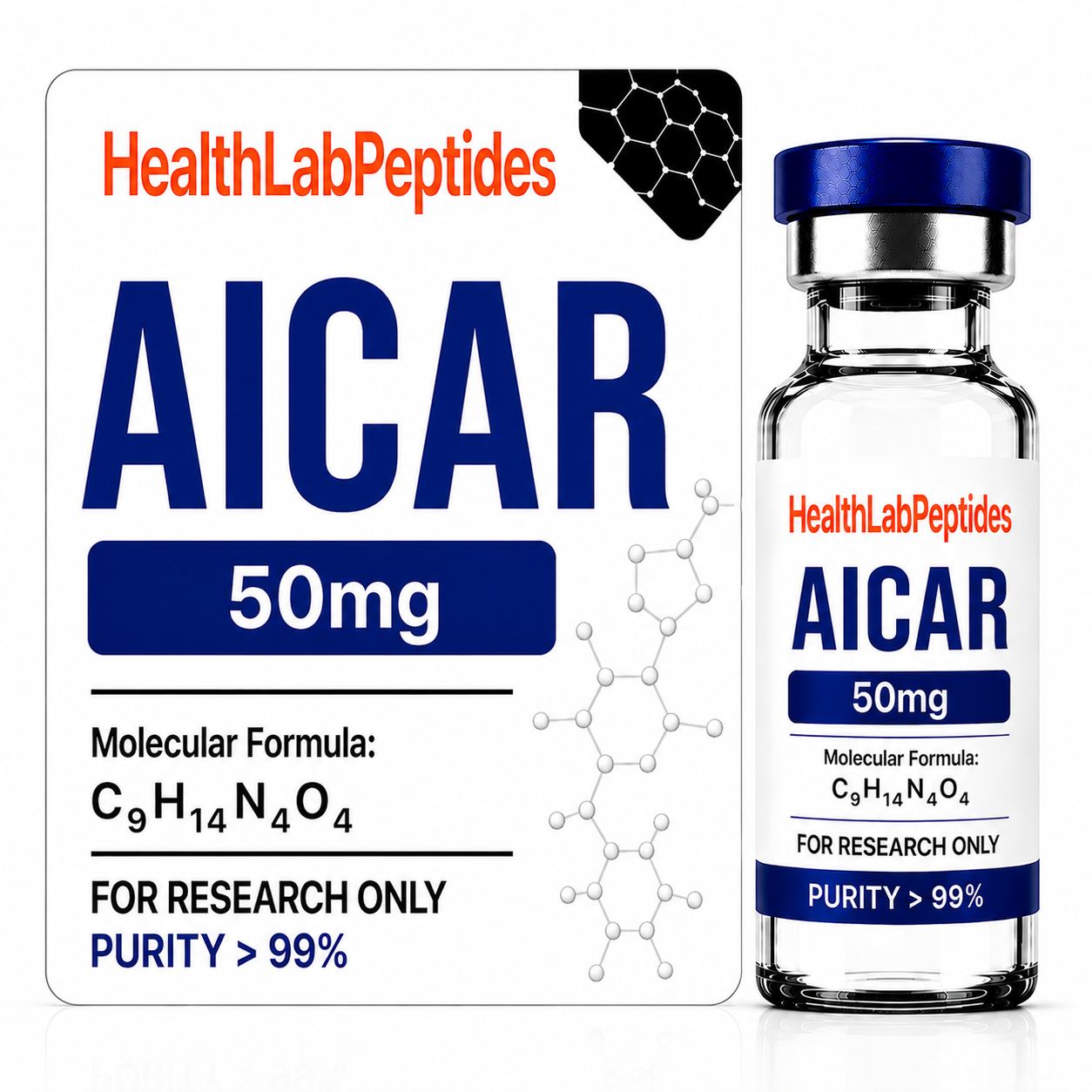
Research suggests that AICAR is an important laboratory probe of AMP-activated protein kinase (AMPK), but an experiment using AICAR does not automatically prove that AMPK caused every observed response. AICAR—5-aminoimidazole-4-carboxamide ribonucleoside, sometimes called acadesine—is a nucleoside analog rather than a peptide. Researchers have used it in cell and animal models to investigate nucleotide sensing, metabolic enzymes, and transcriptional signaling. This article examines the conversion of AICAR into ZMP, the difference between kinase markers and functional endpoints, and evidence of AMPK-independent actions. For broader background, see the AICAR metabolic research overview. All findings discussed here concern experimental science, not personal or medical use.
AICAR is chemically a nucleoside, not a peptide
Peptides consist of amino-acid residues connected through peptide bonds. AICAR instead contains a modified imidazole-related group attached to ribose. The phrase AICAR peptide sometimes appears in online search results but does not accurately describe its molecular class. That distinction is relevant to analytical identity, chemistry, and how a researcher compares it with compounds such as MOTS-c or SS-31. A product’s presence in a peptide supplier’s catalog does not change the chemical identity of the material. Laboratory writing should use the proper compound name before discussing any biological endpoint.
AMPK and cellular energy-associated signaling
AMPK is a protein kinase studied because it helps coordinate responses to changes in cellular nucleotide balance. AMPK-related experiments may examine kinase phosphorylation, substrate phosphorylation, gene expression, and metabolic flux. These endpoints are different, even though they can participate in the same larger regulatory network. A change in a phosphorylated protein does not prove a beneficial outcome in an organism. Experimental results depend on model, cell type, method, and timing, so mechanistic claims require more than attaching the label AMPK activation to a response.
The foundational rat-hepatocyte study from 1995
Corton, Gillespie, Hawley, and Hardie published a report in the European Journal of Biochemistry in 1995, PMID 7744080, DOI 10.1111/j.1432-1033.1995.tb20498.x. They investigated AICAR in rat hepatocytes and observed accumulation of the phosphorylated derivative ZMP alongside AMPK-related effects. Their reported endpoints included phosphorylation of HMG-CoA reductase and changes in pathways involved in lipid synthesis. The paper helped establish AICAR as a biochemical research tool. It did not establish that every later observation under AICAR exposure is necessarily caused by AMPK.
Why ZMP matters to interpretation
After entering certain cells, AICAR can be converted into a nucleotide derivative called ZMP. ZMP can behave as an AMP-like signal in some AMPK-associated pathways. The parent nucleoside and its phosphorylated metabolite are different chemical species. Detecting AICAR in a test medium therefore does not establish intracellular ZMP abundance. Variations in cellular uptake, metabolism, or the surrounding medium can affect the response. A sound experiment distinguishes what was added to the preparation from what was actually formed inside it and which downstream readouts were measured.
AMPK phosphorylation is not the whole mechanism
Studies may quantify phosphorylated AMPK, total AMPK protein, or phosphorylation of downstream substrates such as acetyl-CoA carboxylase. These measurements provide complementary information but should not be confused. A higher ratio of phosphorylated AMPK to total protein does not directly quantify every metabolic pathway, and a substrate response can sometimes involve intersecting mechanisms. Proper interpretation requires controls, assay validation, and a clear description of the biological model. An article that simply says AICAR improves metabolism would substitute an unsupported clinical implication for a biochemical observation.
ACC as a downstream marker
Acetyl-CoA carboxylase, commonly abbreviated ACC, is an enzyme involved in lipid-related metabolism. AMPK-associated phosphorylation of ACC is frequently used as an experimental marker. However, an ACC phosphorylation measurement is not itself a measure of a person’s body composition, exercise performance, or clinical status. It is a defined molecular readout. Researchers should specify whether they detected the protein, its phosphorylated form, enzymatic activity, or a later metabolic effect. Such distinctions help readers understand how far a reported conclusion extends and what remains untested.
Why AICAR is not a selective AMPK switch
A systematic review indexed under PMID 34064363 examined the literature on both AMPK-dependent and AMPK-independent actions of AICAR. The authors warned that numerous results formerly attributed to AMPK have alternative or additional mechanisms. The review is important because it challenges a shortcut common in experimental summaries: AICAR was present, therefore AMPK produced the entire result. A well-supported causal conclusion can require independent pathway measurements, genetic experiments, and comparison with mechanistically distinct tools. Results should be discussed within their evidence rather than treated as universal pathway rules.
A macrophage study showing AMPK-independent signaling
Kirchner, Brüne, and Namgaladze published work in Scientific Reports in 2018, DOI 10.1038/s41598-018-26102-3. Their human macrophage experiments evaluated AICAR alongside NF-kappaB-related signaling and described effects that were independent of AMPK under the tested conditions. This illustrates why a molecular probe is not identical to the pathway often associated with it. The result concerns transcriptional and cellular assays in a particular system. It cannot establish that an RUO research material treats inflammatory conditions or that an effect would reproduce in unrelated tissues and organisms.
Culture medium can change the measured result
Dolinar and colleagues reported in 2018 that some nucleoside-containing cell-culture media could interfere with AICAR-stimulated AMPK activation, PMID 30230919, DOI 10.1152/ajpcell.00311.2017. Their work examined skeletal-muscle and cancer-cell systems and highlighted an often overlooked variable: two experiments can use similarly named reagents but differ in the composition of the cell environment. If investigators compare results across studies, culture medium and cell type are therefore material information. A different response is not necessarily evidence that one batch was inherently more or less biologically active.
Transport, metabolism, and timing
The observed response to AICAR can depend on access to the cell interior, formation of ZMP, and the time chosen for measurement. A single late readout may omit an earlier signaling change, while an early response may not predict later metabolic adjustments. Cell populations also differ in transport and enzyme expression. Researchers should avoid inferring a universal sequence of events from one experiment. A causal account separates the introduced compound, intracellular metabolites, kinase activity, and the final observed endpoint so that each is supported by an appropriate measurement.
Comparing AICAR with other molecular research categories
AICAR sometimes appears in articles alongside mitochondrial peptides and other metabolic research compounds. That grouping can be useful for navigating general biochemical questions, but their molecular structures and primary research assays differ. AICAR is not a mitochondrially encoded peptide or a classical receptor-binding peptide. For comparison, the SS-31 mitochondrial research article discusses a tetrapeptide studied in lipid-membrane systems. The two research subjects are not interchangeable, and a shared keyword such as cellular energy does not demonstrate a common mechanism or beneficial combination.
Experimental controls that strengthen conclusions
A useful study reports the exact material, cell model, assay, controls, biological replicates, and uncertainty. When attributing an effect specifically to AMPK, the evidence may benefit from an independent method that changes AMPK function rather than relying exclusively on AICAR exposure. Such comparisons still need careful interpretation because genetic and pharmacological approaches introduce their own confounding variables. A credible article does not hide inconsistent results: they can help identify model dependencies or show that a mechanism was too broadly assumed. Scientific usefulness comes from identifying what can and cannot be inferred.
AICAR and claims about exercise or body composition
Online descriptions sometimes associate AICAR with endurance, exercise mimetics, weight management, or muscle-related outcomes. These terms may describe areas of experimental interest, but a change in signaling in a cultured cell does not establish a safe or effective application in people. Animal experiments also require species-specific interpretation. A research-only product should not be presented as a means of enhancing performance, treating disease, or achieving a lifestyle result. Search relevance is better served by accurate descriptions of the kinase experiments and the limitations of the evidence.
Material identity and documentation
HealthLab’s AICAR 50 mg research-material listing provides catalog identification for lawful analytical and in-vitro work. The quantity in the listing is a label specification, not an instruction for use. Any Certificate of Analysis should be understood according to the tests it actually reports. It does not establish clinical safety, regulatory approval, or suitability for human or veterinary administration. Scientists comparing studies should pay attention to the compound’s chemical form rather than rely on the generic term peptide research material.
Frequently asked research questions
Is AICAR a peptide? No, it is a nucleoside analog. What is ZMP? A phosphorylated derivative formed inside some cells. Does AICAR always act through AMPK? No; AMPK-independent effects are documented. Can cell-culture media affect results? Yes, nucleosides present in some media can interfere with the response. Does a phosphorylation marker demonstrate a clinical benefit? No. Can a research vial be used in people? No; HealthLab catalog material is for laboratory research only.
Selected scientific references
Corton and colleagues (1995), PMID 7744080, DOI 10.1111/j.1432-1033.1995.tb20498.x; Kirchner and colleagues, Scientific Reports (2018), DOI 10.1038/s41598-018-26102-3; Dolinar and colleagues (2018), PMID 30230919, DOI 10.1152/ajpcell.00311.2017; and systematic review of AMPK-dependent and AMPK-independent AICAR responses, PMID 34064363. These references concern distinct assays and mechanistic questions. Their presence in this article does not establish a medical use for any catalog product.
Conclusion
AICAR illustrates how valuable research probes can also create interpretive hazards. The compound’s conversion to ZMP helped establish its use in AMPK-related experiments, but later research showed that measured effects can depend on culture conditions or pathways outside AMPK. Accurate scientific explanations distinguish chemical identity, metabolite formation, kinase markers, and downstream assays. That approach supports useful research education without consumer health or performance claims.
For Research Use Only
For Research Use Only. Not for human consumption, medical, or veterinary use. No dosing, administration, injection, treatment, or personal-use guidance is provided. These statements have not been evaluated by the FDA. This research material is not intended to diagnose, treat, cure, or prevent any disease.


