

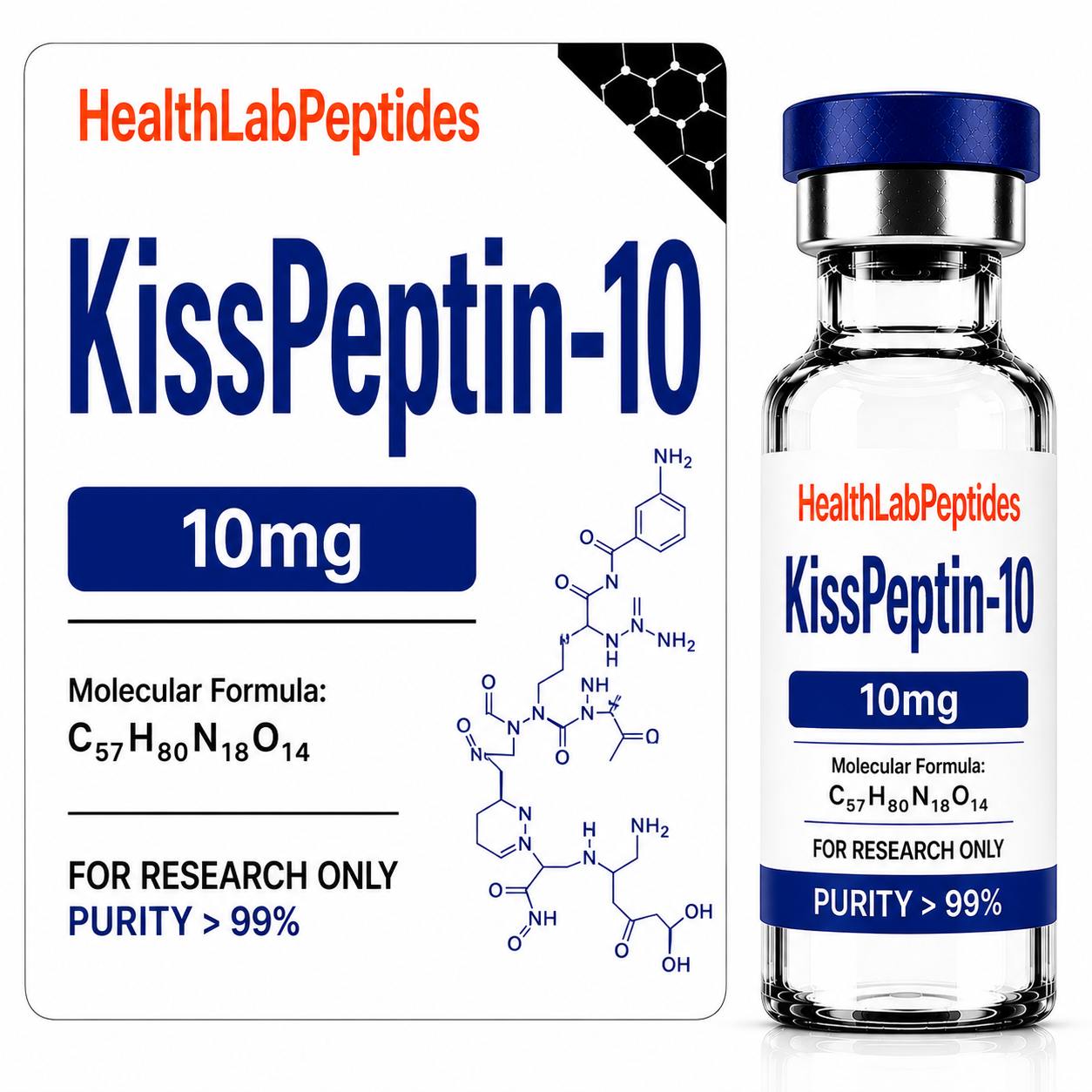
Research suggests: The KISS1 gene encodes a larger precursor that is processed into several kisspeptin forms including KP-54, KP-14, KP-13, and KP-10. The research record is most useful when chemical identity, model choice, and measured endpoints are described separately. This article reviews kisspeptin-10, kp-54, and kiss1r: understanding active peptide fragments and identifies what the primary experiments establish, what remains uncertain, and how a research-only product name should be distinguished from the published materials. For related scientific context, read HealthLab’s existing research overview. This is analytical and in-vitro research education, not advice for personal, medical, or veterinary use.
The smallest active fragment has ten residues
KP-10 is a decapeptide containing the conserved C-terminal region shared by several naturally occurring kisspeptins. It is not a different gene product unrelated to KP-54; instead, its sequence is contained within larger processed forms. This distinction is important when interpreting receptor-binding and functional assays. A shorter peptide can retain receptor activation in an experimental system without being identical to the longer peptide’s metabolic behavior, tissue distribution, or persistence. Peptide length is a chemical descriptor, not proof of clinical effectiveness.
The KISS1 precursor and processing
Kisspeptin biology begins with a larger polypeptide encoded by the KISS1 gene. Processing produces several lengths that share an active C-terminal region. The precursor, KP-54, KP-14, KP-13, and KP-10 should therefore be named accurately in articles and product catalogs. An experiment using KP-54 is not automatically an experiment using isolated KP-10. Differences in cleavage, degradation, or transport can influence observations. Research summaries should identify the exact fragment used rather than treating every source that says kisspeptin as measuring the same substance.
How GPR54 became KISS1R
The receptor was historically described as GPR54 and also appeared under other research identifiers. An IUPHAR nomenclature review published in 2010 recommended the name kisspeptin receptor, with the gene symbol KISS1R. This illustrates how scientific names evolve as the endogenous ligand is identified and receptor biology becomes clearer. When checking older sources, a reader should recognize that GPR54 and KISS1R refer to the same receptor system, not separate compounds that should be combined in a study.
What a KISS1R cell assay detects
KISS1R is a G-protein-coupled receptor whose signaling is associated with Gq/11, phospholipase C, and calcium-related intracellular events. Different assays can measure calcium release, receptor internalization, or other downstream changes. A response in an engineered line demonstrates a property under the tested conditions; it does not establish a human endocrine outcome. Different fragment lengths and experimental conditions can change the measured potency or apparent duration, so each result should be attributed to the relevant ligand and method.
A useful comparison is the independent HealthLab research article, which addresses a related but different measurement. Reading the two investigations side by side can clarify whether a conclusion came from chemical characterization, a receptor assay, a cell model, or a larger biological system. Similar product keywords are not evidence of equivalent molecular mechanisms. Any apparent disagreement should be examined through the underlying methods and reported limitations.
Why the C-terminal RF-amide motif matters
The naturally occurring kisspeptin isoforms share a conserved C-terminal region that includes an Arg-Phe-amide feature associated with receptor activity. This helps explain why a short fragment can remain active in a laboratory assay. However, a conserved motif is not enough to predict every receptor or organism-level response. The amino-acid context, post-translational processing, and assay system still matter. A structural review should distinguish the importance of a motif from a claim that all fragments are biologically interchangeable.
Receptor activation and receptor recycling
Kisspeptin receptor studies have examined both acute intracellular signals and receptor movement through endocytic compartments. A signal that persists after a stimulus is removed may reflect trafficking, feedback, or other experimental features. It should not be interpreted as proof that a catalog product has a defined clinical duration. Comparing KP-10 and KP-54 requires matched systems, appropriate controls, and separate treatment of the ligand’s stability and the receptor’s own regulation. These mechanistic details are more useful than a generic hormone claim.
Isoform comparisons need consistent endpoints
The 2025 isoform review collected studies of natural kisspeptin lengths, including structural observations and assay-specific responses. Because the evidence comes from different models, comparisons should separate receptor binding, second-messenger activity, animal physiology, and regulated human investigations. A result from one category cannot simply be transferred into another. For RUO education, the correct focus is exact molecular identity, nomenclature, and the limits of model-specific evidence; the article provides no personal-use recommendations.
What the primary evidence actually supports
The main cited work is IUPHAR kisspeptin receptor nomenclature review (2010), PMID 21079036, DOI 10.1124/pr.110.002774; isoform review PMID 40271959 (2025). These sources are associated with particular experimental materials, analytical approaches, and study populations or cell systems. Their results should be attributed to the exact model investigated. They cannot be converted into proof that another batch, supplier, cell line, or species will show an identical response. Where two studies measure different endpoints, neither necessarily refutes the other; they may be answering separate questions. A scientific article should state positive, negative, and uncertain findings without selectively promoting one outcome.
How to assess the methods and controls
Begin by confirming the exact molecular entity and the reference material used in the original study. Then identify the comparator, the controls, and the timing of measurement. A binding experiment observes association, a transcript assay measures RNA abundance, and a protein or enzyme assay reports another kind of signal. These levels of evidence are related but not interchangeable. Appropriate replication, transparent analysis, and independent methods strengthen a finding. None of them transforms a laboratory result into a general clinical or consumer claim without additional regulated evidence.
Why findings do not automatically transfer to people
A defined in-vitro assay may simplify a biological system so investigators can isolate one chemical or cellular interaction. In doing so, it omits many features of intact human or veterinary physiology. Animal experiments introduce additional complexity but are still species-specific. Even a historical human investigation of a defined pharmaceutical preparation is not an authorization for an independently sourced research vial. The correct interpretation follows the sample, test method, and measured result, not the popularity of an internet product keyword. No treatment or self-use implication is intended here.
Research-material identification and related product
HealthLab lists Kisspeptin-10 10 mg research material as a laboratory catalog entry. The product name and labeled amount identify the material in the catalog; they are not instructions for use. A Certificate of Analysis can document selected properties of a specific lot only to the extent that the recorded tests support them. It does not establish FDA approval, clinical safety, efficacy, or equivalence to the preparation used in the research literature. Scientists should distinguish the identity of a purchased reagent from the evidence generated by a separate publication.
Questions readers should ask
Was the reported observation made with the same molecule, and was its chemical identity confirmed? What cell, tissue, animal, or analytical preparation was examined? Did the authors actually measure the endpoint claimed in the summary, or was the result inferred from a related marker? Are there model-specific caveats, competing explanations, or missing controls? Can the reader trace the claim to a dated source? These questions help distinguish a reliable research resource from promotional language that turns mechanistic curiosity into an unsupported promise.
Sources and conclusion
Key references: IUPHAR kisspeptin receptor nomenclature review (2010), PMID 21079036, DOI 10.1124/pr.110.002774; isoform review PMID 40271959 (2025). The distinguishing lesson of kisspeptin-10, kp-54, and kiss1r: understanding active peptide fragments is that careful attribution makes molecular research more useful. Scientific value comes from describing the precise observation and acknowledging competing interpretations; it does not depend on claiming favorable outcomes. The article provides source identifiers to support further reading and does not claim that the referenced HealthLab item reproduces the literature results.
Research Use Only
Research Use Only / Not for human or veterinary use. No dosing, reconstitution, injection, administration, treatment, weight-loss, anti-aging, or other consumer-use instructions or promises are provided. HealthLab research materials are not represented as FDA-approved medicines.


