

Research suggests: Epitalon, sometimes written Epithalon, is a tetrapeptide with the sequence Ala-Glu-Asp-Gly (AEDG). The research record is most useful when chemical identity, model choice, and measured endpoints are described separately. This article reviews epitalon telomere research: telomerase versus alt in normal and cancer cell lines and identifies what the primary experiments establish, what remains uncertain, and how a research-only product name should be distinguished from the published materials. For related scientific context, read HealthLab’s existing research overview. This is analytical and in-vitro research education, not advice for personal, medical, or veterinary use.
Why telomere length is an experimental endpoint
Telomeres are specialized DNA-protein structures at chromosome ends. Researchers may measure changes in average telomere length as part of a study of cell replication or genome maintenance. An increase in a cell-culture assay does not prove that a whole organism is younger, safer, or healthier. The measurement can be influenced by the cell population, assay design, and the underlying telomere-maintenance mechanism. Scientific communication should avoid equating one molecular measurement with a proven anti-aging treatment or human-life-span outcome.
The 2025 normal- versus cancer-cell comparison
A Biogerontology study published in 2025 investigated Epitalon in normal epithelial and fibroblast cells and in specific breast-cancer cell lines. The investigators used molecular methods to examine telomere length and proposed mechanisms of maintenance. This comparison is significant because normal and malignant cells can employ different telomere biology. A change observed in the normal-cell samples should not automatically be assigned to the cancer-cell samples, and vice versa. The study is a controlled laboratory investigation rather than clinical evidence for a research-only product.
What telomerase measures
Telomerase is an enzyme complex associated with telomere maintenance in certain cellular contexts. The 2025 paper described hTERT-related gene expression and telomerase-associated observations in normal cells. Yet hTERT mRNA abundance, telomerase enzymatic activity, and measured telomere length are separate variables. A mechanistic conclusion is stronger when the authors measure several stages, but the observations still depend on the particular cell lines and time points. It is inaccurate to use any one marker as proof of a human longevity effect.
ALT is another telomere-maintenance route
Alternative lengthening of telomeres, or ALT, is a telomerase-independent mechanism associated with some cancer-cell contexts. The 2025 investigators reported a pattern in which cancer-cell lines appeared to engage ALT-related processes rather than simply reproducing the telomerase findings in normal cells. This difference is a warning against simplistic claims that Epitalon uniformly activates one beneficial pathway. The mechanism can depend on the cell’s existing biology, genetic context, and study conditions. The clinical meaning of such laboratory observations remains uncertain.
A useful comparison is the independent HealthLab research article, which addresses a related but different measurement. Reading the two investigations side by side can clarify whether a conclusion came from chemical characterization, a receptor assay, a cell model, or a larger biological system. Similar product keywords are not evidence of equivalent molecular mechanisms. Any apparent disagreement should be examined through the underlying methods and reported limitations.
Cancer-cell findings must not be hidden
Because telomere maintenance is relevant to cell proliferation, observations in cancer lines are an essential part of the scientific record. An article that reports only a telomerase increase in normal cells would omit meaningful information about the ALT-associated response described in tumor-cell models. Neither observation by itself establishes that the peptide causes or prevents cancer in humans. Responsible reporting preserves both sets of results and their uncertainties rather than selecting only those that fit an anti-aging narrative.
qPCR, immunofluorescence, and telomere assays
The published investigation used molecular readouts including quantitative PCR and imaging-associated methods. These approaches can provide complementary information but have distinct technical assumptions. A positive signal in a microscopy assay is not identical to an enzyme activity measurement, and average telomere length can reflect multiple influences on a cell population. The choice of comparator cell line and appropriate assay controls affects interpretation. Research summaries should specify which method supported each claim and acknowledge that several measurements may be needed to establish a proposed mechanism.
Why an erratum matters to careful referencing
The PubMed record for the 2025 study notes that an erratum appeared later that year. An erratum does not automatically negate every result, but it is relevant when citing technical data. A conscientious review checks corrected information before treating a reported numerical result as definitive. Scientific uncertainty is not an inconvenience to hide: it helps readers distinguish established measurements from tentative interpretations. The study should be cited with its bibliographic identifiers so readers can find the original work and any corrections.
What the primary evidence actually supports
The main cited work is Al-Dulaimi et al., Biogerontology (2025), PMID 40908429, DOI 10.1007/s10522-025-10315-x; note an erratum was published in November 2025. These sources are associated with particular experimental materials, analytical approaches, and study populations or cell systems. Their results should be attributed to the exact model investigated. They cannot be converted into proof that another batch, supplier, cell line, or species will show an identical response. Where two studies measure different endpoints, neither necessarily refutes the other; they may be answering separate questions. A scientific article should state positive, negative, and uncertain findings without selectively promoting one outcome.
How to assess the methods and controls
Begin by confirming the exact molecular entity and the reference material used in the original study. Then identify the comparator, the controls, and the timing of measurement. A binding experiment observes association, a transcript assay measures RNA abundance, and a protein or enzyme assay reports another kind of signal. These levels of evidence are related but not interchangeable. Appropriate replication, transparent analysis, and independent methods strengthen a finding. None of them transforms a laboratory result into a general clinical or consumer claim without additional regulated evidence.
Why findings do not automatically transfer to people
A defined in-vitro assay may simplify a biological system so investigators can isolate one chemical or cellular interaction. In doing so, it omits many features of intact human or veterinary physiology. Animal experiments introduce additional complexity but are still species-specific. Even a historical human investigation of a defined pharmaceutical preparation is not an authorization for an independently sourced research vial. The correct interpretation follows the sample, test method, and measured result, not the popularity of an internet product keyword. No treatment or self-use implication is intended here.
Research-material identification and related product
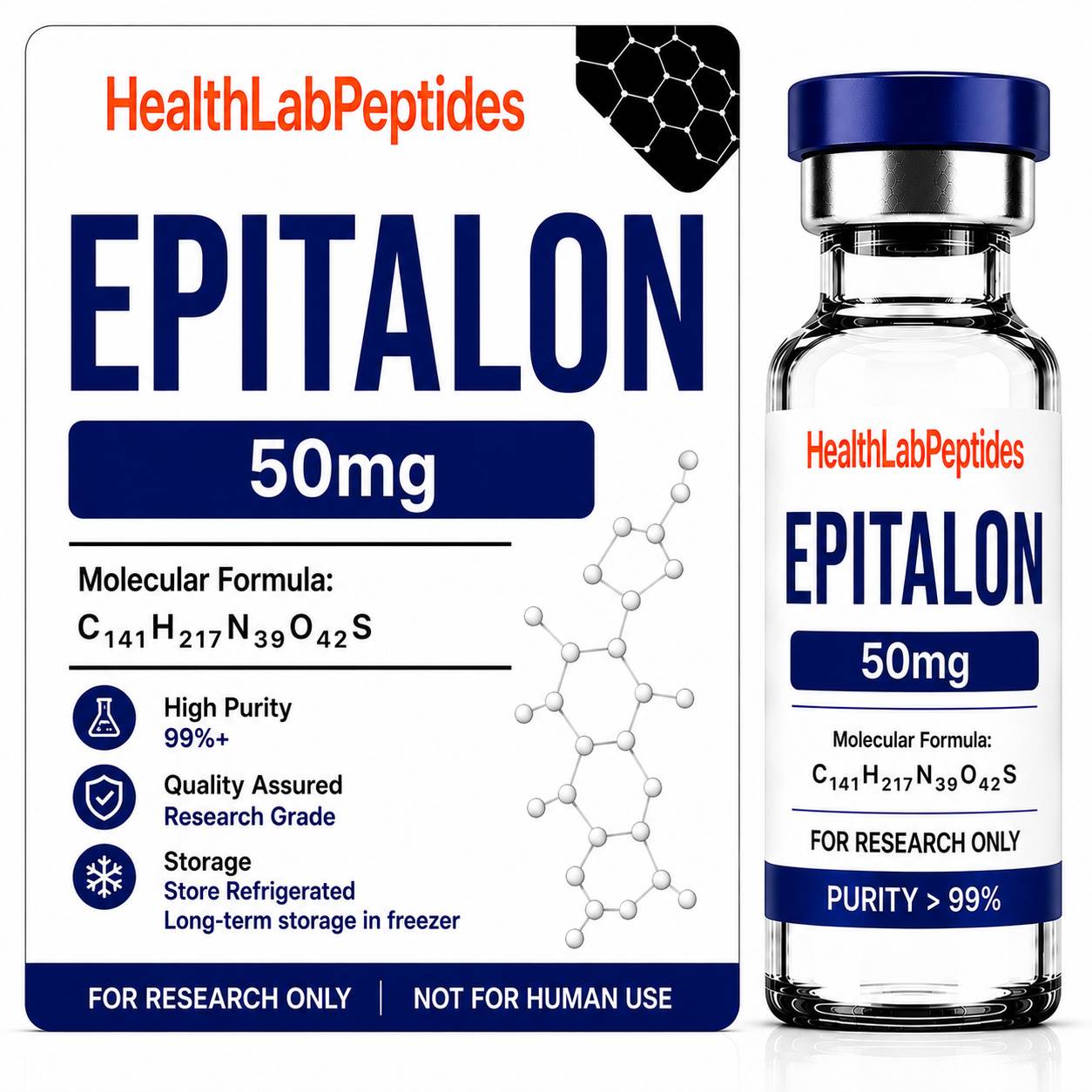
HealthLab lists Epitalon 50 mg research material as a laboratory catalog entry. The product name and labeled amount identify the material in the catalog; they are not instructions for use. A Certificate of Analysis can document selected properties of a specific lot only to the extent that the recorded tests support them. It does not establish FDA approval, clinical safety, efficacy, or equivalence to the preparation used in the research literature. Scientists should distinguish the identity of a purchased reagent from the evidence generated by a separate publication.
Questions readers should ask
Was the reported observation made with the same molecule, and was its chemical identity confirmed? What cell, tissue, animal, or analytical preparation was examined? Did the authors actually measure the endpoint claimed in the summary, or was the result inferred from a related marker? Are there model-specific caveats, competing explanations, or missing controls? Can the reader trace the claim to a dated source? These questions help distinguish a reliable research resource from promotional language that turns mechanistic curiosity into an unsupported promise.
Sources and conclusion
Key references: Al-Dulaimi et al., Biogerontology (2025), PMID 40908429, DOI 10.1007/s10522-025-10315-x; note an erratum was published in November 2025. The distinguishing lesson of epitalon telomere research: telomerase versus alt in normal and cancer cell lines is that careful attribution makes molecular research more useful. Scientific value comes from describing the precise observation and acknowledging competing interpretations; it does not depend on claiming favorable outcomes. The article provides source identifiers to support further reading and does not claim that the referenced HealthLab item reproduces the literature results.
Research Use Only
Research Use Only / Not for human or veterinary use. No dosing, reconstitution, injection, administration, treatment, weight-loss, anti-aging, or other consumer-use instructions or promises are provided. HealthLab research materials are not represented as FDA-approved medicines.


