

Research suggests:
Research suggests: the tripeptide KPV—lysine, proline, and valine—has been examined in experimental systems because selected intestinal cells can transport small peptides through PepT1, a transporter more commonly discussed in nutritional and pharmaceutical absorption research. A 2008 Gastroenterology paper connected transport measurements with cell signaling observations and two mouse colitis models. Those results require careful boundaries: direct uptake, a reporter-gene change, cytokine measurements, and animal tissue findings are four different endpoints. This article evaluates the evidence and its limitations without treating a mouse model as proof of a human medical benefit. For broader chemical context, see the KPV tripeptide signaling overview.
What KPV means at the sequence level
KPV is the sequence Lys-Pro-Val, containing only three amino-acid residues. It is connected historically to investigations of alpha-melanocyte-stimulating hormone fragments, but it is not equivalent to the full hormone. The chemical distinction matters when researchers compare binding or cellular responses. A short fragment can have different transport behavior, stability, and target interactions from the molecule from which it was conceptually derived. An experiment described simply as an alpha-MSH study should not automatically be cited as evidence about KPV, or vice versa. Molecular identification must precede conclusions about mechanism.
PepT1 is a transporter, not a cytokine receptor
PepT1, commonly linked to the gene SLC15A1, is a proton-coupled transporter associated with certain dipeptide and tripeptide movements across cell membranes. It serves a different molecular role from a cell-surface signaling receptor or a nuclear transcription factor. Demonstrating that a peptide is transported by PepT1 does not establish that the transporter itself generates every downstream cellular response. Transport may allow a compound to reach the intracellular environment in which other interactions occur. Scientific writing should separate uptake from signaling and identify which experiments support each step of a proposed chain.
The 2008 Gastroenterology investigation
Dalmasso and colleagues reported “PepT1-mediated tripeptide KPV uptake reduces intestinal inflammation” in Gastroenterology (2008), PMID 18061177, PMCID PMC2431115, DOI 10.1053/j.gastro.2007.10.026. The study evaluated KPV in selected human cell lines and experimental mouse models. The researchers investigated both uptake and certain inflammatory-pathway readouts, thereby offering more than a single isolated marker. Yet the paper remains a preclinical study with particular models and experimental conditions. Its observations do not establish that a research-only KPV-containing material is safe or effective for treating inflammatory bowel disease in people.
Why Caco-2 and HT29 models are different
The 2008 paper included human intestinal epithelial cell lines such as Caco2-BBE and HT29-Cl.19A. Cell lines can differ substantially in their transporters, differentiation state, and signaling behavior. A response in one line is not guaranteed in another, and a cell line is not the same as a normally functioning intestinal tissue in a human organism. Researchers should check which line was used for each assay and whether PepT1 expression was characterized. A general statement that intestinal cells transport a peptide is weaker than a properly supported, model-specific description.
The immune-cell comparison
The study also examined Jurkat cells, a human T-cell model, under defined experimental conditions. Immune-cell and intestinal epithelial experiments address related but different scientific questions because the cells differ in lineage, signaling pathways, and transporter expression. A change in an inflammatory transcript in Jurkat cells does not mean the same response would occur in intestinal epithelium or in a human body. Cross-cell comparisons can help identify candidate mechanisms, but the distinction between models should remain visible in every review. Tissue context and experimental controls are central to interpretation.
How uptake was investigated
The authors used transport-related experiments including a labeled substrate and competing material to evaluate PepT1-associated movement. Competition studies can provide evidence that a shared transport process is involved, but do not necessarily identify every possible route through which a molecule enters a cell. A labeled tracer also requires careful chemical identification and assay controls. The legitimate question is whether the results support a role for PepT1 under the reported conditions. Extending the conclusion to every tissue or formulation would require independent evidence.
NF-kappaB and MAP kinase are separate readouts
NF-kappaB is often studied through reporter-gene or transcription-associated assays, whereas MAP kinase pathways involve phosphorylation events and broader signaling cascades. A reduction in an NF-kappaB reporter response is not necessarily an identical effect on every MAP kinase protein or downstream cytokine. The 2008 paper used different methods to examine several outcomes. A rigorous explanation identifies the measurement behind each claim rather than using the general phrase anti-inflammatory as if it were a single molecular test. Multiple readouts can complement each other, but still remain limited to the investigated systems.
Reporter assays do not measure human symptoms
A luciferase reporter can indicate the activity of a designed transcriptional response in cultured cells. Its output is a laboratory signal influenced by the reporter construct and cell environment. This kind of data can support a signaling hypothesis but cannot identify whether a person experiences a symptom change. Similarly, a cytokine measured by ELISA is an experimental marker rather than a diagnosis. Connecting a molecule to a pathway is different from proving a medically useful outcome. This separation is crucial for a research-only supplier that must not imply treatment uses.
Why the study used two mouse models
The paper examined DSS-induced and TNBS-induced mouse colitis models, which differ in how experimental intestinal injury and inflammation are produced. Using more than one model can help investigators evaluate whether an observation is tied to a particular experimental setting. However, two rodent models are not equivalent to multiple independent human clinical trials. Each has biological limitations, and an observed effect can depend on the injury model, timing, species, and measured outcome. Results from those models cannot be transformed into product-use instructions or broad human efficacy claims.
Histology versus cytokine expression
The mouse experiments included histological observations and inflammatory transcript measurements. Histology evaluates tissue appearance under a microscope, while messenger RNA measures the abundance of selected transcripts. Neither is a stand-in for clinical safety or effectiveness in humans. These observations can provide complementary support for a preclinical question, but their relationship requires analysis rather than assumption. A thoughtful research overview reports whether findings were consistent across endpoints and avoids implying that a single visible change proves complete resolution of a complex disease process.
KPV and the rest of alpha-MSH
KPV is frequently discussed as a C-terminal fragment associated with alpha-MSH research, but the full peptide includes other structural features involved in melanocortin receptor pharmacology. A study of short-fragment uptake through PepT1 does not automatically establish that the fragment shares all receptor properties of the longer molecule. Sequence length, chemistry, and cellular handling can shape different experimental questions. Research about full alpha-MSH, PT-141, or MT-II should not be treated as interchangeable with KPV merely because the literature uses melanocortin-related terminology.
A mechanism is stronger when different experiments agree
Transport-related assays, reporter systems, transcription measurements, and animal tissue observations can each provide partial evidence. Agreement may strengthen a proposed interpretation, especially when controls distinguish transporter involvement from unrelated effects. Yet a mechanistic chain remains only as strong as its individual links. A transport observation does not by itself prove the reason for a cytokine change, and a mouse histological result does not establish the same mechanism in another species. A research review should identify which steps were directly tested and which remain hypotheses.
What a KPV-containing blend does not demonstrate
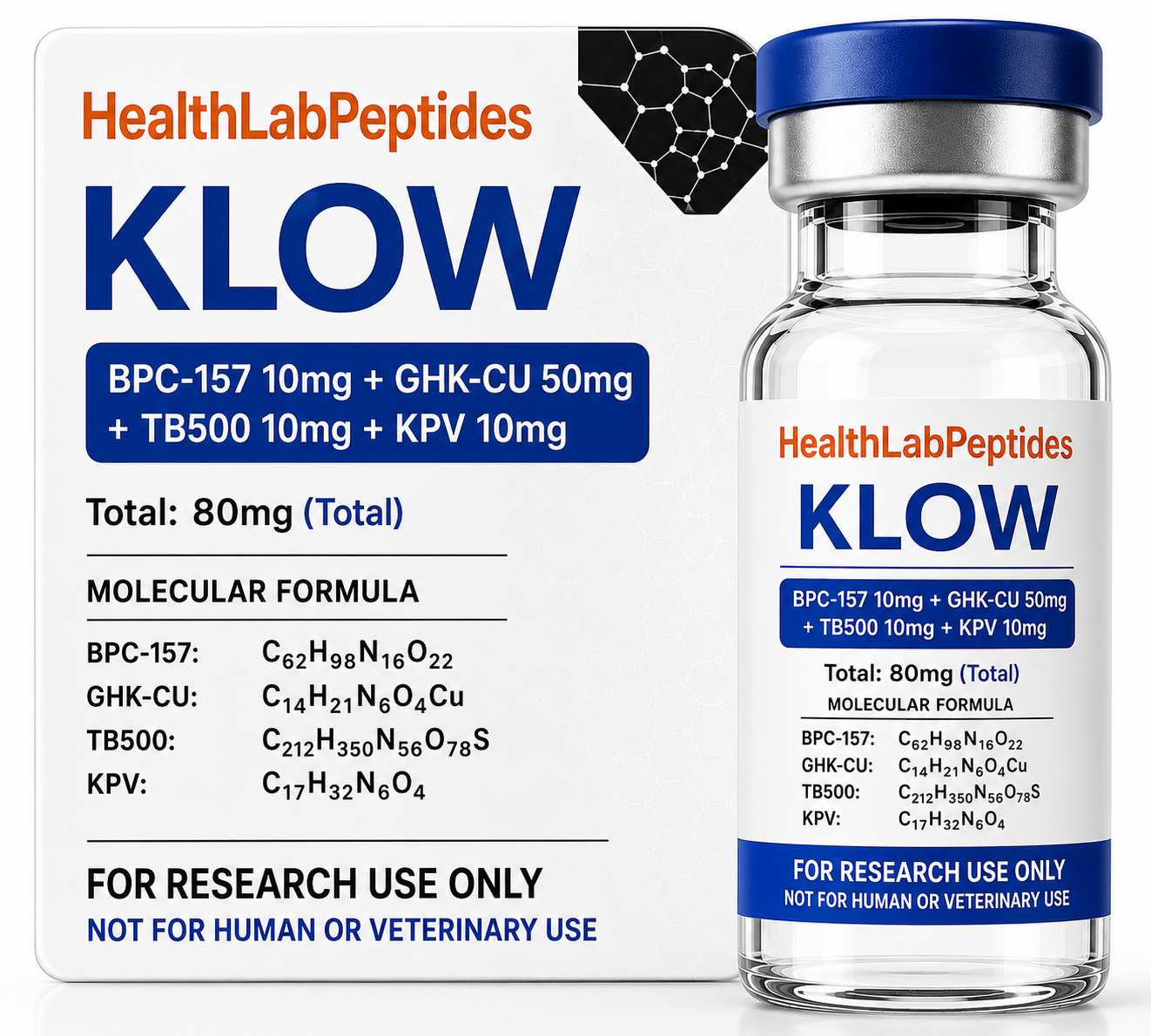
HealthLab’s KLOW 80 mg research blend includes a labeled KPV component alongside BPC-157, TB-500, and GHK-Cu. The PepT1 findings from an individual KPV experiment cannot be attributed to that mixture as a whole. A blend introduces additional material-identity questions and the possibility of assay interactions, and an independent mixture study would be needed. Its component list is catalog information, not evidence of synergy or a personal-use recommendation. The research combination evidence guide discusses why single-molecule results cannot establish blend behavior.
Study quality questions
Researchers should examine how PepT1 expression was established, whether transport competition controls were appropriate, and whether changes in transcription were independently supported. The specificity of each cell line and the distinct mouse injury models also matter. A source that reports only the positive aspects of the paper without its design limits gives an incomplete picture. Independent replication and well-characterized materials would strengthen conclusions about generality. Even strong preclinical evidence does not establish FDA approval or appropriate human use for a research-material product.
Common questions about KPV research
Is KPV a tripeptide? Yes, its sequence is Lys-Pro-Val. Is PepT1 a receptor that directly signals through NF-kappaB? PepT1 is primarily a transporter; transport and downstream signaling are distinct questions. Did the 2008 investigation include mouse experiments? Yes. Does a mouse finding prove treatment efficacy in people? No. Can KPV results be assumed for a four-component blend? No. Does a research-only label permit administration? No.
Source and interpretation
Primary reference: Dalmasso and colleagues, Gastroenterology (2008), PMID 18061177, PMCID PMC2431115, DOI 10.1053/j.gastro.2007.10.026. The investigators connected KPV uptake with PepT1-associated transport and selected cell and mouse-model endpoints. The scientific value of the study lies in its experimental chain and its remaining uncertainties. It does not support medical claims for an independent commercial research reagent or a multi-peptide blend. Those materials must remain described solely in the lawful research context.
Research Use Only
Research Use Only / Not for human or veterinary use. This material is strictly for lawful analytical, scientific, and in-vitro research. No dosing, preparation, treatment, administration, or personal-use guidance is provided. No HealthLab product is represented as approved to treat a disease.


