

Research suggests:
Research suggests: a chromatography purity result and a mass-spectrometric identity result are not interchangeable pieces of evidence. A peptide can yield one prominent chromatographic peak without that peak necessarily containing the correct amino-acid sequence, while a molecular-mass measurement can be consistent with a proposed compound without describing all impurities. Researchers evaluating a peptide Certificate of Analysis should distinguish identity, chromatographic purity, quantitative content, and verification of modifications. This laboratory guide examines HPLC, intact-mass analysis, tandem mass spectrometry, co-elution, and interpretation of analytical records. For background on peptide chains and protein terminology, see the HealthLab molecular classification guide. None of these test methods establishes permission to administer a research material to people.
Why purity is not the same question as identity
Identity asks whether the material matches the intended chemical entity. Purity asks what proportion of detected material is attributable to a component under a specified analytical procedure. The answer to one question does not automatically answer the other. A chromatographic peak may consist of a co-eluting group, and a measured molecular weight may fit more than one possible sequence. Quantitative assay is another distinct question: how much of the specified compound is present in a sample? An accurate laboratory record should avoid using a single purity percentage to imply that sequence, stereochemistry, content, and all possible contaminants were independently established.
Reversed-phase HPLC and peptide separation
Reversed-phase high-performance liquid chromatography separates components based on interactions with a stationary phase and a changing mobile phase. Peptides often have different retention characteristics depending on their amino-acid composition and modification state. When the detector registers a peak, it shows a response under the selected conditions, not an independent proof of the peak’s chemical identity. The retention time can support comparison with a characterized reference material, but it does not replace structural confirmation. Researchers also need to consider detector response and whether some impurities are poorly resolved or detected by the chosen method.
Why a single major HPLC peak can mislead
Peptide impurities sometimes share similar chromatographic behavior with the desired compound. Two molecular species may elute together and appear as one peak, making an apparently clean chromatogram insufficient to establish chemical homogeneity. A well-characterized analytical method aims to separate relevant byproducts and assesses how much uncertainty remains. An HPLC area percentage is especially easy to overinterpret when a marketing label presents it without details about the detector and peak identification. The appropriate conclusion is limited to the method’s separation and detection performance.
What intact-mass measurements contribute
Mass spectrometry measures the mass-to-charge behavior of ions and can help determine whether a peptide has a molecular mass consistent with its proposed identity. This provides a different form of evidence from chromatographic retention. Yet some structural differences can produce equal or nearly equal masses, and the intact mass alone may not identify the order of amino acids. Chemical modifications can also complicate interpretation. Researchers should describe whether a reported mass was monoisotopic or average and how the relevant ion assignment was established. A correct mass is meaningful support for identity, not a complete characterization of all molecular features.
Why MS/MS adds structural information
Tandem mass spectrometry examines fragment ions that can provide information about amino-acid sequence or particular modifications. Combined with chromatographic separation, it can help distinguish a desired peptide from truncated or chemically altered species. However, a fragment spectrum still requires appropriate interpretation and confidence in the assignments. Some isomeric or stereochemical differences may not be resolved by the selected experiment. Therefore LC-MS/MS is valuable as an additional structural method, not proof that every attribute of a peptide sample is known. The quality of a conclusion depends on which ambiguity the method actually addresses.
A published recommendation for peptide assays
A widely used technical review, “Recommendations for the generation, quantification, storage and handling of peptides used for mass spectrometry-based assays,” PMCID PMC4830481, discusses the characterization of peptide standards and the risks posed by variable material quality. It explains that RP-HPLC-UV profiles and MS data should be examined together, with MS/MS providing important sequence information when needed. The authors also discuss co-elution, batch consistency, and appropriate documentation. This reference concerns analytical quality and harmonization of assays rather than a particular health outcome. It should not be converted into a claim that a commercial research vial has pharmaceutical approval.
Reference standards versus a supplier description
A reference standard is intended to provide a carefully characterized comparison material for analytical work. The degree of characterization matters because a reference used to judge another sample can introduce error if its own identity or composition is uncertain. A vendor’s short product name does not replace a properly documented standard. Scientific methods may compare retention, mass, sequence-related fragmentation, and quantitative content against relevant reference records. Clear provenance can improve reproducibility across laboratories. The term reference-grade should not be treated as a clinical classification unless its meaning and applicable standards are specifically documented.
Peptide synthesis can produce structurally related impurities
Solid-phase or other synthetic processes may yield truncated chains, deletion sequences, incompletely modified products, or closely related byproducts. Some impurities differ from the intended molecule by a small sequence change and may have similar retention behavior. Mass-spectrometric characterization is important because an HPLC peak alone may not reveal the nature of an impurity. The analytical challenge grows with molecular complexity, chemical modifications, or mixtures of components. A scientifically useful Certificate of Analysis should describe what method was used and avoid implying that an impurity profile was exhaustively characterized from a single number.
Isomerism and amino-acid sequence
Amino acids such as leucine and isoleucine have the same nominal elemental composition but different chemical structures. Ordinary intact-mass measurements therefore cannot distinguish a substitution of one for the other in an otherwise identical peptide. Stereochemical changes between D and L forms may present another challenge because they do not necessarily change molecular mass. Resolving those questions may require complementary methods. This illustrates why structural identity involves more than matching a supplier’s expected molecular weight. A research article that explains the limits of the instruments is more valuable than a broad promise of purity.
Quantitative content versus peak-area purity
A mass of material listed on a vial is not the same measurement as the fraction of one chromatographic signal attributable to a main peak. Depending on the analytical system, water content, salts, counterions, or other components may influence the relation between total sample mass and the amount of a particular peptide. Quantitative assay therefore asks how much analyte is present, while chromatographic purity asks a different relative question. An evidence-based article does not infer the former from the latter unless the underlying method and reporting support that inference. No labeled quantity should be interpreted as administration advice.
Why independent analytical methods are useful
Orthogonal measurements differ in the chemical property they observe. An HPLC separation, mass spectrum, sequence-related fragment spectrum, and independent content assay can provide different kinds of evidence. Agreement across methods can strengthen confidence while discrepancies reveal questions that need investigation. However, accumulating techniques is not the same as making every possible risk disappear. Each method has a detection range and assumptions. Researchers should connect every reported result to the question it answers, including what was not tested. A strong laboratory report describes those boundaries instead of relying on unqualified adjectives such as perfect or medical-grade.
Applying these principles to a specific research peptide
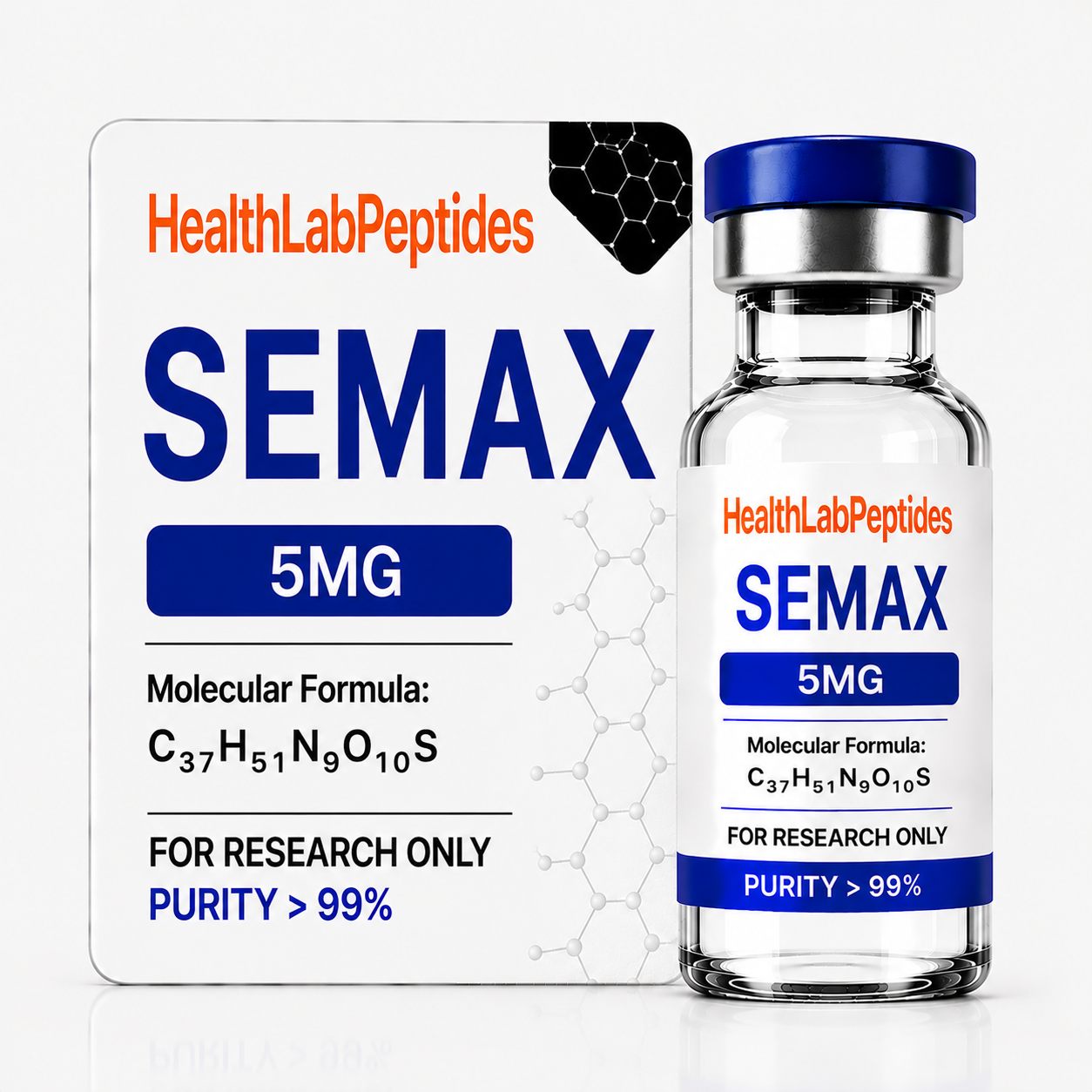
The Semax 5 mg research-material listing describes a defined heptapeptide that illustrates why sequence and quantity should be interpreted separately. A stated label amount is catalog information, while a chromatography trace or mass result would be a measured property of a specific sample. A document about one batch does not establish that unrelated batches are identical. The Semax research guide
Reading a Certificate of Analysis critically
A useful Certificate of Analysis identifies the material and batch, the specific method, measured result, and applicable context. The reader should ask whether purity refers to peak-area analysis, whether the principal peak was assigned by structural evidence, and whether content was separately quantified. The absence of an impurity from a reported trace is not proof that every possible contaminant was excluded. Similarly, an MS spectrum compatible with a target is only as strong as the specificity of the method. Analytical records are valuable when interpreted precisely rather than as broad guarantees of clinical quality.
SEO language should reflect test limitations
Search queries often ask for highest purity peptides or laboratory verified compounds. A research-oriented response can explain the measurements needed to support those phrases without inventing a universal purity cutoff or claiming that a particular certificate proves safety for humans. Google-friendly content should be helpful and technically accurate, not filled with repetitive promotional phrases. Linking an analytical explainer to the appropriate molecular research pages can improve navigation. It cannot substitute for the evidence actually present on the page.
Frequently asked analytical questions
Does HPLC identify a peptide sequence? Not by itself. Does a correct molecular mass guarantee a correct sequence? No. Can two peptide impurities co-elute? Yes, under some methods. Why use MS/MS? It can add information about fragments and sequence. Is a purity percentage equal to actual content? Not necessarily. Does a COA establish that a material can be used in a person? No. Regulatory and safety claims require evidence beyond research-material characterization.
Sources and conclusion
The analytical discussion draws on the peptide mass-spectrometry assay recommendations in PMCID PMC4830481 and the review “Reference Standards to Support Quality of Synthetic Peptide Therapeutics,” PMCID PMC10338602. These works show why identity, chromatographic purity, sequence-related evidence, and quantitative content need separate consideration. No one measurement answers every characterization question. A rigorous research resource explains the methods, uncertainties, and reporting limits so readers can evaluate analytical documents without inferring human-use safety or approval.
Research Use Only
Research Use Only / Not for human or veterinary use. HealthLab material is for lawful analytical and in-vitro research. No dosing, reconstitution, administration, medical, or personal-use instructions are provided. A Certificate of Analysis is not evidence of FDA approval for human use.


