

Research suggests:
Research suggests: nicotinamide adenine dinucleotide (NAD+) is not a single uniform pool that behaves identically throughout a cell. Metabolic reactions and NAD-consuming enzymes occur in distinct compartments, and the location of an assay can materially change its interpretation. NAD+ is a nucleotide-derived cofactor, not an amino-acid peptide, even when sold alongside peptides in a research catalog. This article focuses on NAD+/NADH redox chemistry, nicotinamide salvage, nuclear and cytosolic enzymes, mitochondrial regulation, and why whole-cell measurements cannot reveal every local event. For a separate discussion of NADP(H) and glutathione, see the glutathione and NAD redox research guide.
NAD+ and NADH: Two chemical forms
NAD+ is commonly referred to as the oxidized member of the NAD(H) redox pair, while NADH is the reduced form. The pair participates in numerous enzyme-catalyzed metabolic reactions. A study may measure total NAD-related material, a ratio, or a response linked to an enzyme that consumes NAD+. These endpoints answer different questions. A measurement of bulk NAD+ does not establish the redox state in each organelle or the activity of every NAD-dependent pathway. The exact assay and biological sample must be described before any inference is made.
NAD+ has nonredox roles as well
NAD+ can also serve as a substrate for enzymes involved in signaling and protein modification, rather than merely being converted reversibly into NADH during energy metabolism. Sirtuins and poly(ADP-ribose) polymerases are prominent examples of NAD-dependent enzyme families. The relevant pathways differ in where the enzymes reside, the available NAD pool, and which substrates they modify. Consequently, a measured increase in total NAD+ does not automatically predict a proportional increase in every enzyme’s activity. Biological interpretation requires knowledge of compartment, enzyme expression, and the experimental conditions.
A 2019 review emphasizing compartmentation
A review entitled “Cellular Compartmentation and the Redox/Nonredox Functions of NAD+,” PMID 30784294, PMCID PMC6657305, DOI 10.1089/ars.2018.7722, examined the differences between metabolic and signaling roles of NAD+ in cellular compartments. The authors discussed how mitochondrial, cytosolic, and nuclear conditions create different contexts for interpreting NAD measurements. This review is useful because it challenges an oversimplified picture of NAD as a single reservoir. The paper surveys molecular biology; it does not establish that a commercial RUO NAD+ reagent provides a clinical benefit or is suitable for personal administration.
Why a whole-cell sample can conceal local changes
A whole-cell extract combines material that originally occupied several compartments. If an event occurs in mitochondria while another occurs in the cytosol, an aggregate measurement may obscure both. Bulk ratios also depend on relative compartment sizes and cellular composition. This does not make whole-cell assays uninformative, but it limits the questions they can answer. A laboratory report should distinguish a whole-cell result from an assay specifically designed to isolate a compartmental measurement. The term cellular NAD level should be understood as method dependent rather than as a complete description of intracellular metabolism.
Mitochondrial NAD and the inner membrane
Mitochondria contain specialized metabolic systems and membrane boundaries that affect movement of metabolites and cofactors. Historically, research on NAD(H) and NADP(H) compartmentation has emphasized that these nucleotide pools require regulated exchange or precursor-related processes rather than unrestricted movement across every membrane. Mechanisms of mitochondrial NAD transport and maintenance have been active research topics, so older models should not be repeated without attention to later findings. A study’s date and methods matter when discussing the location of synthesis or transport. Direct measurement is preferable to assumptions based on another compartment.
NAMPT and the nicotinamide salvage pathway
Nicotinamide phosphoribosyltransferase (NAMPT) participates in a salvage pathway that converts nicotinamide toward nicotinamide mononucleotide, or NMN. Other enzymes participate in subsequent steps leading to NAD+. The location and regulation of the relevant proteins can affect how a particular cell maintains its NAD pool. This pathway is not equivalent to adding NAD+ externally, and a finding about enzyme expression does not guarantee the same result after exposure to a research reagent. Scientists should identify which precursor, enzyme, and metabolite their paper actually measured.
NMNAT enzymes and compartment-specific biology
Nicotinamide mononucleotide adenylyltransferase (NMNAT) enzymes participate in NAD biosynthetic steps. Different isoforms have been associated with different cellular locations, including nuclear and cytosolic contexts and mitochondrial research questions. A paper discussing NMNAT1, NMNAT2, or NMNAT3 should not treat them as the same protein merely because their names share a prefix. Experimental differences in localization can influence which pool is affected and how results are interpreted. The specific enzyme and model are necessary details, not incidental terminology.
Sirtuins are not interchangeable enzymes
Sirtuins are a family of NAD-dependent proteins with different substrates and subcellular locations. A change in total NAD+ does not establish that every sirtuin responds identically. Some experiments focus on particular modification events or protein activities, while others examine transcriptional patterns downstream. These are different levels of evidence. A rigorous interpretation checks whether the original paper measured a sirtuin protein, its catalytic activity, a substrate modification, or merely a related messenger RNA. The result should not be translated into broad claims about aging, recovery, or human well-being.
PARP activity and DNA-related research
Poly(ADP-ribose) polymerases are involved in biochemical responses that can use NAD+ as a substrate. Their activity may be studied in relation to DNA-associated processes and protein modification. The use of NAD+ in this reaction has a different chemical meaning from NADH formation in a redox process. Thus, an NAD-consuming enzyme can affect a cellular pool without directly representing a simple energy shortage. When comparing studies, investigators should separate substrate consumption, redox state, and downstream cellular outcomes. A measured PARP-associated signal does not prove a clinical consequence.
NADP+ and NADPH require separate treatment
NADP+ and NADPH contain a phosphate modification and participate in distinct biochemical networks. They should not be reported as if they were the same chemical species as NAD+ and NADH. For example, NADPH is a reducing cofactor for glutathione reductase, while NAD+ has different roles in numerous metabolic and signaling reactions. Some broad descriptions blur this distinction and create misleading statements about antioxidant pathways. A useful scientific article names the individual form and the enzyme or reaction it participates in rather than using the unspecific term NAD metabolism for every process.
Redox measurements and enzyme activity are complementary
A laboratory might measure NAD+/NADH ratios, detect a protein modification associated with an NAD-dependent enzyme, or quantify a metabolite in a subcellular fraction. These approaches provide related but distinct evidence. A change in ratio may reflect metabolic flux without determining the direction of every downstream process. Likewise, an observed modification can be influenced by substrate availability and enzyme localization. Interpretation is stronger when the question, measured species, and method agree. An isolated result should not be used to construct an unqualified narrative about increased cellular energy or reduced disease risk.
Why external NAD+ and endogenous NAD+ are different questions
A paper showing how a cell maintains its endogenous NAD pool does not automatically establish what happens when an externally supplied research reagent is introduced into a separate biological environment. Cellular membranes, extracellular enzymes, precursor metabolism, and other factors can influence the relationship. A catalog product’s molecular identity is a separate issue from a cell’s endogenous biochemical regulation. Scientific summaries should explain the distinction and not assume that the presence of a familiar biological molecule guarantees predictable outcomes from a commercial sample.
NAD+ is not itself a peptide
NAD+ consists of nucleotide-derived chemical groups rather than a sequence of amino-acid residues linked by peptide bonds. The term peptide sometimes appears near NAD+ in online catalogs, but it is not a chemically accurate classification. This distinction matters for analytical methods and for comparisons with true research peptides such as MOTS-c or SS-31. The peptide structure introduction
The HealthLab catalog reference
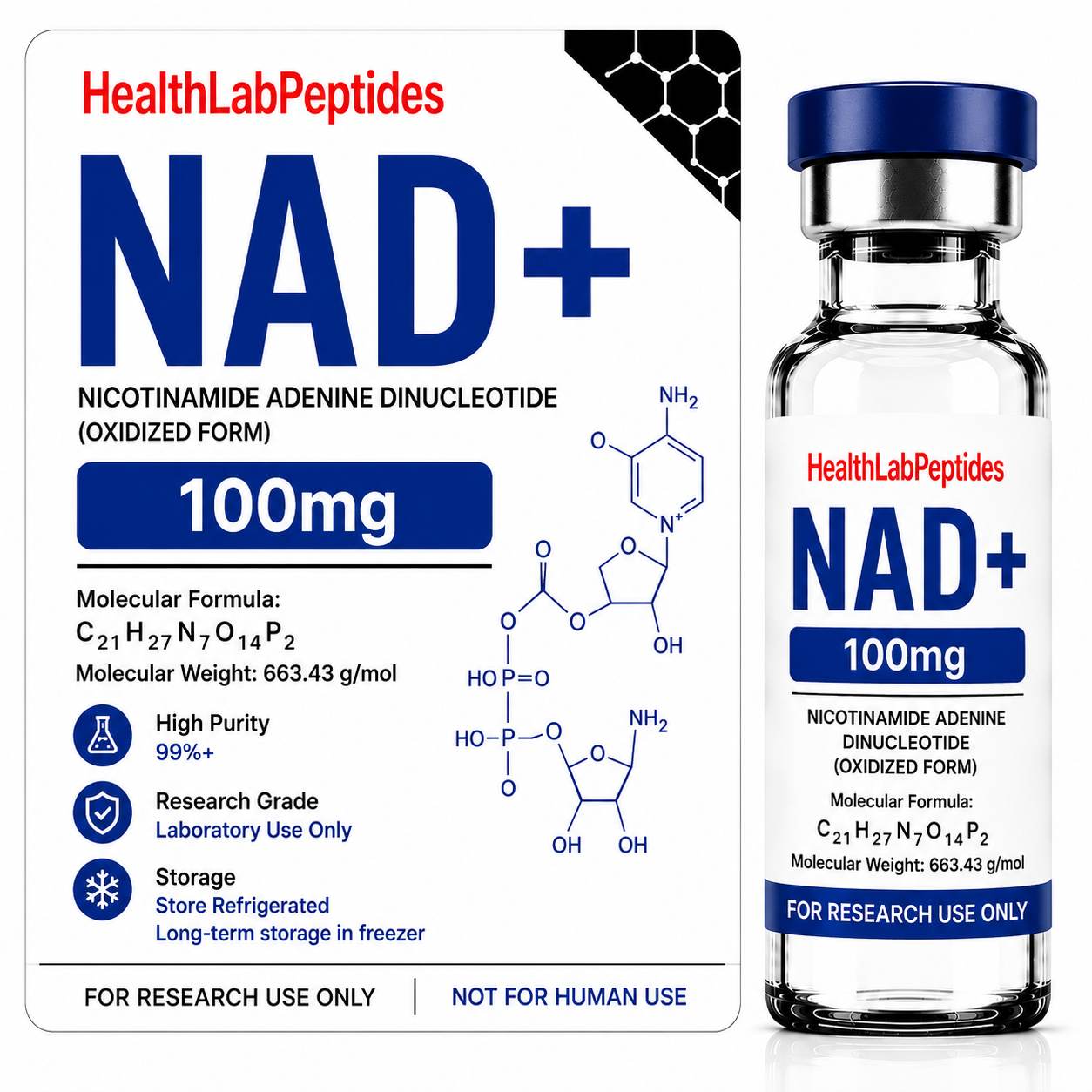
HealthLab’s NAD+ 100 mg research-material listing provides identification for laboratory procurement. That quantity is a catalog characteristic and not an administration recommendation. A Certificate of Analysis may describe selected identity or purity properties for a batch, but cannot prove that the material has a particular effect on intracellular NAD pools in every model. Research-only labeling does not create FDA approval, clinical equivalence, or personal-use suitability. An accurate article separates the chemistry of the reagent from the biology of the cell.
Frequently asked research questions
Is NAD+ a peptide? No. Is NADH the same molecule? It is a different redox form of the related cofactor. Can a bulk NAD+ assay reveal nuclear and mitochondrial pools independently? Not without additional compartment-specific information. Does all NAD+ participate only in redox chemistry? No; NAD-consuming enzymes use it in nonredox reactions. Do cellular NAD studies prove health benefits from an RUO vial? No. Does a COA establish a therapeutic indication? No.
Literature and conclusion
Representative sources include “Cellular Compartmentation and the Redox/Nonredox Functions of NAD+,” PMID 30784294, DOI 10.1089/ars.2018.7722, and “NAD(H) and NADP(H) Redox Couples and Cellular Energy Metabolism,” PMCID PMC5737637. Both emphasize how molecular form and compartment influence interpretation. NAD+ biology is best understood through well-defined enzyme systems, metabolite measurements, and local cellular context, not as a generic promise of improved energy or longevity. This page is a research explainer and does not support clinical use of HealthLab materials.
Research Use Only
Research Use Only / Not for human or veterinary use. The article is limited to lawful analytical and in-vitro scientific research. No dosing, injection, administration, treatment, supplementation, or personal-use instructions are provided. HealthLab NAD+ research material is not represented as an FDA-approved clinical product.


