

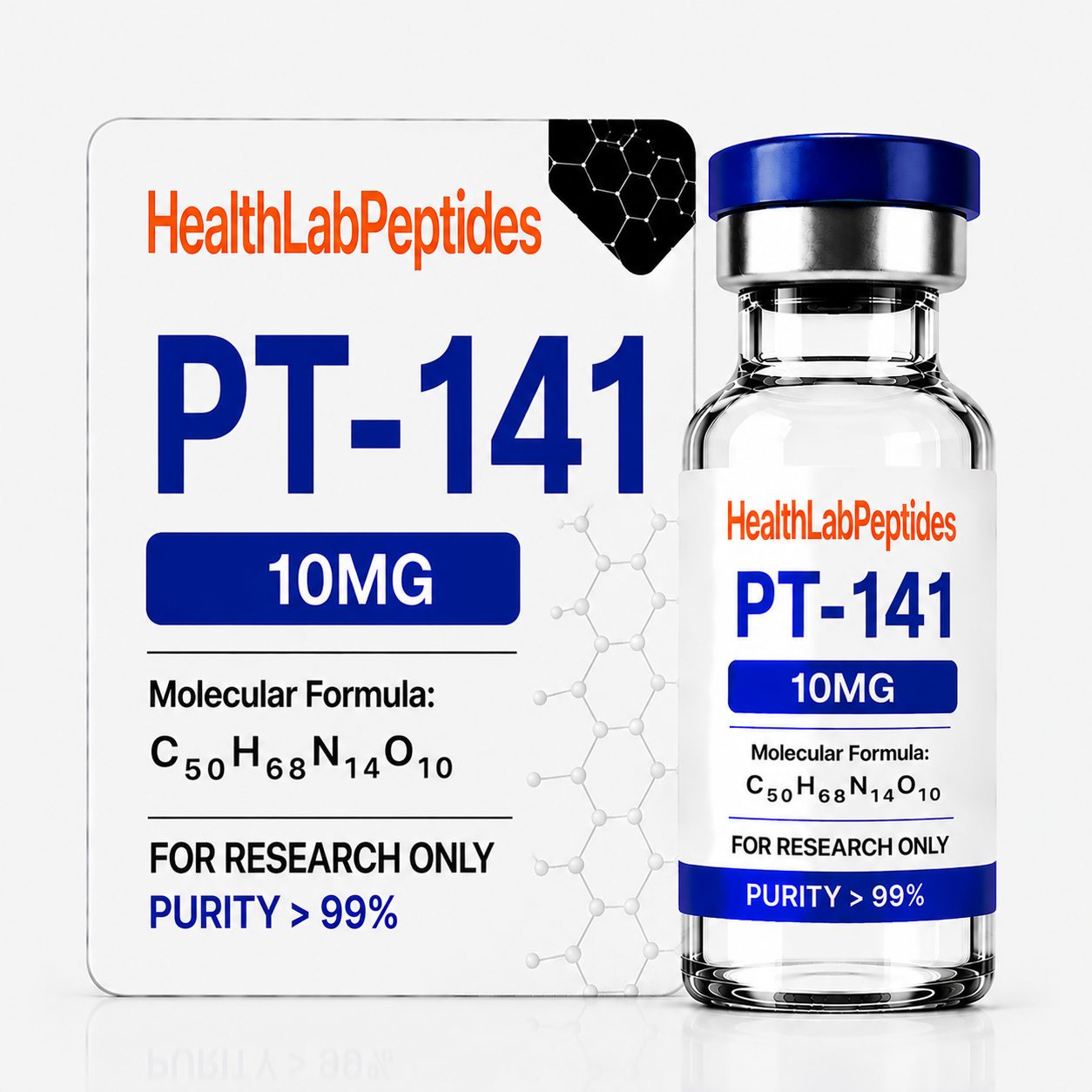
Research suggests that PT-141, commonly called bremelanotide, is a cyclic peptide investigated as a ligand for the melanocortin receptor family. Its scientific significance includes ligand structure, receptor subtype recognition, and the distinction between biochemical receptor assays and evidence used to approve specific medicines. In 2019, the U.S. Food and Drug Administration approved a particular prescription product containing bremelanotide, marketed as Vyleesi, for a defined adult medical indication. That regulatory action does not apply to independently marketed laboratory research materials. This article concentrates on melanocortin receptor biology, subtype selectivity, and correct interpretation of the evidence, rather than making health or personal-use claims. For a broader research introduction, see the HealthLab PT-141 melanocortin research overview.
A cyclic heptapeptide with a defined molecular identity
Bremelanotide is described in the FDA-approved product documentation as a synthetic cyclic heptapeptide derived from research involving alpha-melanocyte-stimulating hormone. Its structural features include an N-terminal acetyl group and a constrained cyclic region. Cyclic architecture can influence conformation, chemical properties, and receptor recognition, but those features must be evaluated experimentally rather than assumed to guarantee any particular effect. A scientific article should distinguish the active molecular entity from its salt form and from a final pharmaceutical formulation. The catalog name PT-141 identifies a research subject; it does not by itself describe every material-quality or regulatory characteristic.
What are melanocortin receptors?
The melanocortin system comprises several G-protein-coupled receptor subtypes known as MC1R, MC2R, MC3R, MC4R, and MC5R. These proteins have different tissue distributions and ligand-recognition properties. Research into receptor subtypes can involve purified binding systems, engineered cell lines, or more complex biological models. Because the receptor family is not a single target, calling a compound a melanocortin agonist does not describe its full binding profile. A responsible comparison specifies which subtype was tested, the assay, and whether the measurement concerns binding or downstream signaling.
MC1R, MC3R, MC4R, and MC5R are distinct targets
Melanocortin receptor subtypes can participate in different physiological systems, and experiments often compare how ligands interact with several of them. The 2019 FDA multidisciplinary review of bremelanotide describes pharmacologically relevant binding to multiple receptor subtypes while noting substantially lower affinity for MC2R under the reported measurements. This matters because selectivity is relative, not absolute. A result at MC4R cannot be taken to mean that the molecule has no activity at MC1R or MC3R. The receptor identity must stay attached to each reported measurement, especially when comparing different compounds.
What agonist means in a receptor assay
An agonist is a molecule that can activate a receptor-associated response in a particular experimental context. But binding and activation are different endpoints. A ligand may bind with a certain affinity, while the resulting signaling depends on the receptor, assay conditions, and cellular machinery. An in-vitro potency ranking across receptor subtypes should not be interpreted as a direct ranking of clinical effects. Scientists should ask what type of activity the paper measured: receptor association, cyclic AMP signaling, recruitment of regulatory proteins, or a more complex tissue outcome. Each supports a narrower conclusion.
The FDA’s 2019 receptor pharmacology description
The FDA’s original Vyleesi multidisciplinary review, NDA 210557, discusses bremelanotide as a synthetic cyclic heptapeptide and reports receptor-binding information across the melanocortin family. That regulatory source is useful because it separates specific nonclinical pharmacology from clinical product evidence. It does not mean that a laboratory vial sold under the code name PT-141 has undergone the same evaluation as the approved medicine. The reviewed drug product, its manufacturing controls, labeling, and studied context are product-specific. Research readers should avoid treating the existence of an FDA review as general authorization for unrelated material.
Why melanocortin chemistry is not identical to growth-hormone signaling
The term peptide covers molecular systems that differ greatly. Melanocortin receptor ligands are distinct from growth hormone-releasing hormone analogs or compounds studied at the ghrelin-related secretagogue receptor. Similarity in being a short peptide does not establish common receptor engagement. This is particularly important when online catalogs group many research materials together using broad hormone or performance terminology. The peptide hormone-receptor communication guide
Molecular conformation and cyclic peptides
Cyclization constrains the range of conformations a peptide can adopt. Depending on the exact sequence and linkage, that can influence interaction with a binding site or the stability of a molecular conformation. Yet cyclization is not a universal signal of receptor specificity, nor proof that a compound is suitable for use in a person. Studies must assess the actual molecule with suitable structural or biochemical methods. A heptapeptide with a ring is also not chemically identical to every other cyclic heptapeptide. Researchers comparing analogs should document the sequence, chemical modifications, and the receptor assays used.
Receptor distribution changes the research question
A receptor measured in a recombinant cell line may be present at levels that differ from those in naturally occurring tissue. Cellular background can influence the magnitude and duration of a signaling response. Consequently, receptor activity demonstrated in a laboratory reporter assay does not directly predict a physiological outcome or explain every mechanism operating in an intact organism. Experiments in tissue preparations add biological context but introduce other interacting pathways. A study comparison should specify the model, receptor expression conditions, and endpoint before extending any conclusions to a broader biological system.
Why MC2R is an important exception
MC2R is the melanocortin receptor most closely associated with adrenocorticotropic hormone signaling. The FDA’s pharmacology review described bremelanotide as having little to no affinity for this subtype compared with several other melanocortin receptors under the tested conditions. That is a subtype-specific finding, not proof that every endocrine pathway is unaffected. It illustrates why a simple statement that a compound stimulates melanocortin receptors is too imprecise. The different subtypes, experimental binding ranges, and functional consequences need separate discussion.
Bremelanotide and PT-141 as research terminology
PT-141 is a historical development code associated with bremelanotide. In scientific literature, the two terms can refer to the same active molecular entity, but a commercial research material described with either name should still be verified independently. Different finished products may vary in formulation, tested specifications, and regulatory controls. Exact nomenclature is especially important because research archives sometimes use a clinical drug name in a way that could imply authorization of a separate vial. A scientific article should describe the shared chemical reference while maintaining the clear distinction between a regulated medicine and RUO catalog material.
A specific prescription product received approval in 2019
The FDA approved Vyleesi (bremelanotide) on June 21, 2019 for a specific indication involving acquired, generalized hypoactive sexual desire disorder in qualifying premenopausal women. The approval concerned the tested prescription drug product and its label. That clinical and regulatory background can be stated as a matter of public record, but it should not become an advertising claim for HealthLab’s PT-141 research material. The latter is not an FDA-approved medication, cannot be presented as a substitute, and is not offered for human or veterinary administration. Research articles need to preserve that product-specific regulatory distinction.
The difference between pharmacology and clinical outcome evidence
A receptor-binding assay tests the interaction of a compound with an experimental molecular target. Clinical research, by contrast, evaluates defined outcomes in participants under a specified protocol. Those two types of evidence may inform one another but are not interchangeable. A compound’s ranking across MC1R, MC4R, and other subtypes does not directly measure the clinical endpoint used in a drug approval study. Nor does a clinical study establish that a separately sourced research material shares the properties of the reviewed formulation. Responsible scientific writing explains this chain of evidence without collapsing its stages.
Comparing PT-141 with other peptide classes
Peptides are frequently grouped by length or market category, yet two heptapeptides can have very different sequences and receptor mechanisms. For example, a cyclic melanocortin ligand and the linear neurobiology-related heptapeptide Semax are not comparable solely because both contain seven amino-acid residues. The heptapeptide research guide
Which laboratory methods answer useful questions?
Researchers can examine ligand structure, receptor-binding affinity, second-messenger responses, or downstream gene-expression patterns. Each method answers a different question. A cell-based assay may be influenced by receptor expression and signaling feedback, while a binding experiment is sensitive to the preparation and detection method. The scientific interpretation should identify controls, replicates, model, and uncertainty. It would be misleading to infer an approved use or a safety profile from a single attractive receptor result. Multiple converging measurements and appropriately designed studies are required for broader claims.
Regulatory information should not become an RUO sales promise
The existence of a prescription medicine containing a compound is not an endorsement of every research product bearing a similar name. FDA approval is tied to a specific formulation, quality system, and indication. A Certificate of Analysis for a research lot can support selected analytical statements, depending on its tests, but cannot reproduce the regulatory review of a licensed product. Search phrases associated with sexual health, hormone modulation, or personal performance are not appropriate claims for HealthLab research materials. The site should present receptor biology accurately without promoting treatment or bodily administration.
HealthLab’s PT-141 catalog identification
The PT-141 10 mg research-material listing is a catalog reference for legitimate laboratory investigation only. The declared amount is part of product identification, not a study protocol, human dose, or recommendation for use. Researchers should independently match the molecule’s name and analytical records to the research question being considered. Any available batch documentation describes only what was actually measured; it does not confer FDA approval or prove that the material is equivalent to a prescription product. The research-only restrictions apply to the entire item.
Frequently asked questions
Is PT-141 associated with bremelanotide? Yes, PT-141 is a historical development name. Is it a cyclic peptide? Yes, the active molecular entity is described as a cyclic heptapeptide. Does it act on only one melanocortin receptor? No; published pharmacology describes interactions with multiple subtypes. Was a bremelanotide medicine approved by the FDA? Yes, a specific prescription product was approved in 2019. Does that approve a HealthLab vial? No. Can a receptor assay establish consumer effectiveness? No.
Scientific and regulatory source identifiers
FDA Vyleesi original approved label, NDA 210557 (2019), including the chemical description and receptor-related clinical pharmacology; FDA multidisciplinary review for NDA 210557, containing the comparative melanocortin receptor binding assessment; and the FDA’s public product approval record dated June 21, 2019. These documents support the molecule’s identity, receptor-family context, and product-specific regulatory distinction. They do not establish human-use approval for any unrelated RUO material.
Conclusion: Receptor selectivity and product approval are different subjects
PT-141 is useful as a research example of a cyclic melanocortin ligand whose properties vary across receptor subtypes. Binding assays, cellular signaling studies, and regulatory reviews address different scientific questions. A particular bremelanotide prescription product received FDA approval, but that fact does not authorize a research supplier’s material for clinical or consumer applications. Precise structure, receptor subtype identification, and clear evidence boundaries allow a rigorous research article to inform readers without implying unsupported uses.
For Research Use Only
For Research Use Only. Not for human consumption, medical, or veterinary use. No dosing, administration, injection, treatment, reconstitution, or other personal-use instructions are provided. These statements have not been evaluated by the FDA. HealthLab research material is not intended to diagnose, treat, cure, or prevent any disease.


