

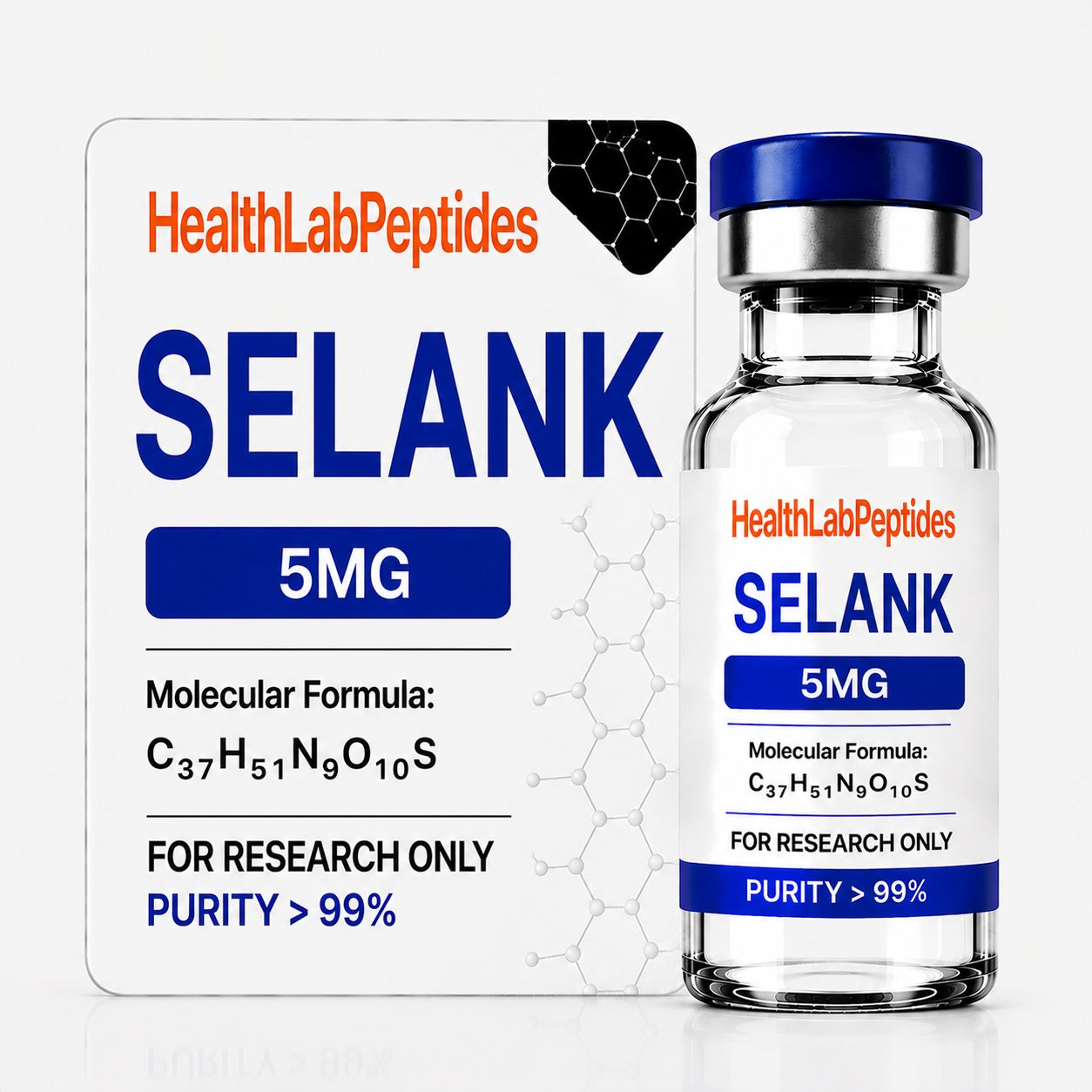
Selank Peptide Research: Mechanisms, Neuroscience and Current Scientific Evidence
Research into neuroactive peptides continues to expand as scientists investigate compounds associated with neurotransmitter signaling, neuroimmune communication, gene expression, and other biological processes.
Selank is a synthetic heptapeptide that has been investigated in neuroscience, molecular biology, neurochemistry, pharmacology, and neuroimmunology research.
This article discusses Selank solely in the context of published and experimental research. References to biological pathways, laboratory findings, or experimental models do not establish that Selank is safe or effective for treating any condition.
Selank is not approved by the U.S. Food and Drug Administration as a drug for therapeutic use in the United States. Material offered by HealthLab Peptides is intended for Research Use Only (RUO) and is not intended for human or veterinary use.
What Is Selank?
Selank is a synthetic peptide consisting of seven amino acids. It was developed as an analog of tuftsin, a naturally occurring peptide associated with immune-system signaling.
Scientific literature concerning Selank includes investigations involving areas such as:
- GABAergic signaling
- serotonergic pathways
- dopaminergic signaling
- neuroimmune communication
- cytokine signaling
- gene expression
- neuroplasticity-related pathways
- brain-derived signaling pathways
These subjects represent areas of scientific investigation rather than established therapeutic uses.
Selank Chemical Structure
Selank is a synthetic heptapeptide with the following reported molecular characteristics:
Molecular formula: C33H57N11O9
Molecular weight: approximately 751.9 g/mol
Its molecular properties have made Selank a subject of experimental research involving peptide stability, metabolism, distribution, signaling, and other laboratory endpoints.
Development of Selank
Selank was developed from research involving tuftsin and modified peptide sequences.
Scientists have investigated whether structural modification of naturally occurring peptide sequences can affect characteristics such as molecular stability, enzymatic degradation, and biological interactions under experimental conditions.
Subsequent Selank research expanded into areas including neuroscience, neurochemistry, neuroimmunology, molecular pharmacology, and behavioral research models.
These investigations remain part of an evolving scientific literature.
How Selank Is Being Investigated
Selank research involves several interconnected biological systems rather than one universally established molecular target.
Experimental literature has investigated possible interactions involving:
- GABA-related signaling
- serotonin-related pathways
- dopamine-related pathways
- monoamine metabolism
- cytokine signaling
- gene transcription
- neuroimmune communication
- neurotrophic signaling
The precise significance of these observations remains under investigation, and findings from laboratory or animal models should not automatically be extrapolated to humans.
Selank and GABA Signaling Research
One area of scientific interest concerns Selank and GABAergic signaling.
Gamma-aminobutyric acid, or GABA, is an important inhibitory neurotransmitter within the central nervous system.
Experimental Selank research has examined subjects including:
- receptor-related signaling
- neurotransmitter interactions
- synaptic signaling
- neural-network communication
- inhibitory signaling pathways
These studies investigate biological mechanisms. They do not establish that Selank can treat anxiety, stress, insomnia, or another medical condition.
Selank and Serotonin Research
Researchers have also examined Selank in relation to serotonin-associated pathways.
Serotonin participates in numerous physiological and neurological processes, making serotonergic signaling an important area of neuroscience research.
Experimental investigations have examined whether Selank is associated with changes in serotonin-related signaling or metabolism under particular research conditions.
The clinical significance of these findings, if any, has not been established.
Dopamine Pathway Research
Dopaminergic signaling represents another area appearing in Selank research.
Scientists have investigated endpoints involving:
- dopamine-related signaling
- neurotransmitter metabolism
- synaptic activity
- receptor-associated pathways
- interactions among neural signaling systems
Research into a biological pathway should not be interpreted as evidence that Selank produces a particular psychological, cognitive, behavioral, or therapeutic outcome in humans.
Neuroplasticity Research
Neuroplasticity describes the capacity of neural systems to undergo structural or functional changes.
Experimental peptide research may examine biological processes associated with:
- synaptic remodeling
- neural adaptation
- cellular signaling
- protein expression
- dendritic processes
- learning-associated pathways
Selank has appeared in research involving some of these areas.
Much of this work remains experimental or preclinical, and additional research is necessary to determine the significance and reproducibility of reported observations.
Gene Expression Research
Gene-expression analysis has become an important tool in modern peptide research.
Experimental studies involving Selank have investigated changes associated with genes or signaling pathways related to:
- immune communication
- cellular signaling
- neurotransmitter systems
- stress-response mechanisms
- protein expression
Such findings can help researchers formulate hypotheses about biological mechanisms.
They should not be interpreted as evidence that Selank produces established health benefits.
Selank and Neuroimmune Research
Selank’s relationship to tuftsin has also contributed to scientific interest in neuroimmune signaling.
Researchers have investigated areas including:
- cytokine signaling
- immune-cell communication
- macrophage-related processes
- inflammatory signaling pathways
- interactions between neural and immune systems
Neuroimmunology is a broad research field examining communication between the nervous and immune systems.
References to these pathways describe research topics and are not claims that Selank prevents, reduces, or treats inflammatory or immune disorders.
Cytokine Research
Cytokines are signaling proteins involved in cellular and immune communication.
Laboratory research associated with Selank has examined cytokine-related pathways, including research involving various interleukins and other signaling molecules.
Because cytokines participate in complex biological networks, individual experimental observations require careful interpretation.
Additional independent research is necessary to establish the reproducibility and significance of these findings.
Selank and BDNF Research
Brain-derived neurotrophic factor (BDNF) is extensively studied in neuroscience because of its involvement in neuronal development, signaling, and plasticity.
Research concerning Selank has included investigation of pathways associated with neurotrophic signaling.
Researchers may examine endpoints involving:
- synaptic signaling
- cellular responses
- neural differentiation
- protein expression
- plasticity-associated mechanisms
The presence of Selank in this research does not establish that the peptide improves memory, cognition, brain health, or neurological function in humans.
Pharmacokinetic Research
Pharmacokinetics describes the study of how a substance behaves within a biological system.
Published experimental research concerning Selank may examine subjects including:
- absorption
- distribution
- metabolism
- enzymatic degradation
- tissue distribution
- elimination
These investigations help researchers characterize experimental compounds.
Descriptions of pharmacokinetic studies are presented here for scientific and educational purposes and are not instructions for administration or personal use.
Blood-Brain Barrier Research
Researchers studying neuroactive compounds frequently investigate interactions with or transport across the blood-brain barrier.
Selank-related experimental literature has considered areas such as:
- transport mechanisms
- tissue distribution
- peptide stability
- experimental delivery models
- central nervous system distribution
Descriptions of delivery methods appearing in scientific publications reflect experimental methodology. HealthLab Peptides does not provide administration instructions or recommendations for human use.
Selank and Semax Research
Selank and Semax are sometimes discussed together because both are synthetic peptides investigated in neuroscience research.
However, they have different amino-acid sequences and should not be considered interchangeable.
Comparative research may examine differences involving:
- neurotransmitter signaling
- gene-expression profiles
- cytokine signaling
- neurotrophic pathways
- experimental behavioral models
- pharmacokinetic characteristics
Additional comparative research is necessary to characterize their similarities and differences.
Selank Safety Research
The available scientific literature includes investigations of Selank safety and tolerability under specific experimental conditions.
However, the evidence base is limited compared with that available for FDA-approved medications, and findings from individual studies should not be generalized beyond the populations, methods, doses, and conditions actually studied.
Research areas have included:
- laboratory toxicology
- short-term tolerability observations
- immunogenicity
- pharmacokinetics
- adverse-event observations in published studies
These data do not establish the safety of Selank for unsupervised human use, nor should they be interpreted as a recommendation to use Selank.
Limitations of Current Selank Research
Several important limitations should be considered when reviewing Selank literature.
Much of the available research is experimental or preclinical. Some human studies have involved relatively small study populations, methodologies differ between publications, and independent replication is limited for some findings.
Researchers should therefore distinguish among:
preclinical observations, experimental hypotheses, mechanistic evidence, preliminary human research, and established clinical evidence.
These categories are not interchangeable.
A result observed in cells or animals does not establish that the same result will occur in humans.
Laboratory Handling and Stability Research
Peptide stability can be affected by environmental conditions and laboratory handling.
Researchers working with peptide materials should use validated institutional protocols and appropriate laboratory practices for storage, handling, preparation, contamination control, documentation, and disposal.
Specific procedures should be determined by qualified researchers according to the material being studied, applicable safety documentation, institutional requirements, and the experimental protocol.
HealthLab Peptides does not provide preparation or administration instructions for human or veterinary use.
Areas of Ongoing Selank Research
Selank continues to appear in scientific investigations involving areas such as:
- neuroscience
- neurochemistry
- molecular biology
- neuroimmunology
- pharmacology
- systems biology
- transcriptomics
- proteomics
- peptide chemistry
- cellular signaling
Improved analytical technologies may allow researchers to investigate increasingly complex relationships among peptide structure, gene expression, neurotransmitter systems, proteins, and cellular signaling networks.
Frequently Asked Questions
What is Selank?
Selank is a synthetic heptapeptide developed as an analog of tuftsin. It has been investigated experimentally in neuroscience, neurochemistry, neuroimmunology, and related fields.
Is Selank FDA approved?
Selank is not approved by the U.S. Food and Drug Administration as a drug for therapeutic use in the United States.
Is Selank a research peptide?
Selank is sold by HealthLab Peptides solely as a Research Use Only laboratory material.
Products labeled Research Use Only are not offered by HealthLab Peptides for human or veterinary consumption or therapeutic use.
What areas of Selank research are being investigated?
Published and experimental research has examined topics including neurotransmitter signaling, gene expression, cytokine pathways, neuroimmune communication, pharmacokinetics, and other molecular mechanisms.
Research into these subjects does not demonstrate that Selank provides a health or therapeutic benefit.
Does Selank research prove clinical effectiveness?
No.
Experimental, preclinical, or preliminary clinical observations should not be treated as proof of clinical efficacy.
Establishing a therapeutic indication requires appropriate clinical evidence and regulatory review.
How does Selank differ from Semax?
Selank and Semax have different peptide sequences and have been investigated in different, although sometimes overlapping, areas of neuroscience research.
They should not be considered interchangeable based solely on their appearance within similar research literature.
Future Research Directions
Future Selank research may further investigate:
- molecular mechanisms
- peptide stability
- pharmacokinetics
- biomarker responses
- neurotransmitter networks
- neuroimmune signaling
- gene-expression patterns
- reproducibility of experimental findings
Future research may clarify existing observations, identify limitations, or produce findings that differ from earlier hypotheses.
Scientific conclusions should therefore be based on the totality and quality of available evidence rather than individual studies.
Conclusion
Selank remains a subject of experimental scientific interest because researchers have investigated its interactions with several biological systems, including neurotransmitter signaling, neuroimmune communication, cytokine pathways, gene expression, and neuroplasticity-associated mechanisms.
The scientific literature should nevertheless be interpreted according to the limitations of the underlying evidence.
Laboratory findings, animal studies, mechanistic observations, and preliminary human investigations do not automatically establish clinical safety, effectiveness, or an approved therapeutic use.
Researchers evaluating Selank should consult original peer-reviewed literature and distinguish carefully between experimental findings and established clinical evidence.
Research Use Only — Important Notice
Selank products offered by HealthLab Peptides are sold strictly for Research Use Only (RUO) and in-vitro laboratory research.
NOT FOR HUMAN OR VETERINARY USE OR CONSUMPTION.
HealthLab Peptides does not market Selank as a drug, dietary supplement, medication, treatment, or product intended to diagnose, treat, cure, mitigate, or prevent disease.
References to neuroscience, GABA, serotonin, dopamine, BDNF, neuroplasticity, neuroimmune signaling, cytokines, pharmacokinetics, or other biological processes describe subjects appearing in scientific research. They do not represent claims that Selank products sold by HealthLab Peptides produce these effects in humans.
HealthLab Peptides does not provide dosage recommendations, administration instructions, injection guidance, cycling protocols, or instructions for human or veterinary use.
Information on this page is provided for educational and scientific discussion of published research and should not be interpreted as medical advice, prescribing information, or instructions for use.
Researchers are responsible for ensuring that research materials are acquired, handled, stored, and used in accordance with applicable laws, regulations, institutional requirements, and laboratory safety practices.
Selected Research Sources
Researchers interested in Selank should consult the original scientific literature through resources such as:
- PubMed
- National Center for Biotechnology Information (NCBI)
- peer-reviewed neuroscience journals
- peer-reviewed pharmacology journals
- peer-reviewed peptide and neuroimmunology literature
When evaluating a study, particular attention should be given to the experimental model, sample size, methodology, controls, endpoints, statistical analysis, replication, and whether the findings are in-vitro, animal, preclinical, or human clinical observations.
O
 Mots-C 40mg