
Research suggests that AICAR peptide remains one of the most important research compounds for studying cellular energy regulation and metabolic signaling. Unlike many peptides investigated for endocrine or regenerative pathways, AICAR has become a cornerstone of laboratory research focused on AMP-activated protein kinase (AMPK)—often referred to as the cell’s primary energy sensor.
Over the past two decades, scientists have investigated AICAR across a wide range of experimental models involving glucose metabolism, mitochondrial biology, cardiovascular physiology, skeletal muscle adaptation, and healthy aging. As of 2026, research continues to expand as investigators explore how AMPK signaling influences cellular responses to changes in energy demand.
Although AICAR has been widely studied in laboratory settings, it remains a Research Use Only (RUO) compound and is not approved by the U.S. Food and Drug Administration (FDA) for general therapeutic use.
What Is AICAR?
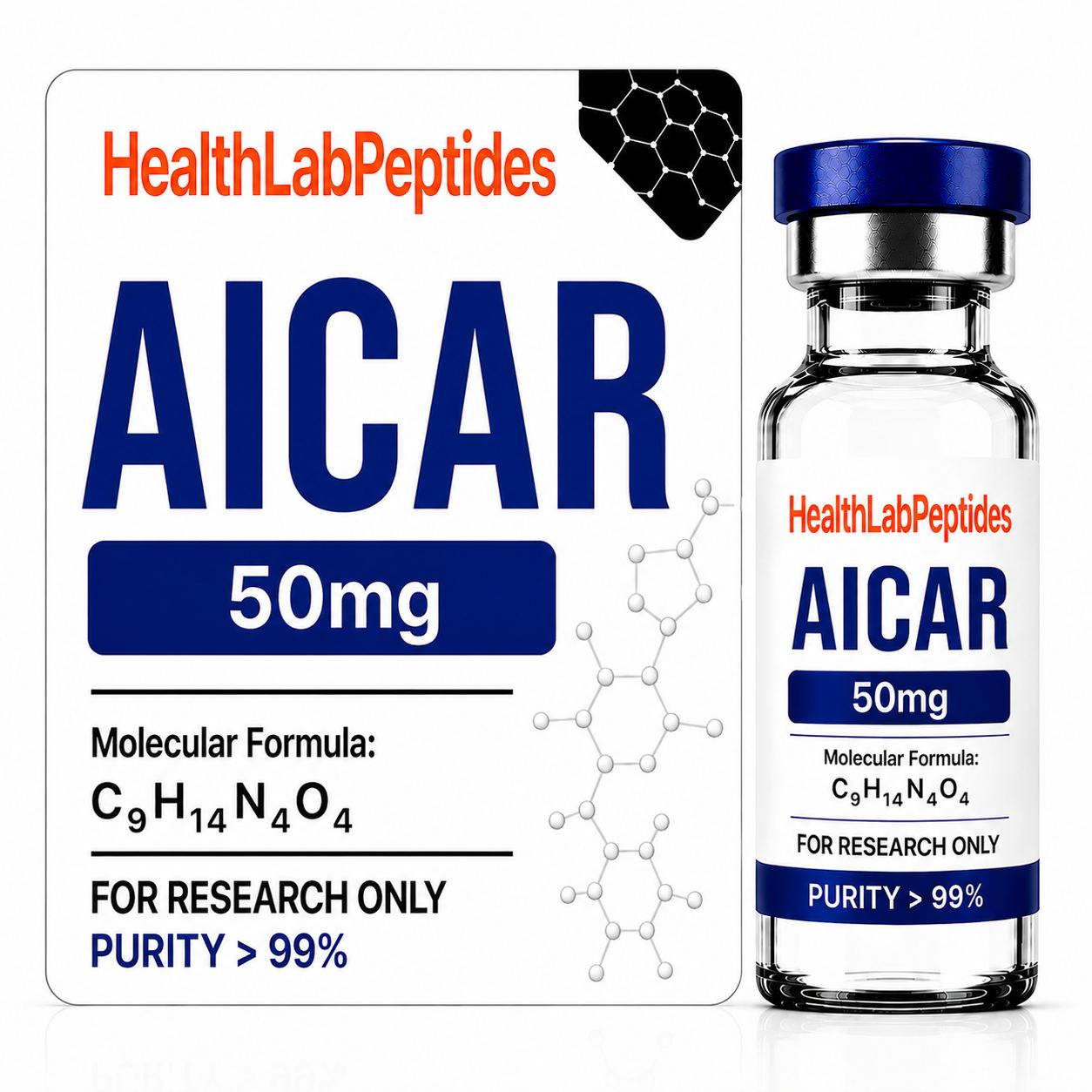
AICAR, short for 5-Aminoimidazole-4-carboxamide ribonucleotide, is a synthetic compound that closely resembles a naturally occurring intermediate involved in purine biosynthesis. Once inside cells, AICAR is converted into ZMP, a molecule that mimics AMP (adenosine monophosphate).
Because ZMP resembles AMP, it activates AMP-activated protein kinase (AMPK), one of the body’s most important regulators of cellular energy balance.
Rather than acting directly on hormones or growth factors, AICAR influences how cells detect and respond to changes in energy availability. This unique mechanism has made it one of the most frequently used compounds in metabolic research laboratories worldwide.
Understanding AMPK: The Cell’s Energy Sensor
To understand AICAR, it is helpful to understand the role of AMPK.
AMPK functions as an intracellular monitoring system that continuously evaluates cellular energy status. When energy stores decline, AMPK helps coordinate a variety of adaptive responses designed to restore balance.
Researchers continue investigating how AMPK activation influences:
- Glucose utilization
- Fatty acid oxidation
- Mitochondrial activity
- Cellular energy production
- Protein metabolism
- Autophagy
- Oxidative stress responses
- Metabolic flexibility
Because AMPK affects nearly every major metabolic tissue, scientists consider it one of the central regulators of whole-body energy homeostasis.
How AICAR Works
Once introduced into experimental systems, AICAR enters cells through nucleoside transport pathways. Intracellular enzymes convert it into ZMP, which activates AMPK by mimicking the effects of increased AMP levels.
Activation of AMPK triggers a cascade of signaling events that shifts cellular metabolism toward energy conservation and energy production.
Researchers continue studying downstream pathways involving:
- Glucose transport
- Fat oxidation
- Mitochondrial biogenesis
- Cellular respiration
- Glycogen metabolism
- Lipid metabolism
- Protein synthesis regulation
- Cellular stress adaptation
Because these pathways influence numerous biological systems, AICAR has become valuable across multiple areas of biomedical research.
Why Researchers Continue Studying AICAR
One reason AICAR remains highly relevant is its broad influence on cellular metabolism.
Rather than targeting a single tissue or receptor, AMPK activation affects nearly every organ system involved in maintaining energy balance.
Scientists continue investigating AICAR in studies involving:
- Metabolic regulation
- Exercise physiology
- Mitochondrial biology
- Skeletal muscle research
- Cardiovascular physiology
- Liver metabolism
- Glucose homeostasis
- Healthy aging
- Cellular stress responses
- Inflammation signaling
Each of these fields continues generating new questions about how cells adapt to changing metabolic demands.
Cellular Energy Metabolism
Energy metabolism remains the foundation of AICAR research.
Scientists use AICAR to examine how cells regulate ATP production under conditions of increased energy demand or metabolic stress.
Current investigations include:
- ATP synthesis
- Cellular respiration
- Energy sensing
- Glycolysis
- Oxidative phosphorylation
- Metabolic adaptation
- Nutrient sensing
- Cellular efficiency
Understanding these mechanisms helps researchers better characterize normal physiological responses to exercise, fasting, and environmental stressors.
Mitochondrial Research
Mitochondria serve as the primary source of cellular energy, making them a central focus of AICAR investigations.
Researchers continue studying whether AMPK activation influences laboratory markers associated with:
- Mitochondrial biogenesis
- Mitochondrial efficiency
- Oxidative metabolism
- Cellular respiration
- Reactive oxygen species regulation
- Energy production
- Mitochondrial quality control
Because mitochondrial dysfunction has been implicated in numerous disease models, this remains one of the fastest-growing areas of metabolic research.
Glucose Metabolism Research
AMPK plays an important role in maintaining glucose balance throughout the body.
Researchers continue investigating how AICAR affects laboratory models involving:
- Glucose transport
- Insulin signaling pathways
- Glycogen metabolism
- Hepatic glucose production
- Skeletal muscle glucose uptake
- Cellular carbohydrate metabolism
These studies contribute to a broader understanding of metabolic regulation, although further clinical research is needed to determine how experimental findings may translate to human physiology.
Exercise Physiology and Skeletal Muscle Research
AICAR gained widespread scientific attention because of its ability to activate AMPK during laboratory studies involving skeletal muscle metabolism. Researchers continue using AICAR to better understand how muscle tissue adapts to increased energy demands and prolonged physical activity.
Current investigations focus on laboratory markers associated with:
- Skeletal muscle metabolism
- Cellular energy utilization
- Endurance-related adaptations
- Glucose transporter activity
- Mitochondrial function
- Muscle fiber metabolism
- Fuel utilization
- Exercise-induced signaling pathways
Rather than evaluating athletic performance directly, these studies help scientists understand the molecular events that occur inside muscle cells during metabolic stress.
Fatty Acid Oxidation and Lipid Metabolism
One of the primary functions of AMPK activation is regulating how cells use available energy sources. As a result, AICAR has become an important research compound for studying lipid metabolism.
Researchers continue investigating how AMPK signaling influences:
- Fatty acid oxidation
- Lipid transport
- Cellular fat metabolism
- Triglyceride regulation
- Energy substrate selection
- Metabolic flexibility
- Hepatic lipid metabolism
Understanding these pathways provides insight into how cells adapt to changing nutritional and energetic conditions.
Cardiovascular Research
The cardiovascular system requires a continuous supply of energy to maintain normal function, making AMPK an important area of investigation.
Scientists continue exploring AICAR in laboratory models involving:
- Cardiac metabolism
- Myocardial energy production
- Ischemia-reperfusion biology
- Cellular stress responses
- Vascular function
- Endothelial signaling
- Cardiac mitochondrial activity
Researchers are particularly interested in understanding how cardiac cells respond to metabolic stress and whether AMPK activation influences cellular resilience under controlled laboratory conditions.
Liver and Metabolic Homeostasis
The liver plays a central role in regulating glucose and lipid metabolism.
Current research continues examining how AICAR influences laboratory models related to:
- Hepatic glucose production
- Glycogen metabolism
- Fat metabolism
- Cellular nutrient sensing
- Metabolic homeostasis
- Energy balance
These investigations contribute to a broader understanding of whole-body metabolism and endocrine communication.
Healthy Aging and Longevity Research
As scientists continue exploring the biological mechanisms associated with aging, AMPK has emerged as one of the most important signaling pathways involved in cellular maintenance.
Researchers are investigating whether AICAR influences laboratory markers associated with:
- Cellular resilience
- Protein quality control
- Mitochondrial maintenance
- Oxidative stress responses
- Autophagy
- Metabolic adaptation
- Healthy aging biology
Although these areas remain highly active in laboratory research, further clinical studies are necessary before translating findings into human health recommendations.
Oxidative Stress and Cellular Protection
Normal cellular metabolism produces reactive oxygen species (ROS), which cells must continuously manage to maintain homeostasis.
Researchers continue using AICAR to investigate laboratory pathways involving:
- Antioxidant enzyme activity
- Cellular redox balance
- Mitochondrial oxidative stress
- DNA protection mechanisms
- Protein homeostasis
- Cellular adaptation to metabolic stress
Understanding these mechanisms may provide valuable insight into normal cellular physiology and aging biology.
Current Clinical Evidence
AICAR has been investigated extensively in laboratory settings and in a limited number of early clinical studies. Most published research has focused on understanding its biological mechanisms rather than establishing therapeutic applications.
Current evidence indicates:
- AICAR reliably activates AMPK in experimental models.
- Laboratory studies continue expanding knowledge of metabolic regulation.
- Human clinical research remains relatively limited.
- Long-term safety data are still being developed.
- Additional randomized clinical trials are needed.
Researchers emphasize that promising laboratory findings should not be interpreted as proven clinical outcomes.
Safety Considerations
Published research generally reports that AICAR has been well characterized in controlled laboratory environments. However, its complete safety profile has not been established for general therapeutic use.
Scientists continue evaluating:
- Dose-response relationships
- Metabolic adaptations
- Cardiovascular responses
- Cellular signaling changes
- Long-term biological effects
- Tissue-specific responses
Because research remains ongoing, AICAR should be considered an investigational compound.
AICAR Compared with Other Research Compounds
Although often discussed alongside peptides, AICAR differs significantly because it functions primarily through AMPK activation rather than peptide receptor signaling.
Researchers frequently compare AICAR with compounds such as:
- MOTS-c
- SS-31
- NAD+
- 5-Amino-1MQ
- Retatrutide
- Tirzepatide
- Semaglutide
- AOD-9604
Each compound targets distinct biological pathways, allowing scientists to investigate multiple aspects of metabolism and cellular energy regulation.
Related Research Peptides
Researchers interested in metabolic science often investigate additional Research Use Only (RUO) compounds alongside AICAR, including:
- MOTS-c
- SS-31
- NAD+
- 5-Amino-1MQ
- AOD-9604
- Retatrutide
- Tirzepatide
- Semaglutide
- BPC-157
- TB-500
- GHK-Cu
- Tesamorelin
- Ipamorelin
- CJC-1295 DAC
- IGF-1 LR3
- Hexarelin
Together, these research compounds help scientists investigate metabolism, mitochondrial biology, endocrine physiology, regenerative science, and cellular signaling.
Why Researchers Choose HealthLab Peptides
HealthLab Peptides offers a growing selection of Research Use Only (RUO) compounds designed for laboratory professionals and scientific investigators.
Researchers choose HealthLab Peptides because of:
- Competitive everyday pricing
- High-purity research materials
- Fast and reliable shipping
- Clearly labeled RUO products
- Expanding product selection
- Dependable customer service
Researchers exploring AICAR may also be interested in:
- AOD-9604
- MOTS-c
- NAD+
- SS-31
- 5-Amino-1MQ
- CJC-1295 DAC
- Ipamorelin
- GHK-Cu
Browse the complete research catalog at:
Frequently Asked Questions
What is AICAR?
AICAR (5-Aminoimidazole-4-carboxamide ribonucleotide) is a research compound that activates AMP-activated protein kinase (AMPK), one of the body’s primary cellular energy regulators.
Why is AICAR studied?
Researchers investigate AICAR to better understand metabolism, mitochondrial function, glucose regulation, lipid metabolism, exercise physiology, and healthy aging.
Is AICAR a peptide?
No. Although commonly sold alongside research peptides, AICAR is a synthetic small molecule that activates AMPK rather than a peptide composed of amino acids.
Is AICAR FDA approved?
No. AICAR is not approved by the U.S. Food and Drug Administration for general therapeutic use and is intended for Research Use Only (RUO).
Final Thoughts
AICAR continues to occupy a unique position in biomedical research because of its direct influence on AMPK, one of the most important regulators of cellular energy balance. Its broad effects on metabolism, mitochondrial biology, glucose utilization, and cellular adaptation have made it an indispensable research tool across multiple scientific disciplines.
As interest in metabolic health, longevity research, and mitochondrial function continues to grow, AICAR remains central to laboratory investigations seeking to understand how cells respond to energetic stress. Although additional clinical studies are needed to clarify its long-term implications, current research continues to strengthen its importance within modern metabolic science.
For laboratories seeking high-quality Research Use Only compounds, HealthLab Peptides offers an expanding catalog of research materials supported by competitive pricing, dependable service, and fast order fulfillment.
Research Use Only (RUO) Disclaimer
Research Use Only (RUO). Products offered by HealthLab Peptides are intended exclusively for laboratory and scientific research. They are not for human or veterinary use and are not intended to diagnose, treat, cure, or prevent any disease. Statements regarding these products have not been evaluated by the U.S. Food and Drug Administration (FDA). HealthLab Peptides makes no medical or therapeutic claims regarding its products. Researchers are responsible for complying with all applicable laws, regulations, and institutional policies.