

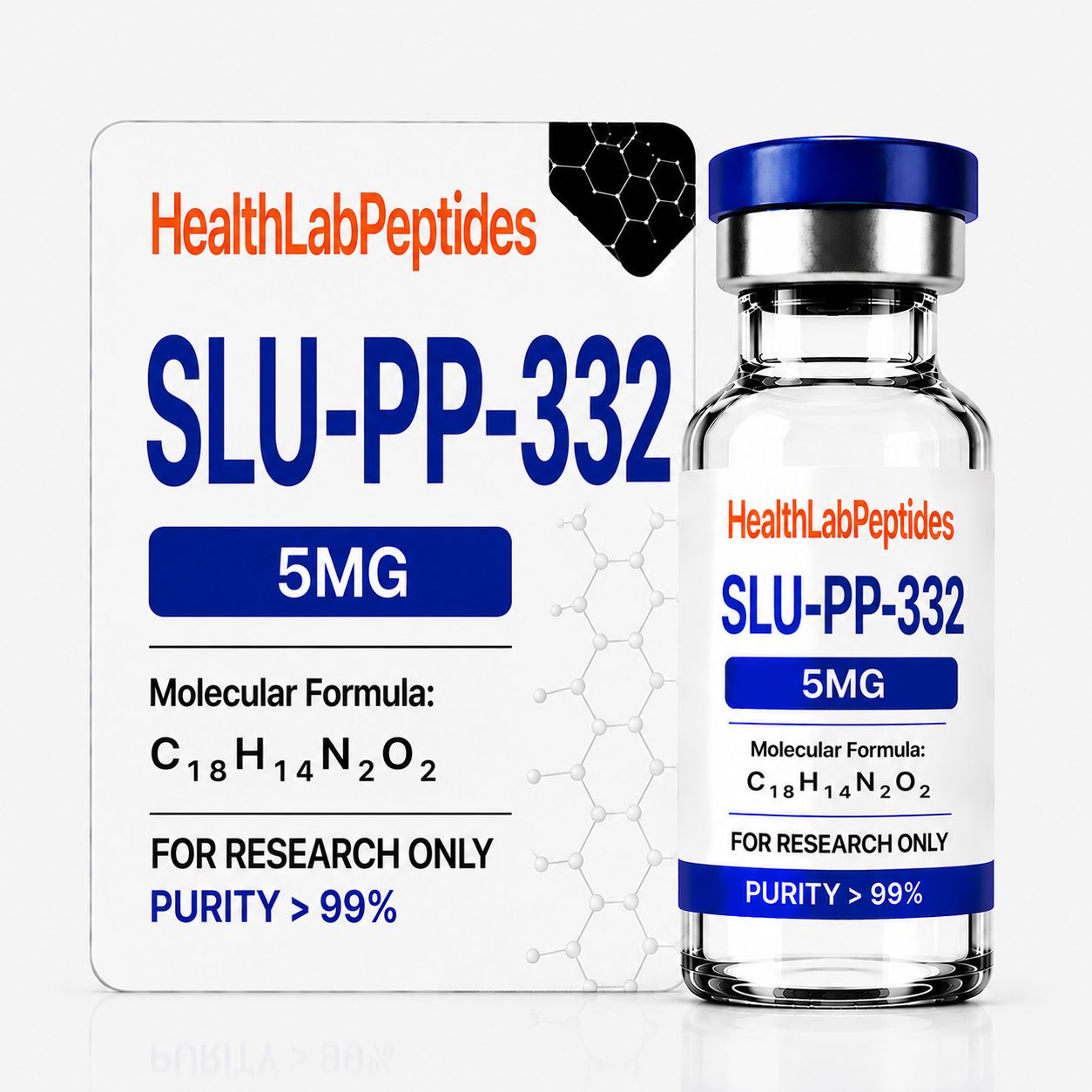
Research suggests: SLU-PP-332 is a synthetic small-molecule ERR agonist rather than an amino-acid peptide. The primary scientific question in slu-pp-332 metabolite research: lc-hrms findings from human liver fractions concerns evidence from defined experiments, not the effects of any independent commercial preparation. This article examines structural identity, the original assays, and relevant uncertainties. For additional background, see HealthLab’s existing research overview. The material is discussed solely for research and educational purposes, not for human or veterinary use.
Chemical class matters in a research catalog
SLU-PP-332 is an organic small molecule studied as an agonist for estrogen-related nuclear receptors ERRα, ERRβ, and ERRγ. It is not constructed as a chain of amino acids linked by peptide bonds. Its appearance in a catalog alongside peptides should not lead to misclassification in an article or in analytical records. Its structure and fragmentation behavior differ from those of short peptide hormones. This distinction affects the relevance of molecular-assay references, impurity identification, and comparisons with other experimental compounds.
A 2026 analytical study on metabolites
A Drug Testing and Analysis paper published in 2026, PMID 41688415, investigated SLU-PP-332 using pooled human liver S9 fractions and liquid chromatography–high-resolution mass spectrometry. The investigators reported numerous putative Phase I and Phase II transformation products and discussed their analytical characteristics. These are findings from in-vitro metabolism preparations, not a clinical trial. They do not establish safety or effectiveness for a laboratory product, nor should the discussion be used to provide anti-doping evasion advice or personal-use guidance.
Why liver S9 differs from a living liver
A liver S9 fraction is a prepared biological sample containing selected enzyme activities. It can be useful for investigating potential chemical transformation pathways, but it does not reproduce the entire physiology of a living organism. The components present, the metabolic context, and available cofactors influence what is observed. A molecule’s metabolism in an S9 preparation does not automatically predict the full set of circulating products, organ distribution, or biological activity in humans. The matrix used belongs in the description of every result.
Phase I transformations are chemical assignments
The reported analytical work identified oxidation- and reduction-associated products of the parent compound, including several hydroxylated species. Assigning a chemical formula from high-resolution mass data is useful but may not uniquely establish the position of every structural change. Some regioisomers can share the same mass. Additional fragmentation or independent characterization is often needed. A comprehensive article should describe what the investigators assigned and where their structural certainty remained limited, rather than claiming exhaustive metabolite identification.
For a complementary but distinct approach, the related HealthLab research article discusses a different dimension of the evidence. A structural characterization, receptor response, cellular endpoint, or analytical method may be informative without proving the others. Comparing the two pages is useful only when the actual molecular species, tested model, and measured signal are kept separate. Shared keywords do not make experiments interchangeable.
Conjugation-related transformations
Phase II metabolism discussions can include glucuronidation and sulfation of suitable molecular sites. Such conjugates have different masses and chemical properties from the original compound. The 2026 study included products consistent with these categories. Identifying a conjugate in an in-vitro preparation does not establish its pharmacological effect or prove that it will be present at the same level in another biological system. The appropriate conclusion is that the selected analytical platform detected products under defined assay conditions.
How molecular chemistry differs from ERR transcription assays
A separate 2026 study of SLU-PP-332 analogs, PMID 41850449, examined structure–activity relationships and ERR-associated transcriptional readouts. This answers a different question from identifying metabolites in liver fractions. Chemical modifications that change analytical behavior may also influence receptor activity, but that relationship must be directly measured. It cannot be inferred from the mere observation of a metabolite. The two studies are complementary because one explores structural pharmacology while the other examines transformation products.
Why exercise-mimetic terminology is not a product claim
SLU-PP-332 is often discussed using the phrase exercise mimetic, but that label describes a field of experimental research and does not mean a research vial can substitute for physical activity or provide health benefits. Publications involving animal models and biochemical assays cannot establish safe human performance use. The article focuses on the chemical and analytical evidence, including uncertainties, rather than promoting any outcome. The HealthLab catalog name is supplied for research navigation only.
Questions of scientific interpretation
The relevant research citations are Avliyakulov et al., Drug Testing and Analysis (2026), PMID 41688415, DOI 10.1002/dta.70035; Okda et al., International Journal of Biological Macromolecules (2026), PMID 41850449. Before repeating a published statement, identify its experimental setting, reference compounds, sample size or replication, analytical controls, and statistical uncertainty. A null result can be just as informative as a positive one, especially where the authors evaluated multiple models. Correlations do not necessarily show causation, and an observation from an engineered cell system cannot describe an entire living organism. The authors’ conclusions should be read alongside the methods and limitations.
Why the measured endpoint matters
A molecular structure establishes atomic arrangement in a preparation. A binding assay tests association under specified conditions. A cellular reporter measures a chosen downstream pathway, and an analytical chemistry experiment characterizes chemical species. Results at these levels are not interchangeable. It is possible to observe strong evidence for one property with little evidence for a related biological effect. More convincing mechanistic claims need independent methods or direct tests of proposed causal steps. This is the difference between describing actual research and making unsupported promises.
Research-only product keyword and catalog link
The SLU-PP-332 5 mg HealthLab research-material listing corresponds to the compound discussed here. Its amount and commercial name identify a catalog item; they do not provide an experimental protocol or an instruction for use. Any available Certificate of Analysis supports only the batch properties tested and documented. A publication using a different material does not establish purity, equivalence, clinical safety, or FDA approval of an independently supplied sample. The correct relationship between the article and product link is informational.
Limitations, negative findings, and remaining questions
Readers should ask whether a result would reproduce with an independent preparation, whether the biological model reflects the question being asked, and whether unexpected assay interference was excluded. When the evidence is incomplete, the article should state uncertainty rather than omit it. Published work may use clinical-sounding language in a hypothesis, but that does not authorize applying the findings to consumers. Even an investigational clinical program uses defined regulated formulations that are distinct from unrelated RUO materials. A careful summary keeps those boundaries visible.
Scientific references and conclusion
Sources: Avliyakulov et al., Drug Testing and Analysis (2026), PMID 41688415, DOI 10.1002/dta.70035; Okda et al., International Journal of Biological Macromolecules (2026), PMID 41850449. The literature is useful because it defines a research problem and supplies measurable evidence for selected steps. This article does not assert that any HealthLab item reproduces those results in people or animals. The key conclusion is that methods, molecular identity, and experimental context determine what can reasonably be inferred. Naming a product and linking it for lawful research navigation is not a substitute for an evidence-based mechanism or regulatory review.
Research Use Only
Research Use Only / Not for human or veterinary use. No dosing, preparation, injection, administration, therapeutic, weight-loss, athletic-performance, or other personal-use guidance is offered. No HealthLab research material is represented as a medical treatment or an FDA-approved drug.


