

Research suggests: Hexarelin is a synthetic growth hormone-releasing hexapeptide investigated in both GHS-R-associated and CD36-binding experiments. Understanding hexarelin and cd36: the 2004 photoaffinity binding-site experiment requires separating the molecule, the model, and the endpoint. This article reviews the cited experiments and places their findings in the context of legitimate scientific investigation, including null results and uncertainty. For background, see the existing HealthLab research analysis. All information is provided for laboratory education and not human or veterinary use.
One peptide can be investigated at distinct proteins
Hexarelin is commonly grouped with growth hormone secretagogues, which are studied through GHS-R-related pathways. However, other research has investigated its interaction with CD36, a scavenger receptor expressed in several cellular contexts. The presence of two named proteins in the literature does not mean they represent the same receptor or produce identical downstream outcomes. A scientifically accurate account distinguishes the receptor being measured and the experimental preparation used. This helps prevent the label secretagogue from swallowing every other chemical-binding question.
What CD36 is
CD36 is a membrane-associated scavenger receptor protein involved in multiple molecular interactions, including certain lipid- and protein-associated processes. It is not the same as the seven-transmembrane GHS-R1a receptor. Its distribution and cellular functions vary by tissue. A ligand interaction in a purified or cell-surface CD36 assay does not automatically establish a pituitary endocrine response. Conversely, a hormone-associated response in a secretagogue model does not identify a CD36 binding site. Both are separate experimental facts requiring their own evidence.
The 2004 photoaffinity approach
A 2004 Biochemical Journal paper, PMID 15176951, used a photoaffinity cross-linking strategy to investigate where a labeled hexarelin-related ligand interacted with CD36. The researchers then examined labeled protein fragments to narrow the binding region. The approach provides molecular mapping evidence, but a cross-linking result is not direct clinical efficacy evidence. It reveals proximity or binding under the labeling and experimental conditions. A separate functional study would be needed to test what that interaction means for a cellular pathway.
The mapped CD36 region
The investigators reported a labeled fragment corresponding to an area of CD36 from Asn132 to Glu177 and discussed Met169 as a possible ligand contact point based on further chemical-cleavage experiments. This is a notably precise molecular finding, but it should remain attached to the original experimental method. A mapped region does not establish every atomic interaction or the magnitude of downstream signaling. The technique is useful for generating and testing receptor-binding hypotheses, not for declaring that the compound repairs tissues or benefits the heart.
A complementary HealthLab scientific comparison addresses a different dimension of the material. Comparing these sources can clarify whether a conclusion was established through molecular identification, binding, cell signaling, tissue measurements, or experimental physiology. Similar terminology is not enough to transfer a numerical result across distinct assays. Controls and model differences should be examined before treating findings as consistent or contradictory.
Why photoaffinity labeling has limitations
A photoaffinity reagent becomes chemically reactive under defined conditions and can form a covalent link near a protein-binding region. This can help map a ligand–protein interaction, but the addition of a label may change the ligand’s behavior, and the cross-link may capture spatial proximity rather than a complete functional site. Proteolytic fragment mapping further narrows the inference without necessarily providing a high-resolution structural model. A careful research article explains the specificity controls and the extent of chemical evidence.
Separate binding from endothelial cell responses
CD36 is expressed in cell types that participate in immune and vascular processes. A study finding binding to CD36 does not automatically show a favorable response in those cells or a benefit in an intact organism. Cell-signaling or tissue experiments may be relevant follow-up questions, but each needs direct evidence. A compound’s presence in papers about angiogenesis or lipid handling should not be converted into a therapeutic claim for an independent research vial.
How the CD36 result fits the hexarelin literature
The GHS-R and CD36 investigations illustrate that a synthetic peptide can be studied under multiple mechanistic frameworks. A report of receptor binding, a pituitary response, and a cellular uptake measurement are not interchangeable. The appropriate scientific synthesis names each protein, model, and endpoint. This preserves the significance of the 2004 mapping result without suggesting that every effect of hexarelin must pass through CD36 or that the compound is approved for personal use.
Evidence strength and study limitations
The main research source is Biochemical Journal (2004), PMID 15176951; associated historical GHS-R studies. A mechanistic conclusion should be connected to its original preparations, comparison groups, sampling times, and analytic method. A measured difference is not always evidence of a direct causal molecular target; converging experiments and appropriate negative controls improve confidence. Any response detected in one laboratory model may differ in another model or species. A scientifically rigorous article reports those limitations alongside the positive results, rather than treating a promising abstract as a complete evidence base.
How a careful reader evaluates the methods
A useful review starts by checking the exact chemical form and naming convention. It then identifies which receptor, protein, metabolite, transcript, or assay signal was measured. A binding constant is not a clinical endpoint; a reporter gene is not the same as protein function; and a selected endocrine marker does not establish all endocrine effects. When the source reports multiple outcomes, each deserves its own explanation. Independent replication, well-described controls, and clear statistical uncertainty are more useful than a simplified claim of potency.
Research product keywords and catalog identification
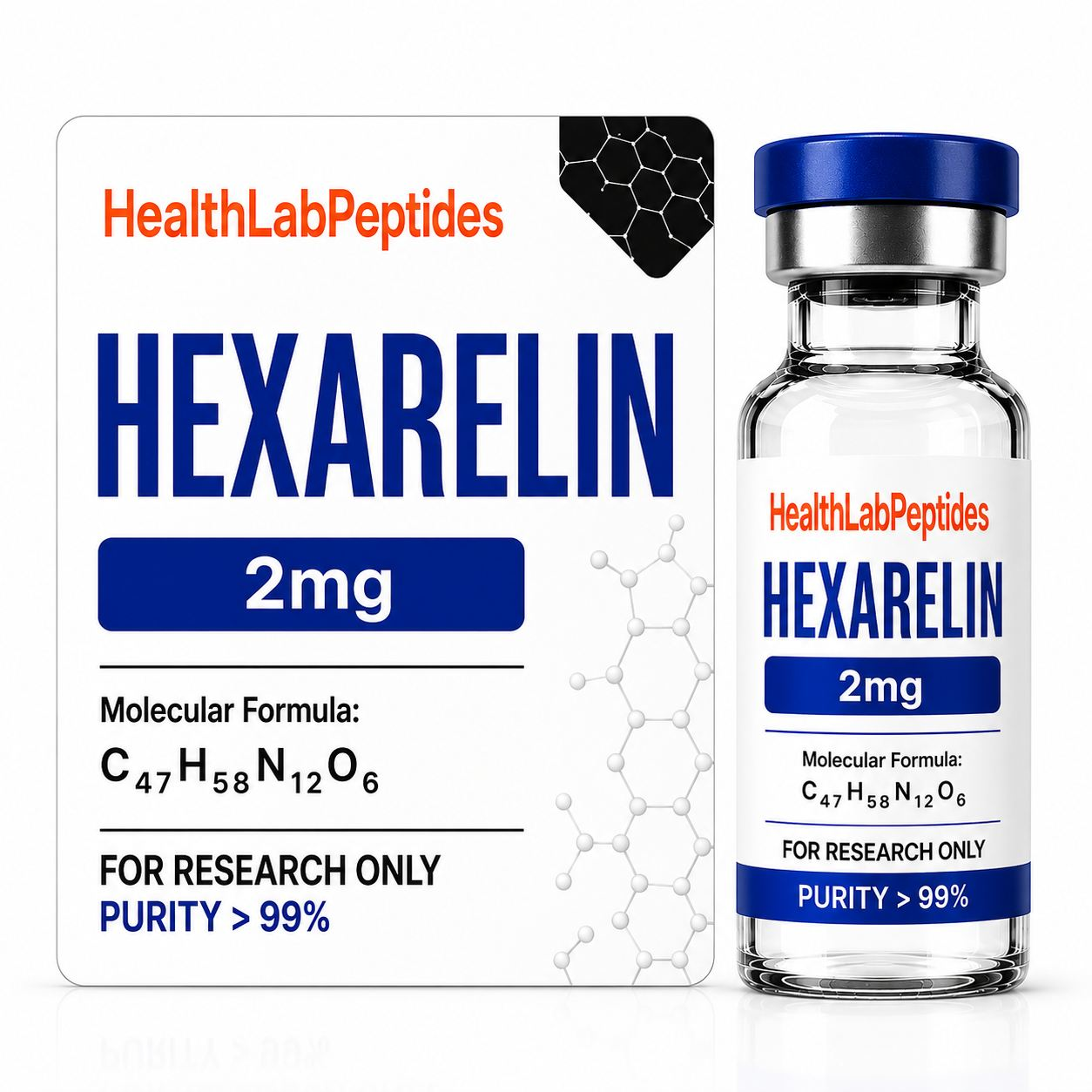
HealthLab lists Hexarelin 2 mg laboratory research material. The product keyword and labeled quantity identify an item in a research catalog; they do not describe an experimental or consumer regimen. A Certificate of Analysis documents only the measurements recorded for a particular batch. It does not establish suitability for administration, FDA approval, or equivalence to a medicinal formulation mentioned in the literature. Scientific findings from a publication apply to its specific material and experimental system, not automatically to another supplier’s lot.
What can and cannot be concluded
The strongest defensible statement is the specific observation from the study’s model. A molecular interaction can inform a pathway hypothesis while leaving questions about target specificity, assay interference, and organism-level biology unresolved. Even if an author discusses possible medical relevance, that is not proof of an approved clinical use. A research-only supplier should avoid transforming measured markers into promises concerning health, mood, cognition, performance, muscle, body composition, or treatment. Negative evidence and scientific uncertainty remain part of the story.
Questions and source references
Readers can ask: was the exact molecule characterized; was the evidence generated in cells, animals, people, or a chemical system; what controls support the finding; and could another mechanism explain the response? Primary references: Biochemical Journal (2004), PMID 15176951; associated historical GHS-R studies. Those details help readers verify the original result and identify where additional research is needed. The article’s purpose is to make the underlying study interpretable and to avoid inferring a human or veterinary outcome from a laboratory observation.
Research Use Only
Research Use Only / Not for human or veterinary use. The content provides no dosing, administration, injection, reconstitution, treatment, or other personal-use advice. HealthLab research material is not represented as an FDA-approved medicine.


