

Research suggests: Glutathione reductase couples glutathione redox cycling to NADPH-consuming enzyme activity in defined biochemical and cellular systems. This article critically examines glutathione reductase research: measuring nadph consumption in cell compartments by distinguishing source evidence, model-dependent findings, and what the study did not establish. Begin with the corresponding HealthLab research overview for related chemical and biological context. All material is presented for lawful laboratory research education only.
Glutathione reductase is not glutaredoxin
Glutathione reductase participates in conversion of oxidized glutathione, GSSG, toward reduced glutathione, GSH, using NADPH. Glutaredoxin is a different enzyme family associated with certain protein-thiol reactions. The similar names can mislead readers into treating distinct reactions as one pathway. An article should identify the actual enzyme being measured and the substrate involved. This matters because a change in NADPH consumption is not necessarily a direct measurement of protein S-glutathionylation or a whole-cell antioxidant outcome.
Why NADPH is part of the reaction
NADPH is a reduced nicotinamide adenine dinucleotide phosphate cofactor. It contributes reducing equivalents to several enzymatic processes, including glutathione reductase. NADPH must not be conflated with NADH or with the oxidized species NAD+. A measurement of NADPH consumption can inform an enzyme-related rate, but it does not establish the concentration or oxidation status of every other cellular antioxidant. The specific cofactor, sample compartment, and analytical system must be reported before inferring a mechanism.
A 2024 compartment-specific measurement paper
Ting and colleagues published work in PLOS One in December 2024 on measuring NADPH consumption by glutathione reductase in cytosolic and mitochondrial contexts. Their methodological emphasis is important because a total-cell value can conceal distinct compartmental rates. A direct enzyme-related assay answers a narrower question than a broad measurement of oxidative stress. The paper’s observations belong to its controlled systems and cannot establish a clinical use for a commercial glutathione reagent.
Cytosolic and mitochondrial signals differ
Mitochondria and cytosol contain different metabolic reactions, protein compositions, and redox-regulation mechanisms. A signal from one compartment should not automatically be assigned to the other. A combined measurement may reflect the relative amounts of material from both, rather than a uniform response. This is a central challenge in interpreting glutathione research: chemical forms and cellular locations matter. The scientist should identify whether the method directly resolves compartments or merely estimates a whole-cell average.
A useful comparison appears in the linked HealthLab scientific analysis, which explores another aspect of the experimental literature. Findings from different preparations, cohorts, assays, or source publications must not be combined without qualification. A shared keyword does not establish equivalent methods, and differing outcomes may reflect separate scientific questions rather than a true contradiction. The original studies should be checked before a conclusion is repeated.
Consumption rate is not total concentration
An enzyme can consume a cofactor at a measurable rate while the total cofactor pool remains relatively steady because other reactions regenerate it. Conversely, a concentration measurement alone does not determine turnover. Rate and pool size are different properties of a metabolic system. When reading a glutathione reductase experiment, it is important to specify what changed: enzyme-associated NADPH consumption, glutathione form abundance, or another reporter. Describing all three as redox improvement would erase valuable scientific distinctions.
Assay specificity and alternative NADPH sinks
Cells contain many enzymes that use NADPH. A measured decrease in overall NADPH signal cannot automatically be attributed to glutathione reductase unless the method distinguishes relevant pathways. Appropriate controls and enzyme-specific evidence are crucial to causal interpretation. A method designed for one compartment also needs to establish that signals from other compartments are not driving the apparent result. This is why methodological papers often focus on specificity and validation as much as the magnitude of the reported response.
Why this literature cannot support a detox claim
The term detoxification is a broad consumer-health phrase rather than a specific measurement of glutathione reductase activity. A molecular assay in cells does not establish that a research-only glutathione product removes toxins from people, prevents disease, or improves health. The scientific value lies in understanding enzyme-linked redox chemistry and compartment-specific controls. The HealthLab product link identifies the chemical subject for lawful research and does not imply personal administration.
Research methodology and evidence quality
Important references include Ting et al., PLOS One (2024), PMID 39637235, DOI 10.1371/journal.pone.0309886; Oppong et al. (2023), PMID 37245422. The reader should examine the material used, comparison group, methodology, statistical treatment, and limits of the observation. A molecular signal is narrower than an organism-level outcome, and a clinical trial on a regulated formulation is different from chemical characterization of an RUO reagent. An isolated favorable result should be reported alongside any negative or uncertain findings. Reproducibility, independent evidence, and transparent controls determine the strength of the inference.
Why the experimental endpoint must be named
Scientific reports can measure transcript abundance, protein modification, receptor behavior, chemical identity, imaging results, or clinical endpoints. These measurements answer different questions, and one cannot substitute for another. Descriptions should state whether a result was directly observed or interpreted through a proposed mechanism. The subject’s commercial relevance is not evidence of biological efficacy. Where a direct causal chain is incomplete, the article should explain the uncertainty rather than imply that the most attractive interpretation is proven.
Related HealthLab research product and keywords
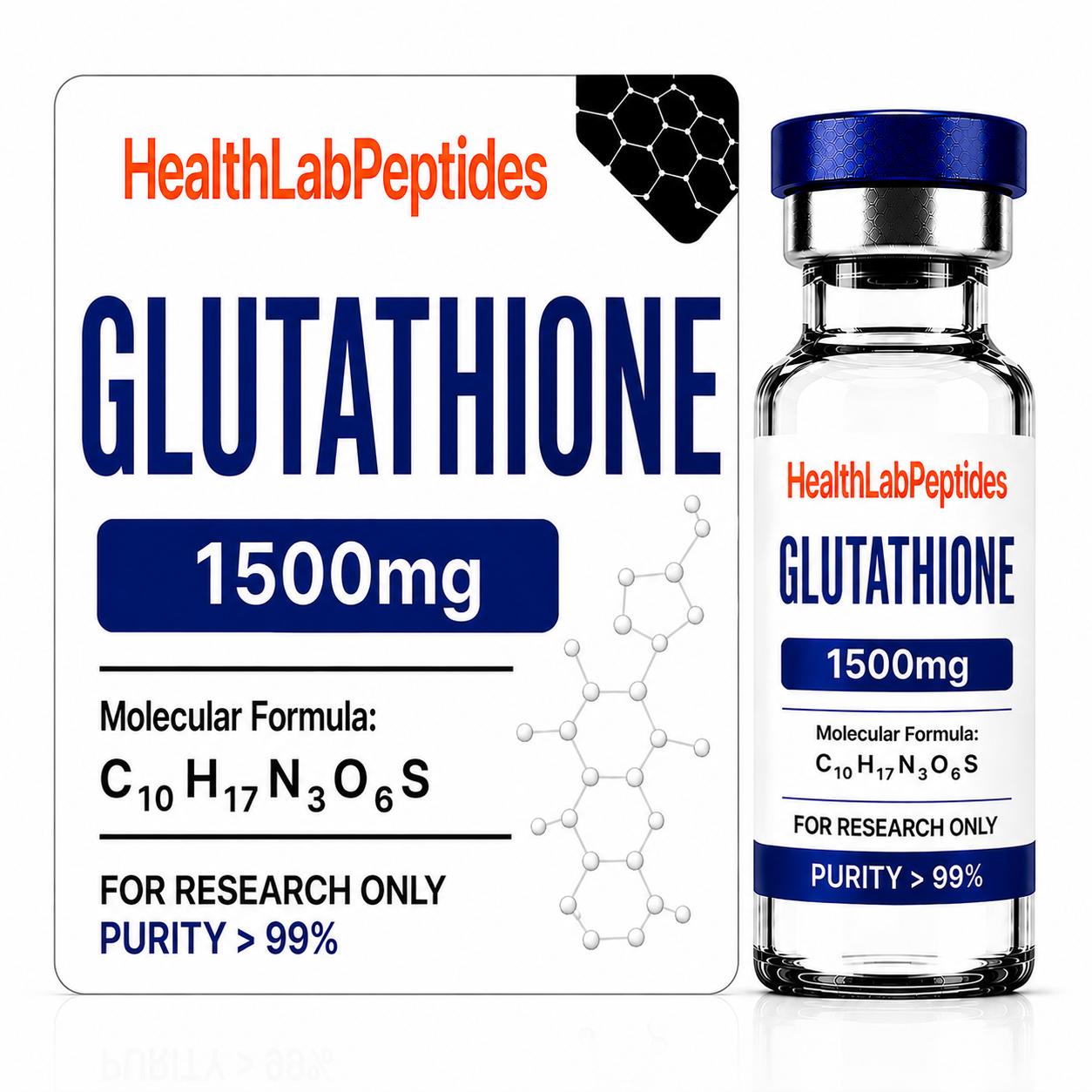
The Glutathione 1500 mg research material listing corresponds to the laboratory compound discussed here. It identifies a catalog item and label quantity only, not a use regimen. Batch documentation such as a Certificate of Analysis can substantiate specified analytic characteristics to the extent tested, but cannot transfer clinical evidence from another preparation or establish FDA approval. Product keywords appear naturally to help readers locate the relevant molecular research while preserving the separation between scientific reporting and consumer-use claims.
What remains unestablished
The cited work does not demonstrate that any separately marketed HealthLab vial is safe for personal use or produces a predictable health, performance, cosmetic, or treatment effect. Cell and animal findings are model specific, and even regulated human studies are population- and product-specific. Scientific articles can responsibly discuss an investigational program while reporting adverse events and null results. A useful review identifies what further replication, characterization, or controlled investigation would be needed rather than asserting that outstanding questions have already been answered.
Reader questions and references
The key questions are whether the original study used the exact material being discussed, what model generated the evidence, what controls were included, and whether the outcome matched the article’s claim. Sources: Ting et al., PLOS One (2024), PMID 39637235, DOI 10.1371/journal.pone.0309886; Oppong et al. (2023), PMID 37245422. The conclusion should remain proportional to that evidence. This research-only resource reports what investigators observed and where the limits lie, without providing administration instructions or making promises for the independent catalog product.
Research Use Only
Research Use Only / Not for human or veterinary use. No dosing, reconstitution, injection, treatment, administration, or other consumer-use instructions are included. HealthLab products are not represented as FDA-approved medicines.


