
Pinealon Peptide: Research, Mechanisms, Laboratory Applications, and Current Scientific Interest
Table of Contents
- What Is Pinealon?
- The Discovery of Pinealon
- Why Scientists Continue Studying Pinealon
- Understanding Short Regulatory Peptides
- Pinealon and Gene Expression Research
- Pinealon in Experimental Neuroscience
- Cellular Communication and Signal Regulation
- Comparing Pinealon with Other Research Peptides
- Related Peptides Frequently Studied Together
- Choosing Quality Research Peptides
- Frequently Asked Questions
- Conclusion
What Is Pinealon?
Research suggests that short-chain peptides continue to become increasingly important tools in molecular biology, neuroscience, and cellular physiology. While larger proteins often receive much of the attention, scientists have discovered that even very small peptides can influence complex biological signaling pathways inside cells.
One peptide that has steadily gained attention in laboratory settings is Pinealon.
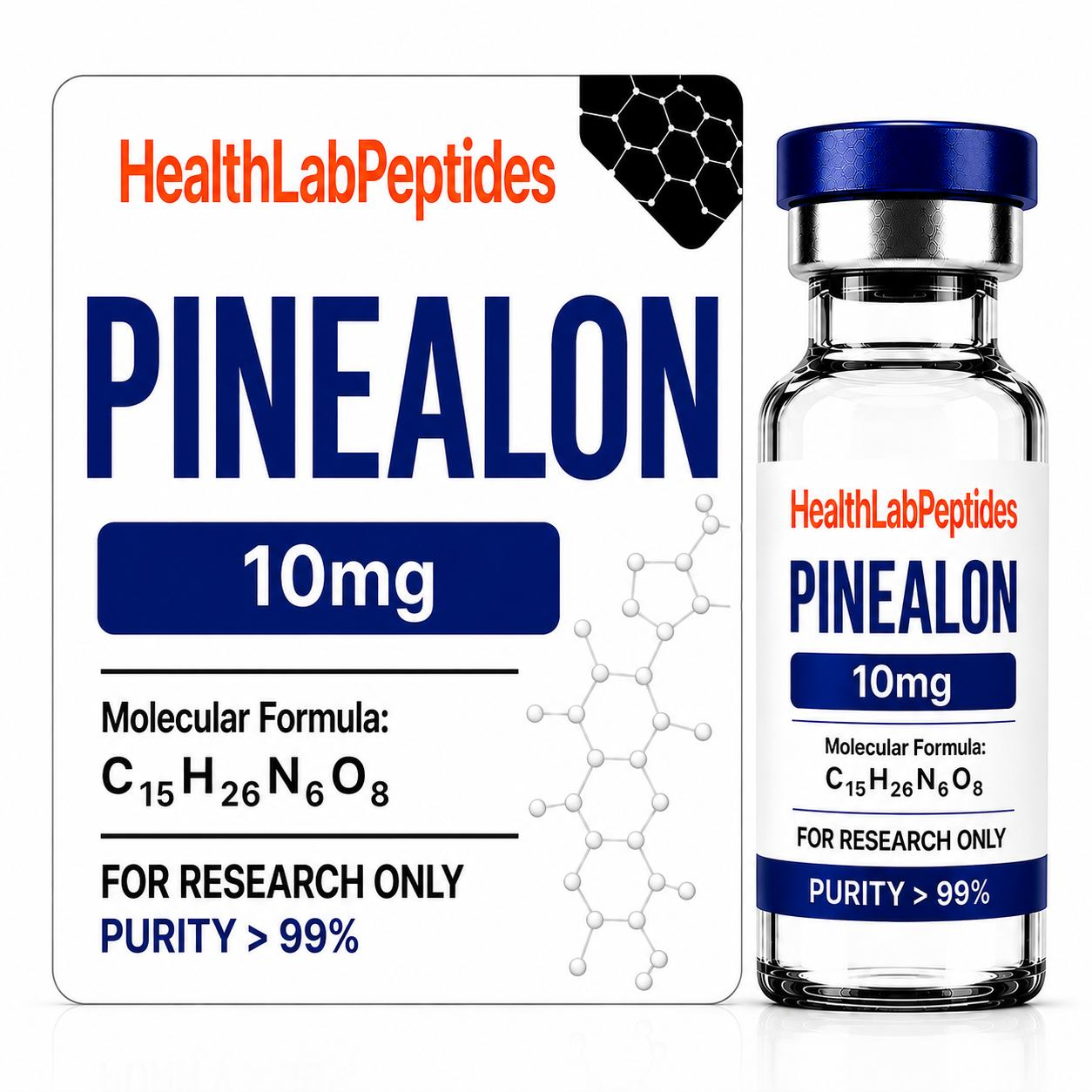
Pinealon is a synthetic tripeptide originally developed to investigate cellular regulation within nervous system tissues. Although considerably smaller than many other research peptides, Pinealon continues to appear in experimental studies examining neuronal biology, gene expression, and cellular adaptation.
Unlike peptides primarily investigated for metabolic signaling or mitochondrial function, Pinealon has become closely associated with laboratory research involving cellular communication inside the nervous system.
As research technologies improve, scientists continue uncovering new information regarding how regulatory peptides participate in biological signaling networks.
The Discovery of Pinealon
Pinealon was developed during investigations into naturally occurring peptide regulators found throughout the body.
Researchers have long recognized that extremely small peptides can function as biological messengers, helping coordinate communication between cells without requiring large protein molecules.
These discoveries helped establish an entirely new field often referred to as peptide bioregulation.
Instead of acting as structural proteins, regulatory peptides participate in signaling pathways that influence normal cellular activity.
Pinealon became one of several synthetic peptides developed to better understand these mechanisms under controlled laboratory conditions.
Although research remains ongoing, interest has steadily increased as modern laboratory technologies provide more detailed insight into peptide-mediated cellular regulation.
Why Scientists Continue Studying Pinealon
Today’s biological research extends far beyond identifying individual molecules.
Scientists now seek to understand how thousands of proteins, peptides, receptors, enzymes, and signaling molecules function together inside living cells.
Rather than asking whether one peptide performs one specific task, investigators now examine entire signaling networks.
Pinealon has become part of this broader research effort because laboratories continue investigating its interaction with processes involving:
- Cellular communication
- Gene regulation
- Neuronal signaling
- Protein synthesis
- Cellular adaptation
- Molecular regulation
- Healthy aging research
- Oxidative stress biology
- Nervous system physiology
Each new laboratory study helps researchers better understand how peptide signaling contributes to complex biological systems.
Understanding Short Regulatory Peptides
Many research peptides contain dozens of amino acids.
Pinealon is different.
Its compact three-amino-acid structure makes it an excellent model for studying how very small signaling molecules may influence cellular function.
Researchers continue exploring whether regulatory peptides such as Pinealon affect biological communication through interactions with DNA, RNA, proteins, and intracellular signaling pathways.
Although many mechanisms remain under investigation, short peptides have become increasingly valuable research tools because they allow scientists to isolate specific molecular interactions.
Pinealon and Gene Expression Research
One of the most exciting developments in molecular biology involves measuring changes in gene expression.
Every cell contains thousands of genes that can be activated or suppressed depending on environmental conditions and biological signals.
Scientists continue investigating whether Pinealon influences these regulatory systems.
Modern laboratories can measure these changes using technologies including:
- RNA sequencing
- Transcriptomics
- Gene expression profiling
- DNA microarrays
- Proteomics
- Artificial intelligence-assisted biological analysis
These tools provide researchers with enormous amounts of information regarding how cells respond during laboratory experiments.
Understanding these molecular responses represents one of today’s fastest-growing areas of peptide research.
Pinealon in Experimental Neuroscience
Much of the scientific interest surrounding Pinealon originates from neuroscience.
The nervous system depends on highly coordinated communication between billions of neurons.
Researchers continue examining how peptide signaling contributes to maintaining this communication within laboratory models.
Experimental studies frequently investigate:
- Neuronal communication
- Synaptic signaling
- Cellular maintenance
- Molecular adaptation
- Protein regulation
- Gene transcription
- Experimental aging models
As neuroscience continues advancing, peptides like Pinealon remain valuable tools for exploring fundamental questions about cellular organization.
Cellular Communication Is More Complex Than Previously Believed
One of the biggest discoveries in biology over the past twenty years is that cells communicate through incredibly sophisticated signaling networks.
A single biological event may involve hundreds of signaling molecules interacting simultaneously.
Researchers therefore rarely study only one pathway anymore.
Instead, they investigate how multiple systems work together.
This broader perspective explains why laboratories often compare Pinealon with several other research peptides that target different biological processes.
Pinealon Compared with Other Research Peptides
Every peptide possesses unique characteristics.
Rather than replacing one another, many peptides complement different areas of laboratory investigation.
For example, researchers interested in neuronal biology frequently compare Pinealon with Semax, another research peptide widely investigated for neuroscience-related laboratory studies.
Learn more about Semax here:
Similarly, Selank remains another important peptide within experimental neurobiology because researchers continue studying its interaction with peptide signaling pathways.
Scientists also investigate DSIP (Delta Sleep-Inducing Peptide) when examining laboratory models involving neurological signaling and biological rhythms.
Although these peptides are studied for different reasons, they often appear together within neuroscience research discussions because each contributes unique information about cellular communication.
Research Extends Beyond the Nervous System
Modern peptide science is highly interdisciplinary.
Scientists investigating Pinealon frequently expand their research into additional biological systems.
For example, mitochondrial biology has become one of the fastest-growing areas of peptide research.
Laboratories studying cellular energy regulation often investigate MOTS-c, a mitochondrial-derived peptide associated with cellular metabolism and mitochondrial communication.
Another peptide attracting attention in mitochondrial research is SS-31, which continues to appear in laboratory studies involving mitochondrial signaling and cellular energy systems.
Meanwhile, researchers examining extracellular matrix biology frequently investigate GHK-Cu, a naturally occurring copper-binding peptide associated with gene expression and cellular communication.
Together, these peptides illustrate the remarkable diversity of modern peptide research.
Tissue Biology Continues to Expand
Researchers interested in tissue biology often compare Pinealon findings with investigations involving BPC-157 and TB-500.
These peptides remain among the most widely studied compounds in laboratory research because of their interaction with cellular signaling, biological organization, and tissue remodeling pathways.
Learn more about BPC-157:
Explore TB-500:
Scientists may also investigate combination formulations such as KLOW 80, which combines BPC-157, TB-500, GHK-Cu, and KPV into a single research product for laboratory investigation.
These multi-peptide formulations reflect a growing trend toward studying interconnected biological signaling rather than isolated molecular pathways.
Part 2
Pinealon Peptide: Research, Mechanisms, Laboratory Applications, and Current Scientific Interest (Part 2)
Modern Peptide Research Is Becoming More Integrated
Only a few years ago, peptide studies often focused on one compound at a time. Today, advances in molecular biology have changed that approach. Researchers now recognize that biological systems function through thousands of interconnected signaling pathways rather than isolated molecular events.
As a result, many laboratories investigate groups of peptides that represent different areas of cellular biology.
For example, investigators studying neuronal signaling with Pinealon may also include mitochondrial peptides, growth hormone-releasing peptides, or tissue signaling peptides to better understand how separate biological systems interact under controlled laboratory conditions.
This systems-based approach has become one of the defining characteristics of modern peptide research.
Growth Hormone Research Peptides
Another major branch of peptide science focuses on growth hormone signaling.
Researchers frequently investigate CJC-1295 because of its interaction with growth hormone-releasing hormone (GHRH) pathways in laboratory models.
Explore CJC-1295:
Many experiments also include Ipamorelin, a peptide commonly studied alongside CJC-1295 to examine growth hormone signaling under experimental conditions.
Learn more about Ipamorelin:
Another well-known research peptide is Tesamorelin, which continues to appear in laboratory investigations involving GHRH receptor activity and endocrine signaling.
Although these peptides are studied for different mechanisms than Pinealon, together they illustrate the remarkable diversity of peptide science.
IGF Research Continues to Expand
Growth factor biology remains another active area of laboratory investigation.
Scientists frequently examine IGF-1 LR3 when researching downstream signaling pathways associated with insulin-like growth factors.
Because IGF signaling influences numerous biological processes, many laboratories include IGF-1 LR3 in broader molecular biology investigations.
Explore IGF-1 LR3:
Understanding how these signaling pathways interact remains an important objective for researchers working across multiple scientific disciplines.
Metabolic Research Peptides
Metabolic biology has rapidly become one of the fastest-growing areas within peptide science.
Researchers continue studying peptides such as Retatrutide and Tirzepatide to better understand receptor signaling involved in metabolic regulation.
Learn more about Retatrutide:
Explore Tirzepatide research:
Although these peptides differ significantly from Pinealon in both structure and biological targets, they demonstrate how broad the field of peptide research has become.
Today’s peptide investigations span neuroscience, endocrinology, metabolism, mitochondrial biology, immunology, and molecular genetics.
Advances in Laboratory Technology
The rapid growth of peptide research has been driven by extraordinary improvements in laboratory technology.
Scientists now have access to tools capable of analyzing biological systems with remarkable precision.
Common research technologies include:
- RNA sequencing
- Transcriptomics
- Proteomics
- Metabolomics
- High-resolution microscopy
- Mass spectrometry
- Bioinformatics
- Artificial intelligence-assisted data analysis
These methods allow investigators to observe subtle molecular changes that would have been impossible to detect only a decade ago.
As technology continues advancing, researchers expect to gain even greater insight into how regulatory peptides influence cellular communication.
Why Research Quality Matters
Regardless of the peptide under investigation, successful laboratory studies depend upon reliable research materials.
Experienced investigators generally prioritize products that provide:
- High analytical purity
- Third-party laboratory testing
- Batch consistency
- Proper cold-chain handling
- Secure packaging
- Transparent documentation
Consistency helps reduce unnecessary experimental variation while improving reproducibility between independent laboratories.
High-quality research materials remain one of the foundations of meaningful scientific investigation.
Frequently Asked Questions
What is Pinealon?
Pinealon is a synthetic tripeptide investigated in laboratory research involving neuroscience, cellular communication, gene expression, and molecular regulation.
Is Pinealon naturally occurring?
Pinealon is a synthetic peptide developed for scientific investigation. It was designed to study biological signaling mechanisms associated with nervous system tissues and cellular regulation.
Why are researchers interested in Pinealon?
Scientists continue investigating Pinealon because of its potential interaction with gene regulation, neuronal communication, protein synthesis, and cellular signaling pathways.
What other peptides are commonly studied alongside Pinealon?
Researchers frequently investigate Pinealon together with other laboratory peptides, including:
- Semax
- Selank
- DSIP
- MOTS-c
- SS-31
- GHK-Cu
- BPC-157
- TB-500
- KLOW 80
- CJC-1295
- Ipamorelin
- Tesamorelin
- IGF-1 LR3
- Retatrutide
- Tirzepatide
Each peptide contributes to a different area of biological research.
Is Pinealon approved as a medication?
Pinealon sold by HealthLabPeptides.com is intended exclusively for Research Use Only (RUO) and is not approved for human or veterinary use.
Final Thoughts
Pinealon represents one of the many exciting developments within modern peptide research. Although it receives less public attention than some larger peptide families, its continued appearance in laboratory studies reflects growing scientific interest in small regulatory peptides and their influence on cellular communication.
As researchers continue investigating neuroscience, gene regulation, mitochondrial biology, and molecular signaling, Pinealon is expected to remain a valuable research tool for understanding how cells coordinate complex biological processes.
The broader field of peptide science continues to expand at an impressive pace. Whether laboratories are studying Pinealon, Semax, Selank, MOTS-c, SS-31, GHK-Cu, BPC-157, TB-500, KLOW 80, CJC-1295, Ipamorelin, Tesamorelin, IGF-1 LR3, Retatrutide, or Tirzepatide, every carefully designed experiment contributes to a deeper understanding of molecular biology.
At HealthLabPeptides.com, we are committed to supplying high-quality research peptides for qualified laboratories and researchers seeking dependable materials for scientific investigation.
HealthLabPeptides.com Research Use Only (RUO) Disclaimer
All products available from HealthLabPeptides.com are sold strictly for Research Use Only (RUO). They are not intended for human consumption, veterinary use, therapeutic use, or diagnostic purposes. These products have not been evaluated by the U.S. Food and Drug Administration (FDA) and are not intended to diagnose, treat, cure, or prevent any disease. HealthLabPeptides.com makes no medical or therapeutic claims regarding any product or information presented. Content on this website is provided solely for educational and scientific discussion. Purchasers are responsible for ensuring compliance with all applicable federal, state, and local laws governing the purchase, handling, and use of research materials.…