

Research suggests: GHK is a copper-binding tripeptide, while GHK-Cu specifies a copper-associated form that is not identical to copper-free GHK. This article critically examines ghk-cu versus copper-free ghk: keratinocyte integrin research and chemical identity by distinguishing source evidence, model-dependent findings, and what the study did not establish. Begin with the corresponding HealthLab research overview for related chemical and biological context. All material is presented for lawful laboratory research education only.
The metal complex and peptide alone are different reagents
A copper-associated GHK sample may contain metal-coordination species that are absent from the copper-free tripeptide. Experiments comparing the forms should therefore address metal content and competing ligands as part of chemical identity. A claim that the tripeptide itself produced a particular result should not be transferred uncritically to the complex, or the other way around. This is especially important in cell-culture research because medium components can influence copper availability. Product keywords should describe which form the laboratory actually investigated.
The 2012 keratinocyte study used copper-free GHK
A 2012 Peptide Science report, PMID 23019153, examined copper-free GHK in cultured normal human keratinocytes and skin-equivalent models. The investigators measured selected cell and tissue-associated characteristics, including expression of integrin-related markers. This study is useful precisely because it evaluated the free peptide rather than simply assuming that the copper complex accounts for every GHK-associated observation. It does not establish clinical cosmetic effectiveness or human-use suitability of an independently marketed GHK-Cu reagent.
Keratinocytes are not fibroblasts
Keratinocytes are major epithelial cells in the epidermis, whereas fibroblasts are associated with other tissue compartments and matrix-related functions. A collagen-synthesis measurement in fibroblast culture is therefore not the same endpoint as an integrin observation in keratinocytes. The 1988 GHK-Cu fibroblast study and the 2012 copper-free GHK keratinocyte study complement one another but cannot be merged into a single universal biological effect. Their cells, materials, and assays differ in important ways.
Alpha-6 and beta-1 integrin measurements
The 2012 paper reported changes in alpha-6 and beta-1 integrin-related staining and expression in selected models. Integrins are involved in cell–matrix and cell–cell-associated interactions. An increase in a marker does not prove that the entire tissue has become stronger or younger. The specific assay may involve immunofluorescence, protein analysis, or a morphological observation, each of which provides different information. Researchers should describe those readouts rather than replace them with claims about appearance or healing.
A useful comparison appears in the linked HealthLab scientific analysis, which explores another aspect of the experimental literature. Findings from different preparations, cohorts, assays, or source publications must not be combined without qualification. A shared keyword does not establish equivalent methods, and differing outcomes may reflect separate scientific questions rather than a true contradiction. The original studies should be checked before a conclusion is repeated.
What p63 and PCNA indicate
The study also discussed p63 and proliferating cell nuclear antigen, or PCNA, as cell-associated markers. These can be informative in studies of basal-cell identity and proliferation, but their abundance is not a direct measure of a complete tissue outcome. A positive marker in a culture model cannot establish clinical benefit, and the observation is conditioned by the model and sampling time. A scientifically useful review states what the markers were used to investigate and acknowledges the missing downstream evidence.
The limitations of skin-equivalent models
A skin-equivalent preparation can organize cells into a more structured setting than a simple monolayer, but it remains an experimental model. It lacks aspects of intact skin physiology and cannot reproduce every feature of a regulated human study. Differences among monolayer cells, ex-vivo models, and intact tissue are important when comparing results. The 2012 paper offers mechanistic observations that require additional validation before any broader conclusion. Its findings do not justify using a research vial cosmetically or medically.
Why a product called GHK-Cu should not inherit every GHK result
The catalog name GHK-Cu specifies a copper-associated material. The 2012 study explicitly investigated the copper-free peptide, so its results must be attributed to that substance. Research on the complex may suggest related biological questions, but does not make the samples identical. The article therefore links the relevant HealthLab product for research navigation while stating this chemical distinction rather than using the study as an unsupported claim for that product.
Research methodology and evidence quality
Important references include Peptide Science (2012), PMID 23019153, DOI 10.1002/psc.2455; Maquart et al., FEBS Letters (1988), PMID 3169264. The reader should examine the material used, comparison group, methodology, statistical treatment, and limits of the observation. A molecular signal is narrower than an organism-level outcome, and a clinical trial on a regulated formulation is different from chemical characterization of an RUO reagent. An isolated favorable result should be reported alongside any negative or uncertain findings. Reproducibility, independent evidence, and transparent controls determine the strength of the inference.
Why the experimental endpoint must be named
Scientific reports can measure transcript abundance, protein modification, receptor behavior, chemical identity, imaging results, or clinical endpoints. These measurements answer different questions, and one cannot substitute for another. Descriptions should state whether a result was directly observed or interpreted through a proposed mechanism. The subject’s commercial relevance is not evidence of biological efficacy. Where a direct causal chain is incomplete, the article should explain the uncertainty rather than imply that the most attractive interpretation is proven.
Related HealthLab research product and keywords
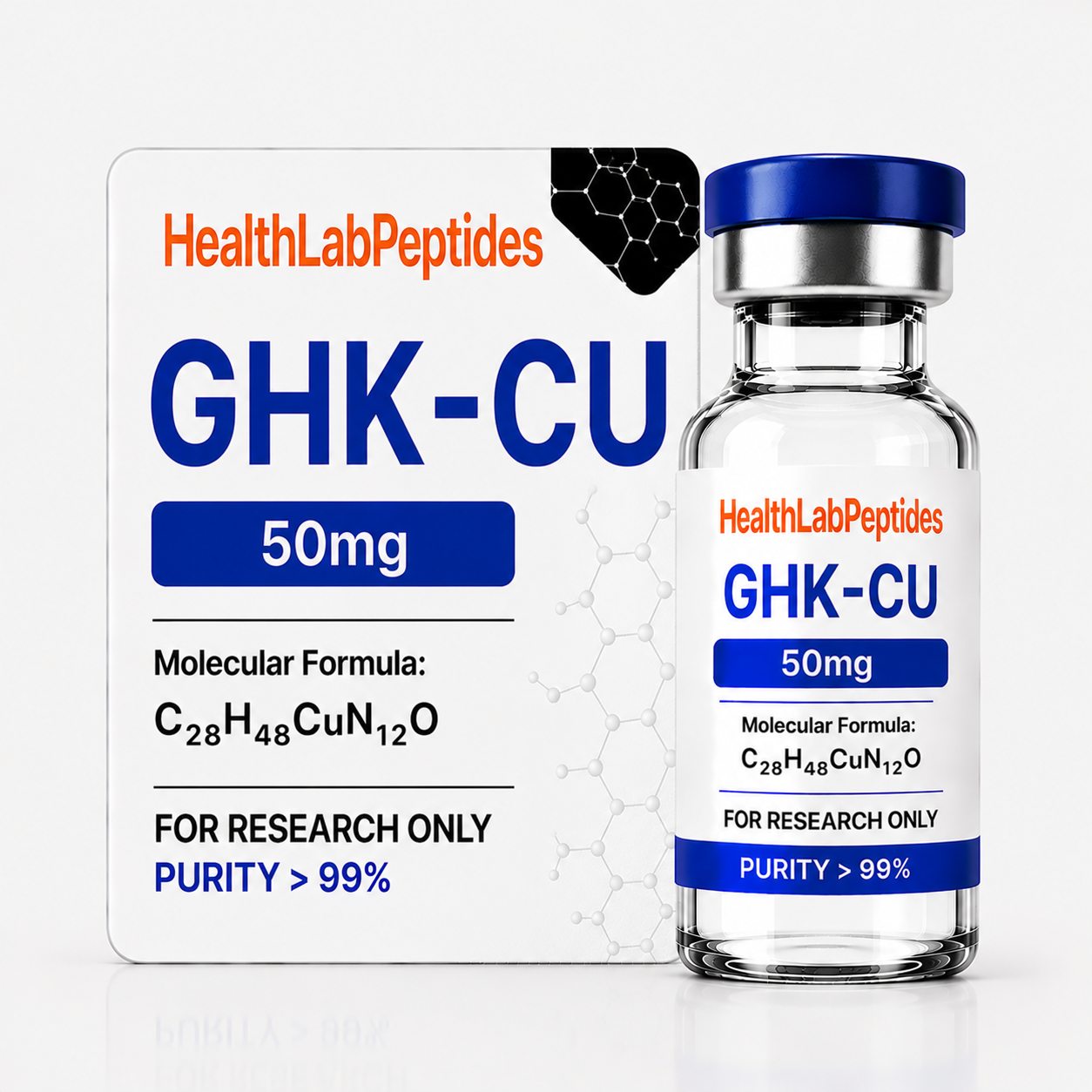
The GHK-Cu 50 mg research material listing corresponds to the laboratory compound discussed here. It identifies a catalog item and label quantity only, not a use regimen. Batch documentation such as a Certificate of Analysis can substantiate specified analytic characteristics to the extent tested, but cannot transfer clinical evidence from another preparation or establish FDA approval. Product keywords appear naturally to help readers locate the relevant molecular research while preserving the separation between scientific reporting and consumer-use claims.
What remains unestablished
The cited work does not demonstrate that any separately marketed HealthLab vial is safe for personal use or produces a predictable health, performance, cosmetic, or treatment effect. Cell and animal findings are model specific, and even regulated human studies are population- and product-specific. Scientific articles can responsibly discuss an investigational program while reporting adverse events and null results. A useful review identifies what further replication, characterization, or controlled investigation would be needed rather than asserting that outstanding questions have already been answered.
Reader questions and references
The key questions are whether the original study used the exact material being discussed, what model generated the evidence, what controls were included, and whether the outcome matched the article’s claim. Sources: Peptide Science (2012), PMID 23019153, DOI 10.1002/psc.2455; Maquart et al., FEBS Letters (1988), PMID 3169264. The conclusion should remain proportional to that evidence. This research-only resource reports what investigators observed and where the limits lie, without providing administration instructions or making promises for the independent catalog product.
Research Use Only
Research Use Only / Not for human or veterinary use. No dosing, reconstitution, injection, treatment, administration, or other consumer-use instructions are included. HealthLab products are not represented as FDA-approved medicines.


