

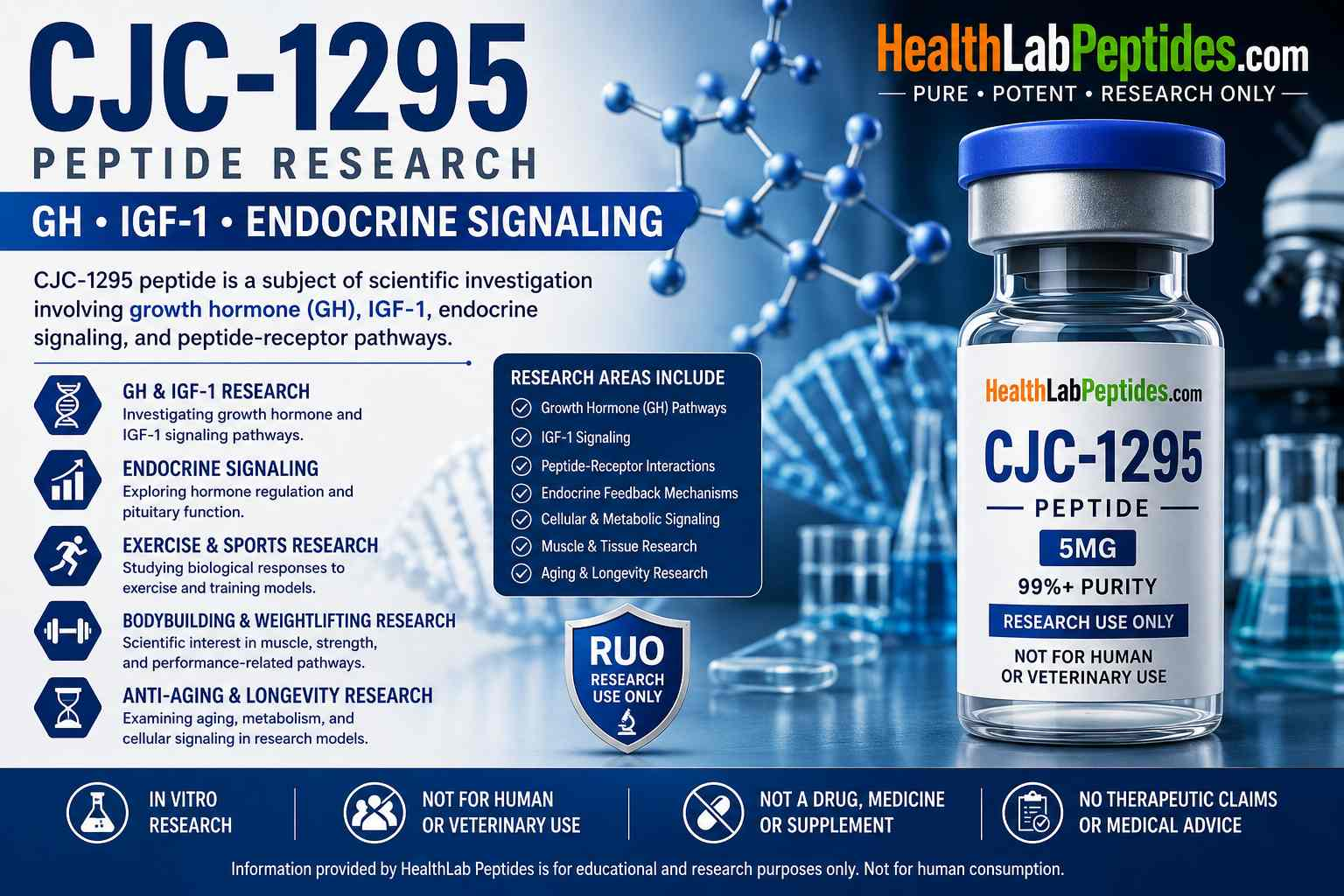
Research suggests that CJC-1295 peptide is an important subject of laboratory investigation involving growth hormone-releasing hormone (GHRH) pathways, growth hormone (GH) signaling, IGF-1 research, endocrine signaling, and peptide-receptor biology. Researchers studying these pathways use controlled experimental models to better understand how GHRH-related signaling influences downstream biological processes.
Scientific interest in CJC-1295 also overlaps with subjects commonly searched as bodybuilding research, weightlifting research, exercise research, muscle research, anti-aging research, longevity research, and sports-performance research. These terms describe areas of scientific investigation and published literature. They do not represent intended uses or claimed benefits of CJC-1295 peptide products offered by HealthLab Peptides.
What Is CJC-1295 Peptide?
CJC-1295 is a synthetic peptide analog related to GHRH. GHRH is involved in signaling associated with the release of growth hormone from the pituitary gland.
Because of this relationship, CJC-1295 has been investigated as a research compound for examining GH and IGF-1 signaling and related endocrine mechanisms.
Researchers may encounter different CJC-related compounds and naming conventions in scientific literature. This distinction matters because molecular modifications can affect experimental characteristics, and findings involving one form should not automatically be assumed to apply to another.
FDA has also noted concerns about inconsistent CJC-1295 naming conventions and limitations in publicly available characterization information for certain forms of the compound. (U.S. Food and Drug Administration)
CJC-1295 and Growth Hormone Research
One of the primary scientific subjects associated with CJC-1295 is growth hormone research.
Growth hormone participates in a complex endocrine signaling network. Laboratory investigation of this network can involve receptor signaling, pituitary function, feedback mechanisms, downstream biomarkers, and interactions between GH and IGF-1 pathways.
A randomized, placebo-controlled human study published in The Journal of Clinical Endocrinology & Metabolism investigated the pharmacokinetic and pharmacodynamic characteristics of CJC-1295 in healthy adults. Researchers reported sustained changes in measured GH and IGF-1 concentrations under the experimental conditions of that study. (PubMed)
That study is part of the scientific record; however, its findings should not be interpreted as instructions for using CJC-1295 or as evidence supporting use of a research product sold by HealthLab Peptides.
CJC-1295 and IGF-1 Research
IGF-1 research is closely connected with scientific investigation of GH signaling.
Researchers may examine GH and IGF-1 as components of broader endocrine networks involving cellular communication, feedback mechanisms, metabolic signaling, and tissue biology.
The published CJC-1295 human study measured both GH and IGF-1 as experimental outcomes, illustrating why CJC-1295 frequently appears in scientific literature concerning the GH/IGF-1 axis. (PubMed)
HealthLab Peptides does not represent CJC-1295 peptide as a means of increasing GH, increasing IGF-1, altering hormones, or producing physiological changes in people.
CJC-1295 and Endocrine Signaling Research
Endocrine signaling involves communication between glands, hormones, receptors, tissues, and regulatory feedback systems.
CJC-1295 research can therefore provide scientists with an experimental subject for investigating aspects of:
- GHRH-related signaling
- GH-associated pathways
- IGF-1-associated pathways
- peptide-receptor interactions
- endocrine feedback mechanisms
- cellular signaling
- metabolic signaling
These represent research topics, not approved or intended applications of the CJC-1295 peptide offered by HealthLab Peptides.
CJC-1295, Bodybuilding and Weightlifting Research
CJC-1295 is frequently discussed online in connection with bodybuilding, weightlifting, muscle growth, athletic performance, and exercise.
Those associations require particularly careful distinction between scientific research and product marketing.
From a research perspective, scientists studying exercise physiology and skeletal-muscle biology may investigate GH/IGF-1 signaling, protein metabolism, cellular responses to mechanical stress, endocrine responses, and related biochemical pathways.
Consequently, phrases such as CJC-1295 bodybuilding research, CJC-1295 weightlifting research, muscle research, and exercise research can describe areas in which the underlying biological pathways are scientifically relevant.
They do not mean that CJC-1295 offered by HealthLab Peptides is intended for bodybuilding, weightlifting, muscle growth, athletic enhancement, exercise performance, or human consumption.
CJC-1295 is also identified by the World Anti-Doping Agency within its prohibited growth hormone-releasing factors category. (Wada-Ama)
Exercise and Sports Research
Exercise physiology encompasses numerous biological systems, including endocrine signaling, skeletal-muscle biology, energy metabolism, cellular stress responses, and adaptation.
Researchers studying these mechanisms may examine the GH/IGF-1 axis independently as part of controlled laboratory investigations.
CJC-1295 therefore appears in scientific discussions related to exercise research and sports research, but HealthLab Peptides does not provide protocols or recommendations for athletic, bodybuilding, weightlifting, exercise, or performance-enhancement use.
CJC-1295 and Anti-Aging Research
Another term frequently associated with growth hormone-related compounds online is anti-aging.
For scientific purposes, peptide anti-aging research can refer to investigation of biological processes associated with aging, cellular signaling, endocrine changes, metabolism, tissue biology, and age-associated molecular pathways.
The term anti-aging research on this page describes a field of scientific investigation only.
HealthLab Peptides does not claim that CJC-1295 slows, prevents, reverses, or treats aging, nor is CJC-1295 marketed as an anti-aging treatment or product for human use.
CJC-1295 and Longevity Research
Longevity research examines biological processes associated with aging and lifespan through laboratory, cellular, molecular, animal, and other experimental models.
Endocrine signaling and metabolic regulation are among the many biological systems researchers may examine within this broad scientific field.
References to CJC-1295 in longevity-related research discussions therefore concern experimental questions surrounding peptide and endocrine biology. They should not be interpreted as evidence that CJC-1295 extends lifespan or produces longevity benefits.
Understanding the Human CJC-1295 Research
Published research involving human participants is scientifically relevant when reviewing the history of CJC-1295.
However, describing a study is fundamentally different from recommending that its experimental procedures be reproduced.
For that reason, HealthLab Peptides does not provide the study’s administration amounts, injection instructions, dosing schedules, or protocols for human use.
Researchers interested in the original experimental methodology should consult the peer-reviewed publication directly. The study was conducted as randomized, placebo-controlled, double-blind trials in healthy adults and evaluated pharmacokinetic and pharmacodynamic endpoints. (PubMed)
Important Limitations and Safety Considerations
CJC-1295 should not be presented as though its safety or effectiveness for human use has been established.
FDA currently identifies potential safety concerns surrounding compounded drugs containing CJC-1295, including possible immunogenicity concerns and complexities involving peptide-related impurities and characterization. FDA also states that available clinical data are limited and identifies serious adverse events associated with CJC-1295, including increased heart rate and systemic vasodilatory reaction. (U.S. Food and Drug Administration)
These limitations reinforce why findings from experimental studies should be described as research findings rather than product benefits or instructions for use.
Research Findings Are Not Instructions for Use
Scientific publications may contain administration routes, experimental doses, schedules, procedures, or observations involving human participants because these details are necessary components of scientific reporting.
Discussion of such publications by HealthLab Peptides is provided for educational and research context only.
It does not constitute:
- dosage guidance;
- administration instructions;
- prescribing information;
- medical advice;
- bodybuilding or weightlifting protocols;
- exercise-performance guidance; or
- recommendations for human or veterinary use.
Researchers seeking experimental details should consult original peer-reviewed scientific literature and establish protocols appropriate to their own authorized research environments.
CJC-1295 Peptide for Laboratory Research
CJC-1295 remains a subject of scientific interest involving GHRH, growth hormone, IGF-1, endocrine signaling, peptide biology, metabolic signaling, exercise physiology, and related experimental pathways.
Researchers can explore additional research peptides and laboratory materials available through HealthLab Peptides when designing appropriately controlled scientific investigations.
Research materials should be used only within laboratory, analytical, and scientific settings consistent with their labeling and applicable requirements.
Research Use Only — In Vitro Research
CJC-1295 peptide offered by HealthLabPeptides.com is sold strictly for Research Use Only (RUO) and In Vitro Research purposes.
This product is intended solely for qualified laboratory, analytical, and scientific research applications, including in vitro laboratory investigation.
NOT FOR HUMAN OR VETERINARY USE OR CONSUMPTION.
HealthLab Peptides does not market CJC-1295 peptide as a drug, dietary supplement, anti-aging product, bodybuilding product, weightlifting product, exercise-performance product, muscle-growth product, therapeutic treatment, or as a product intended to diagnose, treat, cure, mitigate, or prevent any disease or medical condition.
References to growth hormone research, IGF-1 research, bodybuilding research, weightlifting research, exercise research, muscle research, sports research, anti-aging research, longevity research, or metabolic research describe subjects of scientific investigation only. They do not represent intended uses, instructions for use, or claims regarding CJC-1295 peptide products offered by HealthLab Peptides.
Information provided by HealthLab Peptides is for educational and research purposes only. It does not constitute medical advice, prescribing information, dosage guidance, administration instructions, or instructions for human use.
Purchasers are responsible for ensuring that research materials are handled and used in accordance with applicable laws, regulations, institutional requirements, and appropriate laboratory practices.
[…] coupling, thus improving ATP production. SS-31 was shown in several cellular and animal models to protect the kidney against ischemic injury by reducing death of tubular cells and by enhancing the proliferation of surviving tubular cells […]