
Research suggests that mitochondrial biology continues to attract significant scientific interest as laboratories investigate cellular energy production, metabolic signaling, oxidative processes, and communication between mitochondria and other cellular systems. In response to this expanding field, HealthLab Peptides is continuing to develop its research catalog and educational library around compounds associated with mitochondrial and cellular-energy research.
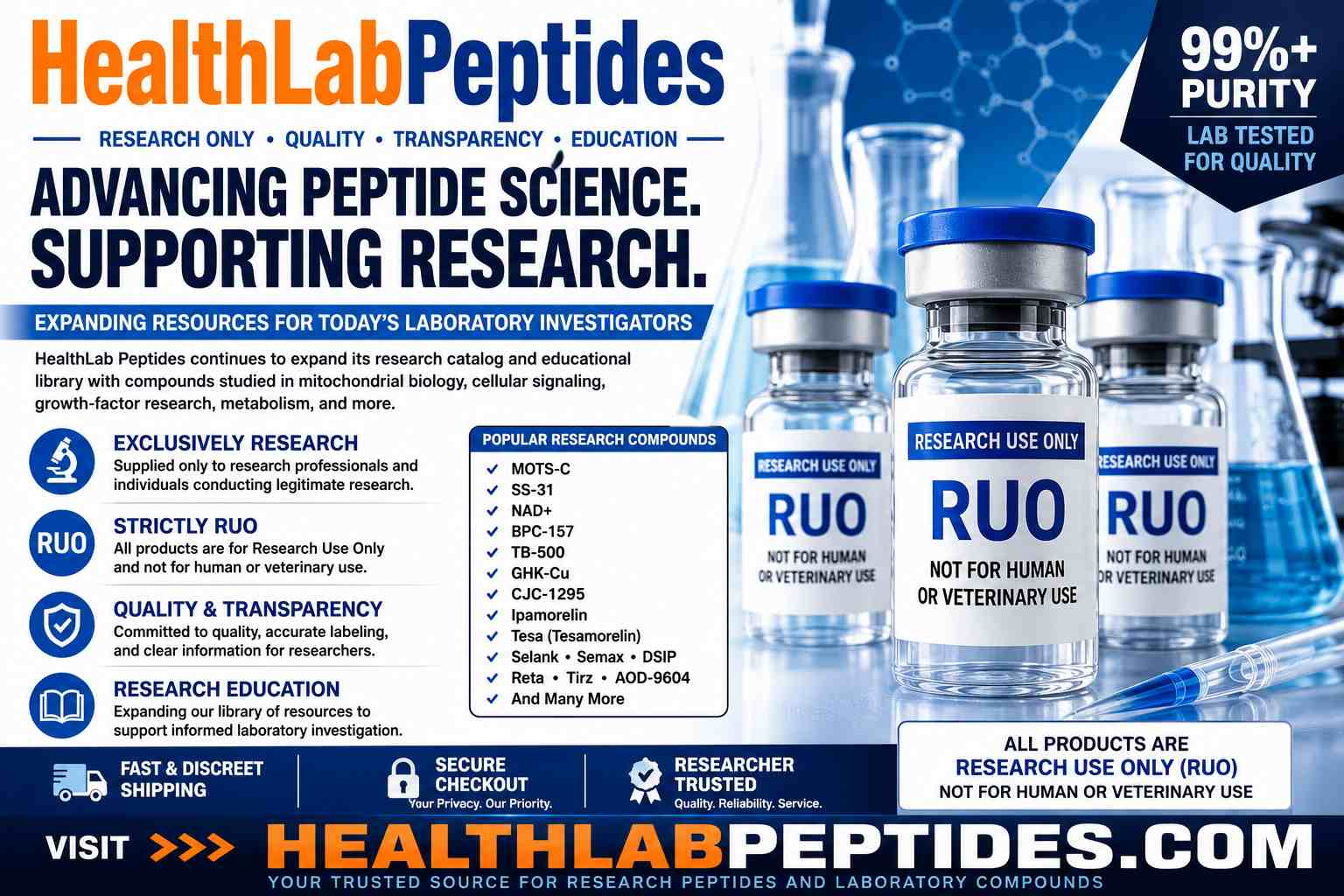
HealthLab Peptides supplies its products exclusively to research professionals and individuals conducting legitimate research. All products are sold strictly for RUO and are not for human or veterinary use.
Mitochondrial Biology Becomes an Important Research Category
Mitochondria are best known for their central role in cellular energy production, but modern research has revealed a considerably more complex biological system.
Scientists investigate mitochondria in relation to cellular signaling, metabolic regulation, oxidative processes, stress responses, cellular communication, and numerous other biological mechanisms.
These interconnected areas have made mitochondrial biology an increasingly important category within modern laboratory research.
HealthLab Peptides has responded by organizing more of its research compounds and educational material around mitochondrial and cellular-energy research, allowing researchers to move between individual compounds and the broader scientific pathways associated with them.
Growing Interest in Mitochondrial Research Compounds
Several compounds have become subjects of laboratory investigation because of their relationship to mitochondrial biology.
MOTS-C is one example. Researchers have investigated this mitochondrial-derived peptide in experimental models involving cellular metabolism and mitochondrial signaling.
SS-31 represents another area of mitochondrial research. Laboratory investigations have examined its interactions with mitochondrial membranes and processes associated with mitochondrial function.
NAD+ occupies a somewhat different position because it is not itself a peptide. Nevertheless, NAD+ is extensively studied because of its role as a coenzyme involved in cellular metabolism and numerous biochemical reactions.
Researchers interested in the broader HealthLab Peptides selection can explore the research peptide catalog, which includes compounds representing mitochondrial biology alongside many other laboratory research categories.
Connecting Cellular Energy With Broader Peptide Research
One objective of the expanding HealthLab Peptides research library is to show how seemingly separate scientific categories can intersect.
Mitochondrial biology provides a particularly good example.
Research involving cellular energy may overlap with investigations of metabolic signaling, cellular stress, molecular communication, peptide signaling, and other biological processes. As a result, researchers frequently examine several compounds or pathways when developing experimental models.
HealthLab Peptides is organizing its educational content so researchers can move from individual compound information toward broader scientific subjects instead of encountering each research product in isolation.
This approach is intended to create a more useful research environment as the amount of information available through HealthLabPeptides.com continues to grow.
NAD+ and Cellular-Energy Research
NAD+ has become an especially recognizable subject within cellular biology because of its fundamental involvement in cellular biochemical reactions.
Rather than functioning through one isolated pathway, NAD+ participates in numerous enzymatic processes and is therefore studied across multiple areas of molecular and cellular research.
This makes NAD+ relevant to researchers investigating cellular energy while also connecting it with broader questions involving metabolism and cellular regulation.
HealthLab Peptides’ educational library examines these relationships from a research perspective while maintaining a clear distinction between laboratory investigation and human use.
All research compounds supplied by the company remain strictly RUO.
MOTS-C and Mitochondrial-Derived Peptide Research
MOTS-C has attracted research attention partly because it belongs to an unusual category of peptides associated with mitochondrial genetics.
This has made the compound an interesting experimental subject for researchers studying communication between mitochondria and broader cellular systems.
Research involving mitochondrial-derived peptides also illustrates how peptide science continues to expand beyond traditional classifications.
Rather than studying peptides only as signaling molecules originating from familiar endocrine pathways, researchers can investigate molecules associated with mitochondrial biology and intracellular communication.
The expanding diversity of these research areas is one reason HealthLab Peptides continues developing specialized research categories rather than treating every compound as part of one general peptide collection.
SS-31 and Mitochondrial Membrane Research
SS-31 has also become a subject of experimental investigation involving mitochondrial biology.
Researchers have examined the compound in laboratory models involving mitochondrial membranes, cellular stress, and related molecular processes.
Although MOTS-C, SS-31, and NAD+ are distinct research compounds with different characteristics, placing information about them within a broader mitochondrial research category can help researchers understand how individual experimental subjects relate to larger areas of scientific investigation.
This category-based organization is becoming an increasingly important part of the HealthLab Peptides research library.
Expanding Beyond Mitochondrial Research
Mitochondrial biology represents only one portion of the research areas covered by HealthLab Peptides.
The company’s growing catalog includes compounds associated with cellular signaling, growth-factor research, peptide signaling, metabolic pathways, and other areas of molecular investigation.
Researchers interested in growth-factor biology, for example, can explore IGF-1 LR3 research information.
Other laboratory investigations involve compounds such as BPC-157, TB-500, GHK-Cu, CJC-1295, Ipamorelin, Tesa, Sermorelin, Selank, Semax, DSIP, KPV, AOD-9604, Tirz, Reta, and additional research materials.
By connecting these subjects through internal research categories and educational articles, HealthLab Peptides is working toward a scientific library that becomes more useful as additional content is published.
Research Information Alongside Research Materials
HealthLab Peptides is continuing to expand beyond the traditional structure of an online research-compound catalog.
Educational resources are being developed alongside the company’s product selection to provide researchers with background information about compounds, biological pathways, mechanisms under investigation, and developments within peptide science.
Researchers who want a broader introduction can begin with What Are Peptides? A Simple Research Overview.
The company has also developed resources examining the larger scientific history of the field, including Peptide Drug Discovery: A Summary of the Scientific Efforts and Achievements That Changed Modern Medicine.
Together, these resources are intended to create connections between individual research compounds and the larger scientific disciplines in which they are investigated.
Maintaining a Research-Only Standard
As public awareness of peptides and related compounds increases, HealthLab Peptides continues to emphasize the intended purpose of its products.
HealthLab Peptides supplies research compounds exclusively to research professionals and individuals conducting legitimate research.
Products are designated strictly for RUO. They are not for human consumption, self-administration, veterinary use, or therapeutic use.
Educational articles discussing scientific literature, mechanisms, experimental models, or biological pathways are likewise provided for research and informational purposes rather than as medical guidance.
Maintaining this distinction remains an important part of the company’s approach as both its catalog and educational library continue to expand.
Continued Expansion of the Research Library
HealthLab Peptides expects mitochondrial science to remain an important component of its expanding research-information library.
Future educational resources can examine individual mitochondrial research compounds as well as larger subjects involving cellular energy, mitochondrial signaling, metabolism, molecular communication, and related biological pathways.
The company also plans to continue connecting these resources with other areas of peptide and molecular research.
Company announcements, significant catalog developments, and updates to the scientific library will continue to appear through HealthLab Peptides News & Press Releases.
About HealthLab Peptides
HealthLab Peptides is an online supplier specializing in research peptides and related laboratory compounds. Through HealthLabPeptides.com, the company maintains a growing research catalog alongside educational resources covering peptide science, mitochondrial biology, cellular signaling, growth-factor research, metabolic pathways, and molecular mechanisms.
HealthLab Peptides supplies its products exclusively to research professionals and individuals conducting legitimate research. All products are strictly RUO and are not for human or veterinary use. Products and educational information are not intended to diagnose, treat, cure, or prevent any disease. HealthLab Peptides makes no medical or therapeutic claims, and its educational content does not constitute medical advice.