
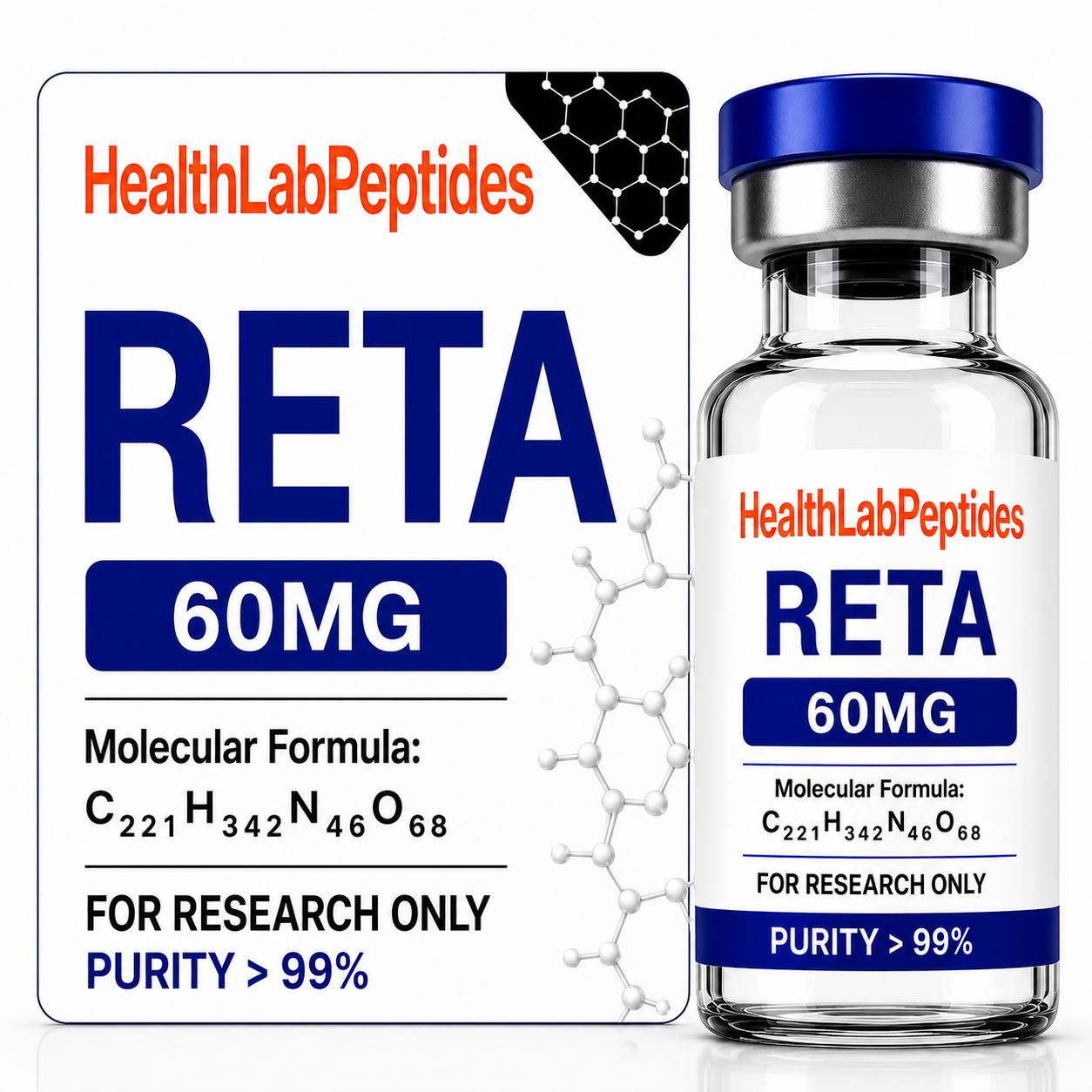
Research suggests Reta peptide research represents an important area of investigation involving multi-receptor signaling, peptide-receptor interactions, structural biology, intracellular signaling, and experimental metabolic pathways.
Reta, also known in scientific literature as retatrutide and LY3437943, has been characterized as a single peptide with agonist activity at three related receptors: the glucagon-like peptide-1 receptor (GLP-1R), glucose-dependent insulinotropic polypeptide receptor (GIPR), and glucagon receptor (GCGR).
Researchers interested in Reta can review the available research materials through the HealthLab Peptides research catalog.
The combination of three receptor targets within a single molecular structure makes Reta particularly interesting for studying receptor pharmacology, structural interactions, signaling selectivity, and the biological consequences of multi-receptor activation.
This article discusses Reta strictly from a scientific and laboratory perspective. Clinical literature is discussed only to provide context regarding the molecule’s research history and should not be interpreted as establishing an intended use for laboratory research material offered by HealthLab Peptides.
What Is Reta?
Reta is a synthetic peptide engineered to interact with three receptors belonging to the class B G protein-coupled receptor family:
- GLP-1 receptor
- GIP receptor
- Glucagon receptor
These receptors participate in complex biological signaling networks and have therefore become important subjects of molecular and pharmacological investigation.
Unlike a compound designed around a single receptor target, Reta provides researchers with an example of multi-receptor peptide engineering.
This allows researchers to investigate questions involving receptor selectivity, relative receptor potency, ligand structure, downstream signaling, and interactions among several signaling systems.
Triple-Receptor Agonism
One of the defining characteristics of Reta is its activity at GLP-1R, GIPR, and GCGR.
Each receptor represents a distinct signaling system.
GLP-1 Receptor
GLP-1R belongs to the class B family of G protein-coupled receptors.
Laboratory research involving GLP-1R may examine:
- Ligand-receptor binding
- Receptor activation
- G protein coupling
- Cyclic AMP signaling
- Receptor internalization
- Downstream intracellular pathways
- Structure-function relationships
GIP Receptor
GIPR is another class B G protein-coupled receptor involved in metabolic and endocrine signaling research.
Experimental investigation may examine:
- Ligand affinity
- Receptor activation
- Intracellular signaling
- Cyclic AMP-associated pathways
- Receptor selectivity
- Molecular structure
- Signal duration
Glucagon Receptor
GCGR represents the third major receptor involved in Reta research.
Studies of glucagon-receptor signaling may examine:
- Ligand recognition
- Receptor conformation
- G protein activation
- Cyclic AMP production
- Downstream signaling networks
- Cellular metabolic responses
Studying a peptide capable of interacting with all three receptors allows researchers to investigate how multi-receptor activity differs from single- or dual-receptor systems.
Structural Biology of Reta
Structural biology has provided increasingly detailed information about how peptide ligands interact with their receptors.
Modern techniques such as cryogenic electron microscopy can allow researchers to visualize receptor-ligand complexes at very high resolution.
Structural studies involving Reta have examined complexes containing:
- Reta and GLP-1R
- Reta and GIPR
- Reta and GCGR
- Associated G proteins
- Receptor transmembrane domains
- Extracellular receptor regions
These studies help identify which amino-acid residues participate in molecular recognition and how differences among receptors influence ligand binding.
Molecular Recognition
A peptide does not interact with every receptor in exactly the same manner.
Individual amino acids within the peptide sequence can contribute differently to binding affinity, receptor activation, and selectivity.
Researchers can investigate:
- Hydrogen-bond interactions
- Hydrophobic interactions
- Electrostatic interactions
- Peptide orientation
- Receptor contact residues
- Conformational changes
- Ligand flexibility
Understanding these interactions helps explain how a single peptide can engage several related receptors while producing different levels or patterns of receptor activation.
Receptor Selectivity and Potency
Multi-receptor agonism does not necessarily mean identical activity at every receptor.
Researchers studying Reta can compare relative activity across GLP-1R, GIPR, and GCGR.
Experimental approaches may include:
- Receptor-binding assays
- Dose-response experiments
- Functional signaling assays
- Cyclic AMP measurements
- Comparative receptor-expression systems
- Computational modeling
- Molecular-dynamics simulations
These approaches help researchers characterize the pharmacological profile of the molecule.
G Protein-Coupled Receptor Research
GLP-1R, GIPR, and GCGR are members of the G protein-coupled receptor family.
GPCRs represent one of the largest and most extensively studied receptor families in biology.
When a ligand interacts with a GPCR, the receptor can undergo conformational changes that influence intracellular signaling.
Researchers may examine:
- G protein recruitment
- Adenylyl cyclase activity
- Cyclic AMP production
- Protein kinase signaling
- Receptor internalization
- Signal termination
- Receptor recycling
Reta provides an experimental model for investigating these processes across several related receptors.
Cyclic AMP Signaling
Cyclic adenosine monophosphate, commonly abbreviated cAMP, is an important intracellular second messenger.
Activation of GLP-1R, GIPR, or GCGR can influence cAMP-associated signaling.
Laboratory assays may measure changes in cAMP following receptor exposure to different peptide concentrations.
Researchers can then construct concentration-response curves and compare receptor activation profiles.
These experiments are useful for characterizing molecular pharmacology without requiring conclusions about whole-organism effects.
Structure-Function Relationships
One major area of peptide science involves understanding how molecular structure affects biological activity.
Researchers can modify individual amino acids or other structural characteristics and then determine how those changes influence receptor interactions.
Variables can include:
- Amino-acid substitutions
- Peptide length
- Side-chain characteristics
- Lipid-associated modifications
- Molecular stability
- Receptor affinity
- Relative receptor activation
Reta is therefore relevant not only to receptor biology but also to broader research involving rational peptide design.
Multi-Agonist Peptide Engineering
Multi-agonist peptides represent an interesting strategy in molecular design because a single molecule can be engineered to interact with several receptor systems.
Researchers can use these molecules to study whether changing the relative activity at individual receptors alters experimental outcomes.
This field can involve comparison among:
- Single-receptor ligands
- Dual-receptor ligands
- Triple-receptor ligands
- Modified peptide analogs
The purpose of these comparisons is to better understand receptor biology and structure-function relationships.
Reta represents one extensively studied example of a triple-receptor peptide.
Experimental Metabolic Signaling
Because GLP-1R, GIPR, and GCGR participate in metabolic signaling systems, Reta has appeared in experimental research examining cellular and systemic metabolic pathways.
Laboratory and preclinical research may evaluate:
- Glucose-associated signaling
- Lipid metabolism
- Cellular energy regulation
- Hormonal signaling
- Gene expression
- Protein signaling
- Metabolomic changes
- Tissue-specific molecular responses
These measurements can help researchers characterize how simultaneous receptor activation influences interconnected biological systems.
Experimental metabolic endpoints should remain distinguished from claims concerning use of a laboratory research material.
Gene-Expression Research
Receptor activation can influence downstream gene expression.
Researchers may therefore examine whether Reta exposure is associated with changes in transcriptional activity within particular experimental systems.
Methods can include:
- Quantitative PCR
- RNA sequencing
- Transcriptomic analysis
- Protein-expression analysis
- Pathway enrichment analysis
- Comparative gene-expression studies
These techniques can identify signaling networks that respond to experimental receptor activation.
Proteomic and Metabolomic Research
Modern biological research increasingly uses large-scale analytical approaches to examine changes across entire groups of proteins or metabolites.
Proteomic research can investigate changes in protein abundance, modification, or signaling.
Metabolomic research can examine changes in small molecules associated with cellular metabolism.
Researchers studying multi-receptor peptides can combine these approaches to investigate broader biological responses.
This type of analysis may help identify relationships among receptor activation, cellular signaling, gene expression, and metabolic pathways.
Preclinical Research Models
Reta has been investigated in preclinical models as part of the broader effort to understand triple-receptor signaling.
Preclinical research can include:
- Cultured cells
- Receptor-expression systems
- Isolated tissues
- Animal models
- Molecular assays
- Biochemical systems
Different models answer different scientific questions.
A receptor-binding experiment, for example, provides information about molecular interaction but does not reproduce the complexity of an intact organism.
Similarly, findings from animal models cannot automatically be extrapolated to humans.
Clinical Research as Scientific Context
Retatrutide has also been investigated in human clinical trials.
Those trials form part of the scientific literature surrounding the molecule and can provide information about receptor pharmacology and biological responses in controlled clinical settings.
However, clinical-trial materials and commercially supplied laboratory research materials represent different categories.
Published clinical research involving retatrutide does not establish that a separate research material is equivalent to the investigational product used in those trials.
Researchers should distinguish among:
- Laboratory research materials
- Preclinical experimental materials
- Investigational pharmaceutical formulations
- Clinical-trial materials
- FDA-approved pharmaceutical products
These distinctions are particularly important when interpreting published results.
Why Human Dose Tables Do Not Belong on This Page
Published clinical trials may report doses, administration schedules, escalation procedures, treatment durations, and other protocol details.
Those details are relevant when evaluating the methodology of the original clinical study.
They are not necessary for describing the molecular research characteristics of Reta research material offered by HealthLab Peptides.
For that reason, this research overview does not reproduce human dosing schedules, injection instructions, titration schedules, or administration protocols from clinical trials.
Researchers who need to evaluate a particular clinical study should consult the original peer-reviewed publication and trial documentation.
Understanding Published Weight and Metabolic Research
Clinical literature involving retatrutide has reported changes in body weight and metabolic measurements under controlled investigational conditions.
Those findings belong to the clinical literature surrounding the investigational drug studied in those trials.
They should not be transformed into product claims for independently supplied laboratory research material.
For HealthLab Peptides, the relevant scientific focus is the molecule’s research characteristics, including:
- Triple-receptor pharmacology
- Receptor-binding behavior
- Structural biology
- Intracellular signaling
- Gene expression
- Experimental metabolic pathways
- Multi-agonist peptide engineering
This distinction allows researchers to discuss the science without presenting a laboratory research product as a weight-management or therapeutic product.
Reta Compared With Other Receptor Research Subjects
Researchers sometimes compare Reta with molecules targeting related receptor systems.
Such comparisons can be useful when the objective is understanding receptor pharmacology.
For example, experimental studies can compare:
- Single GLP-1 receptor activation
- Dual GIP/GLP-1 receptor activation
- Triple GIP/GLP-1/glucagon receptor activation
These comparisons can help researchers examine how adding or changing receptor targets influences molecular signaling.
They should not be presented as consumer comparisons regarding which material produces greater weight loss or other personal outcomes.
Reta and GLP-1 Terminology
Because one of Reta’s targets is GLP-1R, the term GLP-1 legitimately appears in scientific discussions of its receptor pharmacology.
However, Reta should not be reduced simply to a “GLP-1 peptide.”
Its research profile involves three receptor systems:
GLP-1R + GIPR + GCGR
Accurate terminology is especially important when discussing multi-receptor peptide research.
Reta and GIPR Research
GIPR contributes an additional receptor component to the molecule’s multi-agonist profile.
Researchers can investigate whether structural features of Reta influence GIPR binding differently from GLP-1R or GCGR.
Comparative experiments may evaluate:
- Binding affinity
- Receptor activation
- Signal strength
- Signal duration
- Receptor internalization
- Downstream pathways
Such studies can help characterize receptor-specific components of a multi-agonist peptide.
Reta and GCGR Research
GCGR activity distinguishes triple-receptor research from GLP-1/GIP dual-receptor systems.
This provides another dimension for investigating how receptor balance affects experimental signaling.
Researchers may examine:
- GCGR ligand recognition
- Receptor activation
- G protein coupling
- cAMP-associated signaling
- Structural interactions
- Comparative potency
Understanding the GCGR component is important when characterizing the complete molecular profile of Reta.
Why Receptor Balance Matters
The biological behavior of a multi-receptor peptide can depend not merely on which receptors it activates but on the relative activity at each receptor.
This concept is sometimes described as receptor balance.
Researchers can investigate whether changes in peptide sequence alter the balance among:
- GLP-1R activation
- GIPR activation
- GCGR activation
This makes Reta useful as a reference molecule in the broader field of multi-agonist peptide engineering.
Experimental Reproducibility
Reproducible peptide research depends upon careful control of experimental variables.
Results can be affected by:
- Material identity
- Purity
- Experimental concentration
- Receptor-expression level
- Cell type
- Assay methodology
- Exposure conditions
- Instrument calibration
- Analytical techniques
- Statistical methods
Researchers comparing studies should therefore examine methodology rather than relying solely on a peptide name or study headline.
Research Material Characterization
Appropriate material characterization is important when conducting peptide research.
Researchers may evaluate:
- Molecular identity
- Amino-acid sequence
- Nominal quantity
- Purity specifications
- Chromatographic data
- Mass-spectrometry data
- Batch or lot information
- Certificate of Analysis documentation
- Storage specifications
Product-specific analytical claims should be supported by documentation applicable to the particular research material.
A material should not be assumed to possess the characteristics of an investigational pharmaceutical formulation simply because it shares a related molecular designation.
Distinguishing Research From Product Claims
Reta provides a useful example of why scientific literature and commercial product claims must remain separate.
Scientific publications can legitimately discuss:
- GLP-1 receptor activation
- GIP receptor activation
- Glucagon receptor activation
- Clinical trials
- Metabolic endpoints
- Body-weight measurements
- Glucose-associated measurements
- Adverse events
Those topics describe research conducted by independent investigators.
Their presence in scientific literature does not establish that Reta research material sold by HealthLab Peptides is intended to produce those outcomes.
The purpose of this page is therefore to explain the research landscape and molecular biology rather than convert clinical findings into claims for a commercial research product.
Frequently Asked Questions
What is Reta?
Reta, also known in scientific literature as retatrutide or LY3437943, is a synthetic peptide investigated for agonist activity at GLP-1, GIP, and glucagon receptors.
Why is Reta described as a triple-receptor agonist?
The term refers to its experimentally characterized activity at three receptor systems: GLP-1R, GIPR, and GCGR.
What can researchers study with Reta?
Research areas can include receptor pharmacology, structural biology, ligand-receptor interactions, intracellular signaling, cyclic AMP pathways, gene expression, experimental metabolic signaling, and multi-agonist peptide design.
Is Reta simply a GLP-1 research peptide?
No. GLP-1R represents only one of its three principal receptor targets. Reta is investigated in connection with GLP-1R, GIPR, and GCGR.
Has retatrutide appeared in clinical research?
Yes. Retatrutide has been investigated in clinical trials. Those studies involve investigational clinical materials and should remain distinguished from independently supplied laboratory research material.
Does HealthLab Peptides sell Reta as a weight-loss product?
No. HealthLab Peptides supplies Reta strictly as a laboratory research material. It is not marketed as a weight-loss product, obesity treatment, drug, dietary supplement, or therapeutic product.
Does HealthLab Peptides provide Reta dosing or injection instructions?
No. HealthLab Peptides does not provide human or veterinary dosing, injection, administration, reconstitution, titration, cycling, treatment, or personal-use protocols.
Can clinical results be attributed to HealthLab Peptides Reta?
No. Results obtained using an investigational material in a clinical trial should not be attributed to independently supplied laboratory research material.
Related Research Materials
Researchers interested in receptor signaling and peptide pharmacology can browse the HealthLab Peptides research catalog.
Materials appearing within related areas of receptor research should be selected according to legitimate experimental objectives. Their appearance together within scientific literature or a research catalog does not constitute a recommendation to combine them.
Conclusion
Reta represents an important research subject within the rapidly developing field of multi-receptor peptide pharmacology.
Its experimentally characterized interactions with GLP-1R, GIPR, and GCGR provide researchers with opportunities to investigate receptor recognition, structural biology, G protein signaling, cyclic AMP pathways, receptor selectivity, gene expression, and multi-agonist peptide engineering.
Structural studies have provided increasingly detailed information about how Reta interacts with each of its three receptor targets, while cellular and other experimental models continue to expand understanding of downstream signaling.
Clinical studies form another part of the scientific literature surrounding retatrutide, but findings from investigational pharmaceutical research should remain clearly distinguished from independently supplied laboratory research materials.
Continued controlled investigation may provide further insight into the molecular principles governing multi-receptor peptide design and signaling.
Research Use Only — In Vitro Research
Reta offered by HealthLab Peptides is sold strictly for Research Use Only (RUO) and in-vitro laboratory research purposes.
This material is intended solely for qualified laboratory, analytical, and scientific research applications.
NOT FOR HUMAN OR VETERINARY USE, CONSUMPTION, INGESTION, INJECTION, IMPLANTATION, OR OTHER BODILY ADMINISTRATION.
HealthLab Peptides does not market Reta as a drug, dietary supplement, weight-loss product, obesity treatment, diabetes treatment, metabolic treatment, therapeutic product, or as a product intended to diagnose, treat, cure, mitigate, or prevent any disease or medical condition.
References to retatrutide, LY3437943, GLP-1R, GIPR, GCGR, metabolic research, clinical trials, or published clinical outcomes are provided solely to describe areas of independent scientific investigation.
Information provided by HealthLab Peptides does not constitute medical advice, prescribing information, dosage guidance, titration guidance, reconstitution instructions, administration instructions, injection protocols, treatment protocols, cycling protocols, stacking protocols, or directions for human or veterinary use.
Published research involving retatrutide or investigational pharmaceutical formulations should not be interpreted as establishing the approval, safety, efficacy, equivalence, or intended use of Reta research material offered by HealthLab Peptides.
Purchasers and researchers are responsible for ensuring that research materials are acquired, possessed, stored, handled, and used in accordance with applicable laws, regulations, institutional requirements, and appropriate laboratory practices.