
Research suggests Semax peptide continues to attract scientific interest as an experimental research subject involving neurological signaling, neurotrophic pathways, gene expression, neurotransmitter systems, and cellular responses to experimental stress.
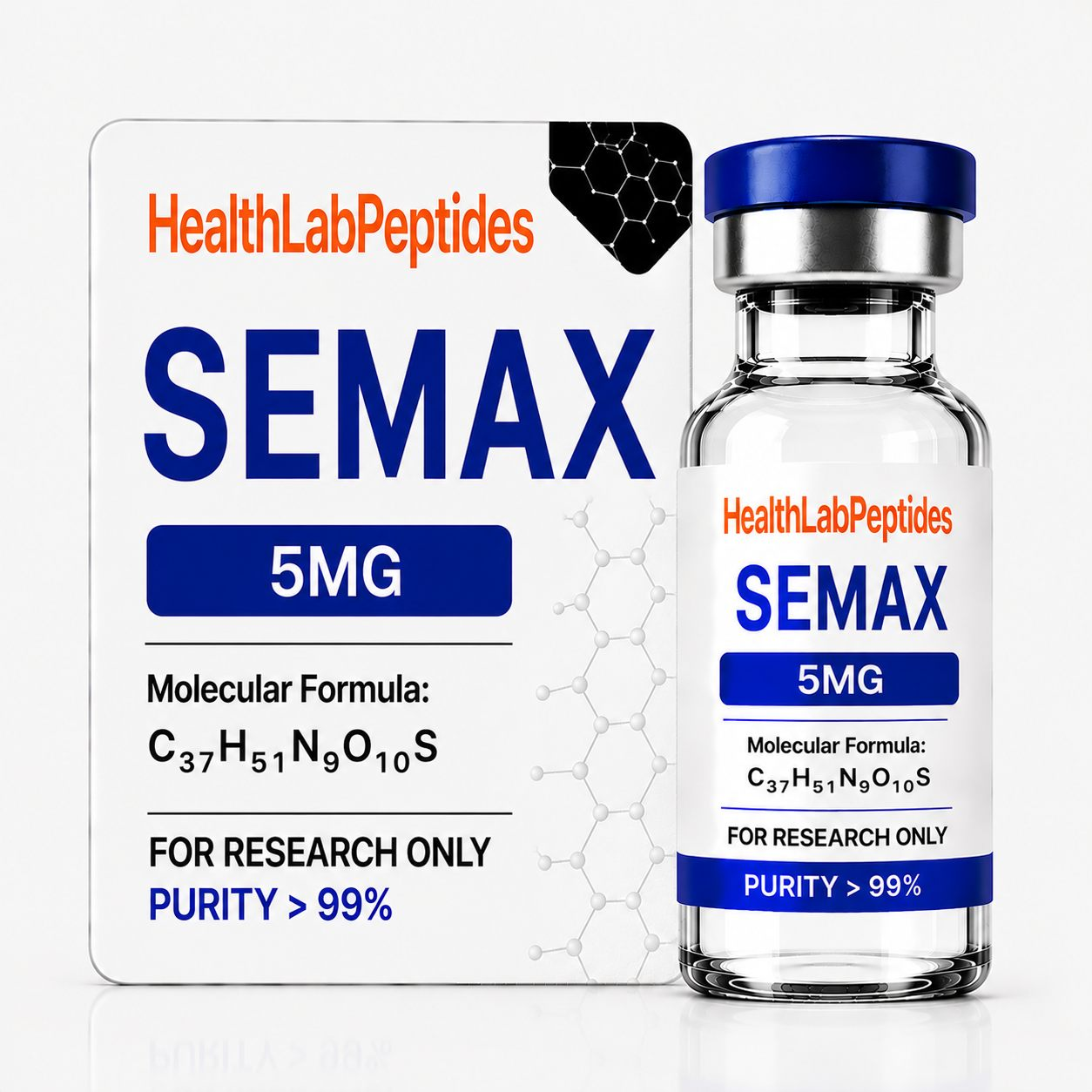
Researchers investigating Semax can review Semax 5mg research material or browse the broader HealthLab Peptides research catalog.
Semax is a synthetic peptide derived from an adrenocorticotropic hormone (ACTH)-related fragment. Its molecular characteristics have led researchers to investigate its interactions with several neurological and biochemical systems.
This article examines Semax strictly from a scientific and laboratory perspective. It does not provide guidance regarding human or veterinary use, administration, dosing, reconstitution, injection, cognitive enhancement, or therapeutic application.
What Is Semax?
Semax is a synthetic peptide whose sequence is related to an ACTH fragment.
Rather than examining ACTH solely in the context of conventional endocrine functions, Semax research has explored several neurological and molecular processes.
Experimental research has examined areas including:
- Neurotrophic signaling
- BDNF-associated pathways
- Gene expression
- Neurotransmitter-associated systems
- Cellular stress responses
- Neuroimmune signaling
- Neural plasticity-associated mechanisms
- Experimental learning and memory models
These research areas represent distinct biological questions and should be evaluated according to the particular experimental model being used.
Semax and ACTH-Fragment Research
The molecular origins of Semax are important to understanding why it became a research subject.
Semax is associated with an ACTH-derived sequence but has been investigated for characteristics extending beyond traditional ACTH endocrine research.
Researchers can examine how structural modifications to peptide sequences influence:
- Receptor interactions
- Molecular stability
- Enzymatic degradation
- Cellular signaling
- Biological activity
- Gene-expression responses
This makes Semax relevant not only to neurological research but also to broader peptide structure-function studies.
Semax and BDNF Research
One frequently discussed area of Semax research involves brain-derived neurotrophic factor (BDNF).
BDNF is an important signaling protein investigated extensively in neuroscience. Research involving BDNF includes biological processes associated with:
- Neuronal development
- Synaptic signaling
- Cellular differentiation
- Neural plasticity
- Gene regulation
- Cellular adaptation
Experimental research has examined whether Semax exposure is associated with changes in BDNF-related signaling or expression under particular research conditions.
These investigations can help researchers study relationships among peptide signaling, neurotrophic pathways, and cellular responses.
A measured change in BDNF or another molecular marker should not, however, be treated independently as proof of a particular cognitive or behavioral outcome.
Neurotrophic Signaling
Neurotrophic factors participate in the development, maintenance, and signaling of neural cells.
Research involving Semax can examine how peptide exposure interacts with these systems in controlled experimental models.
Potential endpoints include:
- Neurotrophic-factor expression
- Receptor-associated signaling
- Intracellular signaling cascades
- Protein phosphorylation
- Gene transcription
- Cellular differentiation
- Synaptic-associated molecular markers
Studying these endpoints contributes to the broader understanding of neurological signaling while keeping conclusions tied to the experimental systems in which they were observed.
Gene-Expression Research
Gene expression represents another area of experimental Semax investigation.
Cells respond to environmental and biochemical signals partly by altering which genes are transcribed and how strongly particular genes are expressed.
Researchers can use gene-expression analysis to examine whether exposure to an experimental material is associated with changes in particular molecular pathways.
Methods used in this field can include:
- Quantitative PCR
- Transcriptomic analysis
- RNA sequencing
- Protein-expression analysis
- Pathway analysis
- Comparative expression studies
Gene-expression changes can provide valuable mechanistic information, but their biological significance depends upon experimental design, methodology, and surrounding evidence.
Neurotransmitter-Associated Research
Semax has also appeared in research involving neurotransmitter-associated systems.
Neurotransmitters allow neurons and other cells to communicate through complex biochemical networks.
Experimental investigation may involve pathways associated with:
- Dopaminergic signaling
- Serotonergic signaling
- Cholinergic systems
- Excitatory signaling
- Inhibitory signaling
- Neurotransmitter metabolism
Researchers may examine receptor activity, neurotransmitter concentrations, enzyme activity, transporter behavior, or downstream molecular responses.
Because these systems interact extensively, an observed change in one pathway should not automatically be interpreted as evidence of a broad neurological effect.
Experimental Learning and Memory Models
Some Semax research has involved experimental models designed to investigate biological mechanisms associated with learning and memory.
These models may examine:
- Neural plasticity
- Synaptic signaling
- Neurotrophic factors
- Gene-expression changes
- Cellular adaptation
- Experimental behavioral endpoints
Such studies can help researchers understand relationships among peptide signaling and neurological processes.
Findings from animal or other preclinical models should remain clearly distinguished from conclusions concerning humans.
Cellular Stress-Response Research
Cells respond to environmental stress through interconnected signaling pathways.
Experimental models may expose cells or tissues to controlled stress conditions and then evaluate resulting molecular changes.
Researchers studying Semax can examine endpoints such as:
- Stress-responsive gene expression
- Cellular signaling
- Oxidative-stress-associated markers
- Protein regulation
- Neurotrophic signaling
- Cellular viability
- Inflammatory mediators
These experiments can contribute to understanding how neural systems respond to defined laboratory conditions.
Neuroimmune Signaling
The nervous and immune systems interact through numerous molecular pathways.
Neuroimmune research examines communication among neurons, glial cells, cytokines, inflammatory mediators, and other signaling molecules.
Semax-related experimental investigation may examine changes in:
- Cytokine-associated signaling
- Gene expression
- Cellular stress markers
- Neuroimmune communication
- Inflammatory signaling pathways
This remains a developing field, and findings should be interpreted according to the specific research model and methodology.
Neural Plasticity Research
Neural plasticity refers broadly to the ability of neural systems to change in response to biological signals and environmental conditions.
Researchers investigating plasticity can examine:
- Synaptic-associated proteins
- Neurotrophic factors
- Receptor expression
- Gene transcription
- Cellular morphology
- Intracellular signaling
Semax provides one experimental subject through which some of these systems have been investigated.
The presence of plasticity-related molecular changes in an experimental model does not independently establish changes in human cognition, memory, intelligence, or performance.
Semax and Selank Research
Semax and Selank are sometimes discussed together because both have appeared in neurological peptide research.
They are nevertheless distinct research subjects.
Semax research frequently emphasizes ACTH-fragment biology, neurotrophic signaling, BDNF-associated pathways, gene expression, and neurotransmitter-related systems.
Selank is structurally related to a tuftsin-associated sequence and has been investigated through somewhat different neurological and immunological pathways.
Researchers interested in Selank can review Selank 5mg research material.
The fact that two materials are studied within neurological research does not establish that they are interchangeable or that they should be physically combined.
In-Vitro Research
In-vitro experiments allow researchers to investigate molecular processes under highly controlled conditions.
Depending upon the research objective, Semax studies may employ:
- Cultured cells
- Isolated proteins
- Receptor assays
- Gene-expression systems
- Biochemical assays
- Molecular-binding studies
These models can help isolate individual mechanisms that may be difficult to evaluate within more complex biological systems.
Their controlled nature is scientifically useful, but it also limits how broadly findings can be generalized.
Preclinical Research
Preclinical investigation can include animal models and other complex experimental systems.
Such research may examine interactions among multiple tissues and signaling pathways that cannot be reproduced completely in isolated cell systems.
Researchers should carefully distinguish findings from:
- In-vitro experiments
- Animal models
- Observational studies
- Human clinical research
Evidence from one category should not automatically be treated as evidence from another.
Research Material Characterization
Reliable experimental work depends upon understanding the identity and characteristics of the material being investigated.
Researchers may evaluate:
- Peptide identity
- Amino-acid sequence
- Nominal quantity
- Purity specifications
- Analytical documentation
- Chromatographic data
- Mass-spectrometry data
- Batch or lot information
- Certificate of Analysis documentation
- Storage specifications
Product-specific purity or specification statements should be supported by appropriate analytical documentation rather than inferred from the general identity of the compound.
Experimental Reproducibility
Reproducibility is especially important when comparing peptide studies conducted under different laboratory conditions.
Experimental outcomes may be influenced by variables including:
- Material identity
- Purity
- Experimental concentration
- Cell type
- Model selection
- Exposure conditions
- Assay methodology
- Analytical equipment
- Statistical methods
- Environmental conditions
Researchers should therefore evaluate the complete methodology of a study rather than assuming that experiments involving the same peptide name are directly comparable.
Interpreting Semax Research
Semax literature spans several experimental areas, including neurotrophic signaling, neurotransmitter-associated pathways, gene expression, neuroimmune biology, cellular stress responses, and neural plasticity.
These fields sometimes use terminology that can easily be converted into consumer-oriented claims.
For example, investigating BDNF signaling is not equivalent to demonstrating improved cognition. Studying an experimental learning model does not establish improved human memory. Observing changes in cellular stress-response pathways does not establish a therapeutic effect.
Maintaining that distinction is essential when evaluating early-stage peptide research.
Frequently Asked Questions
What is Semax?
Semax is a synthetic peptide derived from an ACTH-related sequence. It has been investigated experimentally in neurological, biochemical, and molecular-signaling research.
What areas of Semax research are commonly investigated?
Published research has examined subjects including neurotrophic signaling, BDNF-associated pathways, neurotransmitter systems, gene expression, neuroimmune signaling, cellular stress responses, and neural plasticity.
Are Semax and Selank the same peptide?
No. They are structurally distinct research subjects associated with different peptide sequences and research pathways.
Researchers interested in Selank can review Selank 5mg research material.
Does HealthLab Peptides market Semax as a nootropic?
No. Semax offered by HealthLab Peptides is supplied strictly as a laboratory research material. It is not marketed as a nootropic, cognitive-enhancement product, drug, dietary supplement, or therapeutic product.
Does HealthLab Peptides provide Semax dosing or administration instructions?
No. HealthLab Peptides does not provide human or veterinary dosing, administration, injection, reconstitution, cycling, treatment, or personal-use protocols.
Can preclinical Semax findings be applied directly to humans?
No. Findings from cell-based experiments, animal models, or other preclinical systems must be interpreted within the limitations of those models and cannot automatically be extrapolated to humans.
Related Research Materials
Researchers investigating neurological and cellular-signaling systems can review:
Additional materials are available through the HealthLab Peptides Research Catalog.
The inclusion of multiple materials on this page is for research navigation and comparison. It is not a recommendation to combine materials or use them outside legitimate laboratory investigation.
Conclusion
Semax remains an interesting experimental subject within peptide and neurological research.
Studies involving neurotrophic signaling, BDNF-associated pathways, gene expression, neurotransmitter systems, neuroimmune signaling, and cellular stress responses provide researchers with several avenues for investigating its molecular characteristics.
Careful interpretation remains essential. Changes observed in isolated cells, biochemical assays, animal models, or other experimental systems should be evaluated within the limitations of those systems rather than translated directly into claims about human cognition, performance, or therapeutic effects.
Continued controlled investigation may help further characterize Semax and its interactions with neurological signaling systems.
Research Use Only — In Vitro Research
Semax offered by HealthLab Peptides is sold strictly for Research Use Only (RUO) and in-vitro laboratory research purposes.
This material is intended solely for qualified laboratory, analytical, and scientific research applications.
NOT FOR HUMAN OR VETERINARY USE, CONSUMPTION, INGESTION, INJECTION, IMPLANTATION, OR OTHER BODILY ADMINISTRATION.
HealthLab Peptides does not market Semax as a drug, dietary supplement, nootropic, cognitive-enhancement product, performance-enhancing product, therapeutic treatment, or as a product intended to diagnose, treat, cure, mitigate, or prevent disease.
References to BDNF, neurotransmitters, neural plasticity, learning and memory models, gene expression, neuroimmune signaling, or other biological processes describe areas of scientific investigation only.
Information provided by HealthLab Peptides does not constitute medical advice, prescribing information, dosage guidance, reconstitution instructions, administration instructions, injection protocols, treatment protocols, cycling protocols, stacking protocols, or directions for human or veterinary use.
Purchasers and researchers are responsible for ensuring that research materials are acquired, possessed, stored, handled, and used in accordance with applicable laws, regulations, institutional requirements, and appropriate laboratory practices.