

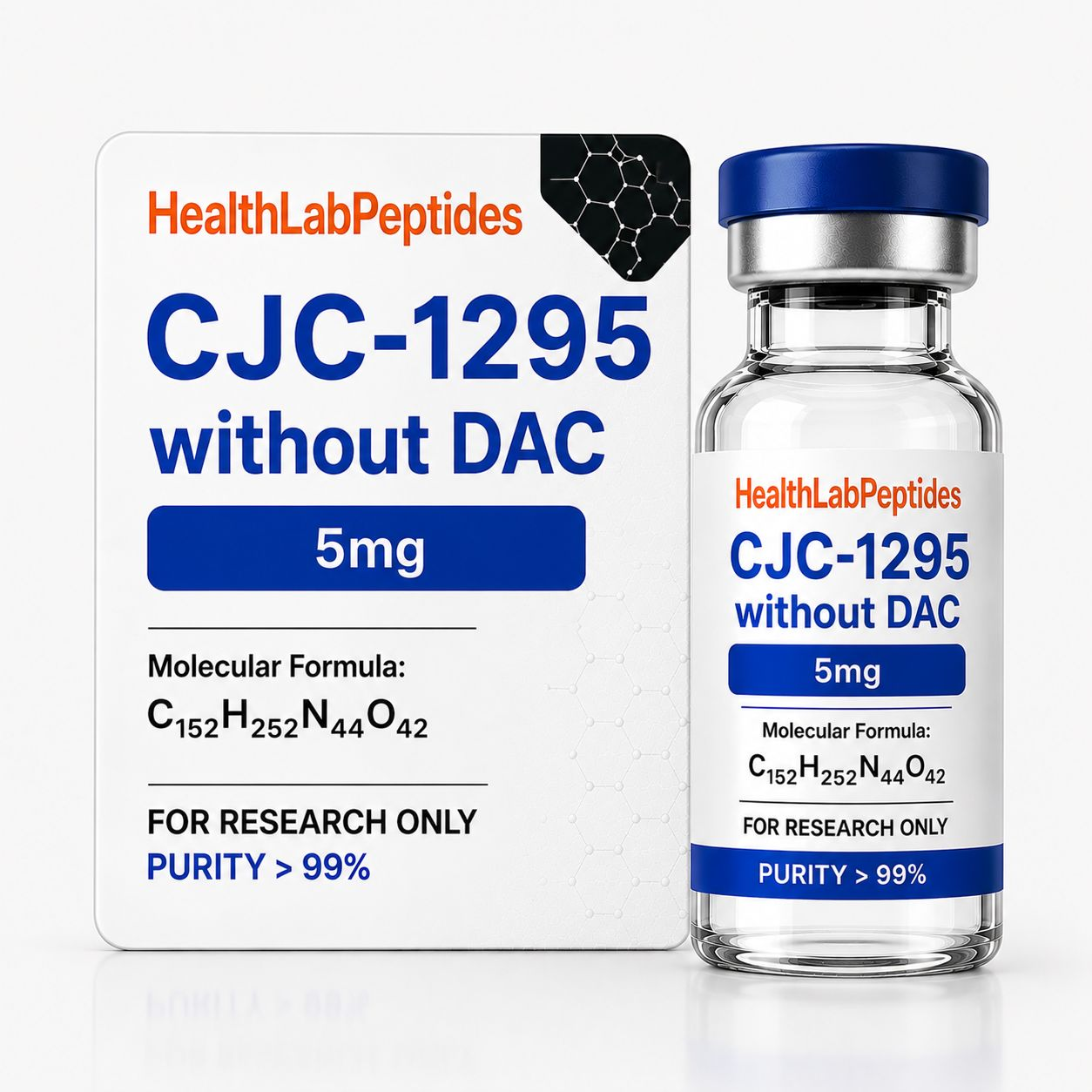
CJC-1295 in 2026: The Complete Guide to Mechanisms, Research Applications, Safety, and Clinical Evidence
Research suggests that CJC-1295 peptide remains one of the most extensively studied peptides for investigating growth hormone regulation and endocrine physiology. More than two decades after its development, researchers continue using CJC-1295 in laboratory settings to better understand how growth hormone-releasing hormone (GHRH) signaling influences metabolism, body composition, cellular communication, and healthy aging.
Unlike peptides that directly replace growth hormone, CJC-1295 is designed to stimulate the body’s own physiological growth hormone release through activation of GHRH receptors. This distinction has made it an important research tool for scientists studying the endocrine system and the complex feedback mechanisms that regulate hormone secretion.
As interest in peptide science continues to expand, CJC-1295 remains a frequent subject of laboratory investigations involving hormone biology, receptor pharmacology, exercise physiology, and metabolic research. Although numerous experimental studies have been published, the peptide is sold by HealthLab Peptides exclusively for Research Use Only (RUO) and is not approved by the U.S. Food and Drug Administration (FDA) for general therapeutic use.
What Is CJC-1295?
CJC-1295 is a synthetic analog of growth hormone-releasing hormone (GHRH). Researchers developed it to bind to GHRH receptors located on cells within the anterior pituitary gland, stimulating the natural release of endogenous growth hormone.
Unlike administering growth hormone itself, CJC-1295 allows researchers to investigate how the body’s own hormonal signaling pathways respond to receptor activation. Because endogenous hormone secretion is controlled through complex feedback loops, this approach provides valuable insight into normal endocrine physiology.
One characteristic that distinguishes CJC-1295 from earlier GHRH analogs is its engineered stability. Depending on the version being studied, researchers can investigate either prolonged receptor activation or shorter, more physiologic hormone pulses.
Understanding the Two Forms of CJC-1295
Although often discussed as a single peptide, researchers generally distinguish between two different compounds.
CJC-1295 DAC
The DAC version contains a Drug Affinity Complex, allowing the peptide to bind to serum albumin. This modification significantly extends its time in circulation, making it useful for laboratory studies examining prolonged GHRH receptor activation.
Researchers commonly use CJC-1295 DAC when investigating:
- Long-duration endocrine signaling
- Sustained growth hormone release
- Extended IGF-1 response
- Hormone pharmacokinetics
- Receptor occupancy over time
CJC-1295 Without DAC (MOD GRF 1-29)
The non-DAC version, often referred to as MOD GRF 1-29, has a much shorter biological half-life.
Because of its shorter duration, researchers frequently study it in experiments focused on:
- Pulsatile hormone secretion
- Natural endocrine rhythms
- Growth hormone pulse frequency
- Physiologic GHRH signaling
- Pituitary responsiveness
Both versions continue to provide valuable scientific information, but each serves different research objectives depending on the experimental design.
How CJC-1295 Works
The primary target of CJC-1295 is the growth hormone-releasing hormone receptor (GHRH-R).
After binding to this receptor within the pituitary gland, intracellular signaling pathways become activated, leading to the release of endogenous growth hormone. Researchers continue studying how this process influences downstream biological systems, including insulin-like growth factor-1 (IGF-1), protein metabolism, cellular communication, and tissue maintenance.
Rather than functioning independently, growth hormone secretion is tightly regulated through interactions among the hypothalamus, pituitary gland, somatostatin, ghrelin, and multiple feedback mechanisms. CJC-1295 provides researchers with a valuable model for investigating these interconnected endocrine pathways under controlled laboratory conditions.
Why CJC-1295 Remains Important in Peptide Research
Interest in CJC-1295 extends well beyond growth hormone itself. Scientists use the peptide to explore broader questions involving hormone regulation, receptor biology, and metabolic adaptation.
Current areas of investigation include:
- Endocrine physiology
- Growth hormone signaling
- IGF-1 regulation
- Circadian hormone release
- Exercise recovery biology
- Healthy aging research
- Protein metabolism
- Cellular communication
- Body composition research
- Hormonal feedback mechanisms
As peptide science advances, these research areas continue to generate new questions regarding how endogenous hormone pathways respond to selective receptor activation.
Growth Hormone Physiology
One of the most established applications for CJC-1295 involves studies of normal growth hormone physiology.
Researchers investigate how activation of GHRH receptors influences:
- Hormone pulse amplitude
- Pulse frequency
- Daily secretion patterns
- Pituitary sensitivity
- Endocrine feedback regulation
Understanding these mechanisms provides important information about how the endocrine system maintains hormonal balance throughout different stages of life.
Metabolic Research
Growth hormone influences numerous metabolic processes, making CJC-1295 valuable for laboratory investigations into energy regulation.
Researchers continue examining relationships between growth hormone signaling and:
- Protein turnover
- Nitrogen balance
- Lipid metabolism
- Glucose regulation
- Cellular energy utilization
- Body composition
Although these findings contribute to scientific understanding, further human clinical investigation remains necessary before therapeutic conclusions can be established.
Exercise Physiology and Recovery Research
Another major area of scientific interest involves the relationship between growth hormone signaling and exercise physiology. Researchers continue using CJC-1295 in laboratory models to better understand how naturally stimulated growth hormone release influences biological processes associated with physical activity and recovery.
Current investigations examine markers related to:
- Muscle protein turnover
- Cellular recovery pathways
- Nitrogen metabolism
- Connective tissue biology
- Skeletal muscle adaptation
- Exercise-induced endocrine responses
- Energy metabolism
- Hormonal recovery following physical stress
While these studies continue expanding scientific knowledge, laboratory findings should not be interpreted as evidence of established performance or recovery benefits in humans.
Healthy Aging Research
Normal aging is associated with gradual changes in hormone production, including reduced secretion of growth hormone. Because of this natural decline, researchers continue investigating CJC-1295 as a laboratory tool for understanding endocrine aging.
Studies are exploring how GHRH receptor activation may influence laboratory markers associated with:
- Hormonal regulation
- Lean tissue maintenance
- Cellular communication
- Sleep physiology
- Metabolic efficiency
- Healthy aging models
- Protein synthesis pathways
Scientists are particularly interested in understanding how endocrine signaling changes over time and how those changes affect overall physiology.
Sleep and Circadian Rhythm Studies
Growth hormone secretion is closely linked to normal sleep cycles, especially slow-wave sleep. This relationship has made CJC-1295 valuable for researchers studying circadian biology.
Current laboratory investigations examine interactions between:
- Sleep architecture
- Circadian hormone rhythms
- Pituitary activity
- Nocturnal growth hormone pulses
- Neuroendocrine regulation
These studies help researchers understand the natural timing of hormone release and its role in maintaining physiological balance.
CJC-1295 and IGF-1 Research
One of the primary downstream effects of growth hormone signaling is stimulation of insulin-like growth factor-1 (IGF-1) production.
Because IGF-1 participates in numerous biological processes, researchers frequently examine how CJC-1295 affects laboratory markers related to:
- Cellular growth signaling
- Protein metabolism
- Connective tissue physiology
- Bone biology
- Skeletal muscle research
- Endocrine communication
Understanding the interaction between growth hormone and IGF-1 remains an important area of endocrine research.
CJC-1295 vs. Ipamorelin
Although CJC-1295 and Ipamorelin are often mentioned together, they act through different biological pathways.
CJC-1295 is a growth hormone-releasing hormone (GHRH) analog that stimulates GHRH receptors in the pituitary gland.
Ipamorelin, by contrast, is a growth hormone secretagogue that activates the growth hormone secretagogue receptor (GHS-R1a), also known as the ghrelin receptor.
Because these peptides target different receptors, researchers frequently compare them to better understand how multiple signaling pathways contribute to endogenous growth hormone regulation.
Common areas of comparison include:
- Receptor selectivity
- Growth hormone release patterns
- Hormonal feedback mechanisms
- IGF-1 regulation
- Endocrine pharmacology
- Signal duration
These comparative studies continue to improve scientific understanding of hormone physiology.
Current Clinical Evidence
CJC-1295 has been investigated in both laboratory and early clinical settings, but the overall body of human evidence remains limited.
Published research demonstrates that the peptide can increase circulating growth hormone and IGF-1 levels under controlled conditions. However, many studies have involved relatively small numbers of participants, and long-term clinical data remain limited.
Current evidence indicates:
- Early clinical studies have characterized pharmacokinetic properties.
- Laboratory investigations continue expanding knowledge of receptor biology.
- Larger randomized clinical trials are still needed.
- No FDA-approved indication currently exists for general therapeutic use.
Researchers continue emphasizing the importance of distinguishing promising laboratory findings from proven clinical outcomes.
Safety Profile
Controlled research has generally described CJC-1295 as having a favorable safety profile within the context of scientific investigation.
Researchers continue evaluating:
- Injection-site reactions
- Fluid balance
- Headache
- Transient flushing
- Hormonal responses
- Dose-response relationships
- Long-term endocrine effects
Additional long-term studies are necessary to fully characterize safety across diverse populations and research conditions.
Related Research Peptides
Scientists studying CJC-1295 often investigate additional Research Use Only peptides to better understand complementary biological pathways.
Popular research peptides include:
- Ipamorelin
- Tesamorelin
- Sermorelin
- Hexarelin
- GHRP-2
- GHRP-6
- IGF-1 LR3
- IGF-1 DES
- PEG-MGF
- BPC-157
- TB-500
- GHK-Cu
- NAD+
- MOTS-c
- SS-31
- AOD-9604
- Retatrutide
- Tirzepatide
- Semaglutide
Together, these compounds support research across endocrinology, metabolism, regenerative biology, mitochondrial science, and cellular signaling.
Why Researchers Choose HealthLab Peptides
HealthLab Peptides offers an expanding selection of high-quality Research Use Only (RUO) peptides for qualified laboratories and scientific investigators.
Researchers choose HealthLab Peptides because of:
- Competitive everyday pricing
- High-purity research materials
- Reliable product availability
- Fast order fulfillment
- Clearly labeled RUO products
- An expanding catalog of research peptides
Explore related products:
- https://healthlabpeptides.com/product/cjc-1295-dac-5mg/
- https://healthlabpeptides.com/product/ipamorelin-10mg/
- https://healthlabpeptides.com/product/tesamorelin-peptide-5mg/
- https://healthlabpeptides.com/product/igf-1-lr3-1mg/
- https://healthlabpeptides.com/product/ghk-cu-50mg/
Browse the complete catalog at:
Frequently Asked Questions
What is CJC-1295?
CJC-1295 is a synthetic analog of growth hormone-releasing hormone (GHRH) that researchers study for its effects on endogenous growth hormone signaling and endocrine physiology.
What is the difference between CJC-1295 DAC and CJC-1295 without DAC?
The DAC version contains a Drug Affinity Complex that extends its time in circulation, while the non-DAC version (MOD GRF 1-29) has a shorter half-life and is commonly used to study pulsatile hormone release.
Why do researchers study CJC-1295?
Scientists use CJC-1295 to investigate growth hormone regulation, IGF-1 signaling, metabolic physiology, healthy aging, exercise biology, and endocrine feedback mechanisms.
Is CJC-1295 FDA approved?
No. CJC-1295 is not approved by the U.S. FDA for general therapeutic use and is offered by HealthLab Peptides exclusively for Research Use Only (RUO).
Final Thoughts
More than twenty years after its introduction, CJC-1295 remains one of the most important peptides in endocrine research. Its unique ability to activate growth hormone-releasing hormone receptors allows scientists to investigate complex biological systems involved in hormone regulation, metabolism, cellular communication, and healthy aging.
As peptide science continues advancing in 2026, ongoing laboratory and clinical studies will further clarify the peptide’s biological mechanisms and expand scientific understanding of endocrine physiology. Although current evidence remains promising, additional large-scale human studies are needed before definitive clinical conclusions can be drawn.
For laboratories seeking dependable Research Use Only peptides, HealthLab Peptides provides an expanding selection of high-quality research compounds supported by competitive pricing and reliable service.
Research Use Only (RUO) Disclaimer
Research Use Only (RUO). Products offered by HealthLab Peptides are intended exclusively for laboratory and scientific research. They are not for human or veterinary use and are not intended to diagnose, treat, cure, or prevent any disease. Statements regarding these products have not been evaluated by the U.S. Food and Drug Administration (FDA). HealthLab Peptides makes no medical or therapeutic claims regarding its products. Researchers are responsible for complying with all applicable laws, regulations, and institutional policies.
Here’s an additional section you can insert before the FAQ to make the article more comprehensive and increase topical depth for SEO.
The Evolution of CJC-1295 Research
Interest in CJC-1295 has evolved considerably since the peptide was first introduced. Early investigations focused primarily on its pharmacokinetic properties and its ability to stimulate endogenous growth hormone release. As researchers gained a better understanding of its receptor activity, scientific interest expanded into broader areas of endocrine regulation and metabolic biology.
Today, CJC-1295 is studied not only for growth hormone physiology but also as a tool for understanding how the endocrine system adapts to aging, exercise, nutritional status, and circadian rhythms. Modern laboratory techniques, including molecular biology, proteomics, and advanced hormone analysis, have allowed researchers to investigate signaling pathways in greater detail than was possible when the peptide was first developed.
Pharmacokinetics and Biological Activity
One of the defining characteristics of CJC-1295 is its extended biological activity compared with native growth hormone-releasing hormone.
Researchers continue examining factors such as:
- Receptor binding characteristics
- Duration of endocrine signaling
- Plasma stability
- Albumin binding (DAC formulations)
- Hormone pulse dynamics
- Elimination kinetics
These pharmacokinetic studies help scientists understand how structural modifications influence peptide behavior inside biological systems and why different GHRH analogs produce different experimental outcomes.
Emerging Areas of Investigation
As peptide science continues advancing, researchers are expanding the scope of CJC-1295 investigations beyond traditional endocrine studies.
Current areas of interest include:
Cellular Aging
Scientists continue examining how endocrine signaling changes throughout the aging process and how GHRH receptor activation may influence laboratory markers associated with cellular maintenance.
Body Composition Models
Experimental research is evaluating interactions between hormone signaling, lean tissue biology, and energy metabolism to better understand normal physiological regulation.
Systems Biology
Rather than studying individual hormones in isolation, many laboratories now investigate how growth hormone interacts with multiple biological systems simultaneously, including metabolism, immune signaling, mitochondrial function, and protein synthesis.
Precision Endocrinology
Advances in laboratory technology have made it possible to examine hormone release with greater precision, allowing researchers to better characterize pulsatile secretion patterns and receptor responsiveness.
Factors That Influence Research Outcomes
Investigators recognize that multiple variables can affect experimental results involving CJC-1295.
Examples include:
- Experimental model selection
- Age of research subjects
- Nutritional status
- Circadian timing
- Hormonal baseline levels
- Study duration
- Laboratory methodology
- Analytical techniques
Because these variables differ among studies, researchers carefully interpret findings within the context of each experimental design rather than drawing broad conclusions from any single investigation.
Looking Toward Future Research
The next generation of CJC-1295 studies will likely focus on improving our understanding of hormone regulation at the molecular level. Researchers continue exploring receptor biology, intracellular signaling networks, and interactions between growth hormone pathways and other endocrine systems.
As analytical technologies become more sophisticated, future investigations may provide deeper insight into how GHRH analogs influence normal physiology and how these mechanisms contribute to broader scientific understanding of endocrine function.
Although many questions remain unanswered, CJC-1295 continues to serve as one of the foundational peptides for growth hormone research, making it an important compound for laboratories investigating hormone biology in 2026 and beyond.
 BPC-157 + TB-500 Peptide Research Material — 10mg