
GHK Copper Peptides in 2026: Evidence-Based Review of Benefits, Mechanisms, and Safety
Research suggests that GHK Copper Peptide (GHK-Cu) remains one of the most extensively investigated peptides in regenerative biology, extracellular matrix research, and skin science. Since its discovery decades ago, scientists have continued studying this naturally occurring copper-binding tripeptide for its interaction with cellular signaling pathways involved in collagen production, tissue remodeling, antioxidant defense, and gene expression.
Interest in GHK-Cu has continued to grow throughout 2026 as laboratories investigate its role in regenerative medicine, biomaterials, aging research, dermatology, and wound-healing biology. Although laboratory findings are encouraging, GHK-Cu is not approved by the U.S. FDA as a general therapeutic treatment, and many proposed applications require additional high-quality clinical investigation.
If you’re searching for GHK Copper Peptides, buy GHK-Cu research peptide, or the latest science surrounding copper peptide research, this guide summarizes what current evidence shows.
What Is GHK Copper Peptide?
GHK-Cu is a naturally occurring tripeptide composed of:
- Glycine
- Histidine
- Lysine
When bound with copper (II), it forms the complex known as GHK-Cu, often called the Copper Peptide.
Originally isolated from human plasma, researchers later identified GHK in saliva and urine, suggesting it naturally participates in several biological signaling pathways.
As people age, endogenous GHK concentrations appear to decline, which has led researchers to investigate whether the peptide influences biological processes associated with aging, extracellular matrix remodeling, and cellular maintenance.
How GHK Copper Peptide Works
Unlike hormones, GHK-Cu functions primarily as a cellular signaling peptide.
Current research suggests it may influence:
- Gene expression
- Copper transport
- Cellular communication
- Extracellular matrix remodeling
- Fibroblast activity
- Antioxidant pathways
- Growth factor signaling
- Collagen synthesis pathways
Researchers estimate that GHK-Cu may influence thousands of genes involved in tissue maintenance and repair, making it one of the more intriguing naturally occurring signaling peptides currently under investigation.
Why Researchers Continue Studying GHK-Cu
1. Collagen Biology
One of the best-known areas of GHK-Cu research involves collagen.
Laboratory studies continue examining how GHK-Cu influences:
- Collagen production
- Elastin synthesis
- Glycosaminoglycan formation
- Fibroblast signaling
- Dermal extracellular matrix organization
Because collagen serves as the primary structural protein in connective tissue, these pathways remain important across dermatology and regenerative medicine research.
2. Skin Aging Research
Scientists continue investigating GHK Copper Peptides within models of skin aging.
Areas under study include:
- Skin elasticity
- Dermal thickness
- Extracellular matrix remodeling
- Oxidative stress
- UV-induced cellular damage
- Epidermal regeneration
Researchers remain interested in understanding how naturally occurring signaling peptides regulate healthy tissue maintenance throughout aging.
3. Wound-Healing Biology
GHK-Cu has also become an important research tool for investigating tissue repair mechanisms.
Current laboratory research examines:
- Fibroblast migration
- Angiogenesis signaling
- Inflammatory regulation
- Matrix remodeling
- Cellular proliferation
- Tissue organization
These investigations help scientists better understand normal wound-healing physiology rather than establish clinical treatment recommendations.
4. Hair Follicle Research
Another growing field involves hair biology.
Researchers continue studying whether GHK-Cu influences laboratory markers associated with:
- Hair follicle activity
- Dermal papilla signaling
- Follicular regeneration
- Scalp extracellular matrix biology
- Hair growth cycle regulation
While laboratory findings remain promising, additional human clinical studies are necessary before drawing conclusions regarding effectiveness.
5. Antioxidant Defense
Oxidative stress remains a major area of aging research.
Scientists continue evaluating whether GHK-Cu influences:
- Free radical activity
- Cellular antioxidant enzymes
- DNA repair pathways
- Mitochondrial function
- Cellular stress responses
These mechanisms continue generating significant interest across longevity research.
Gene Expression Research
One of the most fascinating characteristics of GHK Copper Peptide is its influence on gene regulation.
Several published investigations suggest GHK-Cu may help regulate genes associated with:
- Tissue remodeling
- Cellular growth
- Inflammation signaling
- Antioxidant defense
- Stem cell biology
- Extracellular matrix maintenance
Researchers believe these widespread genomic effects help explain why GHK-Cu continues appearing across multiple research disciplines.
GHK Copper Peptides and Regenerative Medicine
Regenerative medicine remains one of the fastest-growing areas of peptide research.
Scientists continue evaluating GHK-Cu in laboratory models involving:
- Biomaterial integration
- Tissue engineering
- Scaffold development
- Skin substitutes
- Connective tissue biology
- Orthopedic research
- Dental regeneration
- Biomedical implants
These studies remain experimental and should not be interpreted as established clinical therapies.
Current Clinical Evidence in 2026
Although laboratory evidence supporting GHK Copper Peptide continues expanding, clinical evidence remains more limited.
Current literature indicates:
- Multiple laboratory studies demonstrate biological activity.
- Small human studies have investigated topical cosmetic applications.
- Large randomized controlled trials remain limited.
- Additional research is needed before therapeutic recommendations can be established.
Researchers continue emphasizing the difference between laboratory findings and proven medical applications.
Safety Profile
Published studies generally report favorable tolerability under controlled research conditions.
Researchers continue evaluating:
- Cellular toxicity
- Tissue compatibility
- Copper metabolism
- Local irritation
- Long-term exposure
- Dose-response relationships
Because long-term clinical research remains limited, the complete safety profile continues to be investigated.
GHK-Cu vs Other Research Peptides
Unlike growth hormone secretagogues or metabolic peptides, GHK Copper Peptide primarily focuses on cellular signaling involved in tissue maintenance.
Researchers frequently compare GHK-Cu alongside:
- BPC-157
- TB-500
- KPV
- MOTS-c
- SS-31
- AOD-9604
- Thymosin Beta-4
- IGF-1 LR3
Each peptide acts through different biological pathways, making comparative research valuable.
Frequently Studied Research Areas
Scientists continue investigating GHK Copper Peptide within:
- Skin biology
- Cosmetic science
- Connective tissue research
- Hair follicle biology
- Orthopedic tissue engineering
- Cardiovascular biology
- Pulmonary fibrosis models
- Liver regeneration
- Neurological injury research
- Biomaterials
- Aging biology
- Stem cell research
These remain active areas of scientific investigation throughout 2026.
Related Research Peptides
Researchers interested in GHK-Cu often also investigate:
- BPC-157
- TB-500
- KLOW 80
- NAD+
- MOTS-c
- SS-31
- Tesamorelin
- Ipamorelin
- CJC-1295 DAC
- Semax
- Selank
- LL-37
- Thymosin Alpha-1
- Thymosin Beta-4
- ARA-290
- KPV
- IGF-1 LR3
- IGF-1 DES
- PEG-MGF
- Hexarelin
- Retatrutide
- Tirzepatide
- Semaglutide
Many laboratories study these compounds independently or as part of broader investigations into cellular signaling, tissue biology, metabolism, and aging.
Why Researchers Choose HealthLab Peptides
At HealthLabPeptides.com, researchers can find a growing catalog of high-quality Research Use Only (RUO) peptides for laboratory investigation.
Why researchers choose HealthLab Peptides:
- Competitive pricing across the peptide catalog
- High-purity research materials
- Fast shipping
- Extensive peptide selection
- Clearly labeled Research Use Only products
- New products added regularly
Related products include:
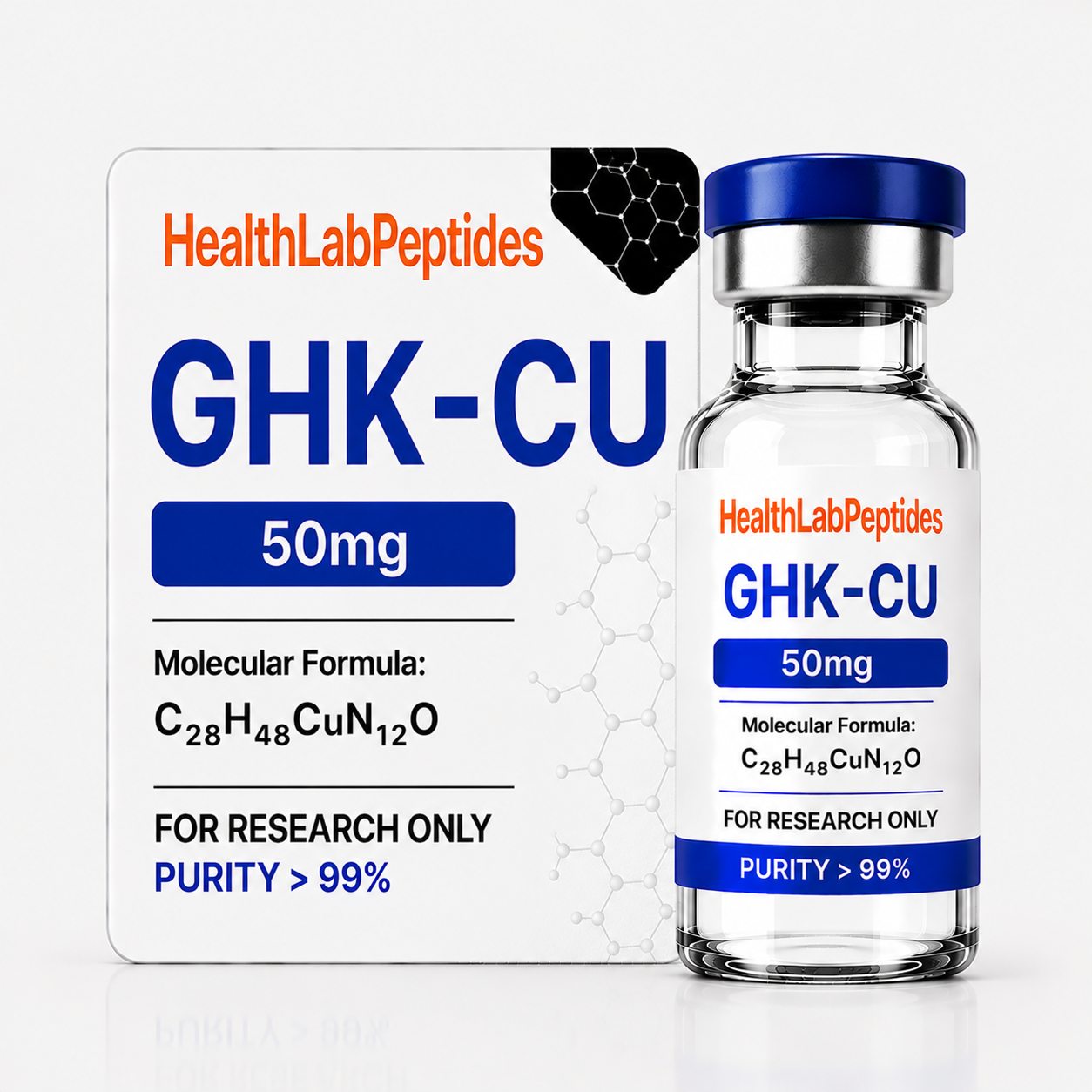
- https://healthlabpeptides.com/product/ghk-cu-50mg/
- https://healthlabpeptides.com/product/bpc-157-10mg/
- https://healthlabpeptides.com/product/tb500-5mg-peptide/
- https://healthlabpeptides.com/product/klow-80mg/
- https://healthlabpeptides.com/product/nad-1000mg/
Browse the complete catalog:
Frequently Asked Questions
What is GHK Copper Peptide?
GHK-Cu is a naturally occurring copper-binding tripeptide that researchers study for its role in cellular signaling, extracellular matrix biology, and tissue remodeling.
Is GHK-Cu FDA approved?
No. GHK Copper Peptide is not FDA-approved as a prescription medication for general therapeutic use.
Why is GHK-Cu popular in research?
Scientists continue investigating GHK-Cu because it influences biological pathways associated with collagen biology, skin science, antioxidant activity, connective tissue remodeling, and gene expression.
Can GHK-Cu be combined with other peptides?
Researchers frequently investigate GHK-Cu alongside peptides such as BPC-157, TB-500, KPV, MOTS-c, and NAD+ when studying complementary biological pathways. These combinations remain experimental.
Final Thoughts
GHK Copper Peptide continues to rank among the most studied signaling peptides in regenerative biology. Its influence on collagen production, extracellular matrix remodeling, antioxidant defense, tissue repair pathways, and gene expression has made it a valuable research tool across numerous scientific disciplines.
While laboratory evidence continues to expand in 2026, large-scale human clinical trials remain limited. Future research will help clarify the peptide’s full biological potential, long-term safety profile, and possible clinical applications.
For laboratories seeking high-quality Research Use Only peptides, HealthLabPeptides.com offers an expanding selection of GHK-Cu and other research compounds supported by competitive pricing, quality standards, and reliable service.
Research Use Only (RUO) Disclaimer
Research Use Only (RUO). Products sold by HealthLab Peptides are intended exclusively for laboratory and scientific research. They are not for human or veterinary use and are not intended to diagnose, treat, cure, or prevent any disease. Statements regarding these products have not been evaluated by the U.S. Food and Drug Administration (FDA). HealthLab Peptides makes no medical or therapeutic claims regarding its products. Researchers are responsible for complying with all applicable laws, regulations, and institutional policies.