
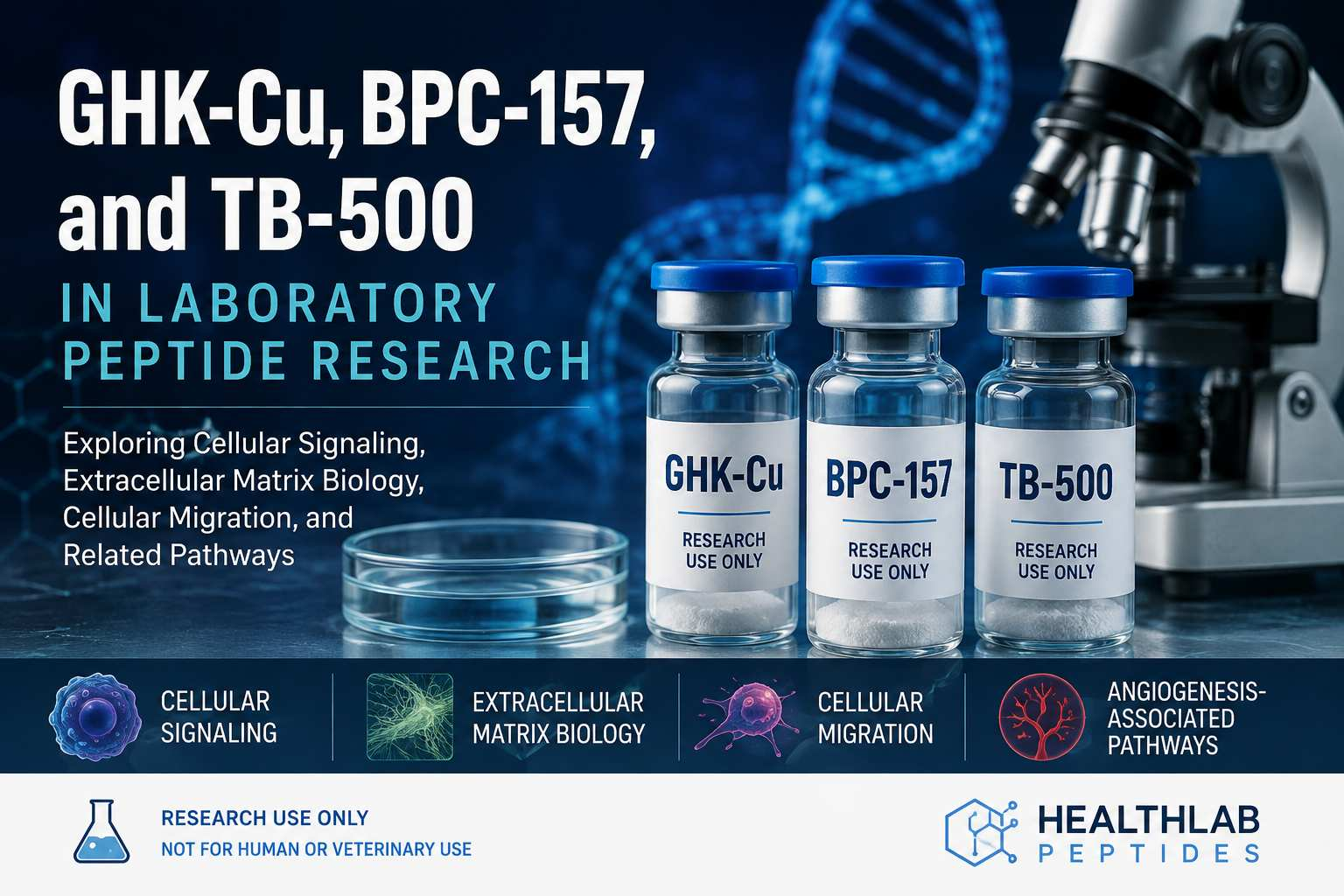
Research suggests that GHK-Cu, BPC-157, and TB-500 are investigated across several distinct areas of experimental peptide science, including cellular signaling, extracellular matrix biology, cellular migration, angiogenesis-associated pathways, and other molecular processes. Although these compounds are sometimes discussed together, each represents a different peptide structure and research area.
Researchers interested in individual materials can review GHK-Cu 50mg, BPC-157 5mg, and TB-500 5mg research materials from HealthLab Peptides.
This article examines these peptides strictly from a laboratory, in vitro, and preclinical research perspective. It does not provide medical advice, administration instructions, dosage information, or recommendations for human or veterinary use.
Why Researchers Study GHK-Cu, BPC-157, and TB-500
Peptides are short chains of amino acids capable of participating in a wide range of biological processes.
Different peptide structures may interact with different cellular pathways, receptors, proteins, or molecular systems. Researchers can therefore use peptide compounds as experimental tools for investigating specific aspects of biological signaling.
GHK-Cu, BPC-157, and TB-500 are particularly interesting because the scientific literature surrounding each compound involves different—but sometimes overlapping—areas of experimental investigation.
Research areas include:
- Cellular signaling
- Cellular migration
- Extracellular matrix-associated processes
- Fibroblast activity
- Angiogenesis-associated pathways
- Cytoskeletal organization
- Gene-expression responses
- Cellular stress-response pathways
- Inflammatory signaling
- Experimental tissue-response models
These terms describe areas of scientific investigation, not intended medical uses or claimed therapeutic effects.
Researchers new to peptide science can also review What Are Peptides? A Simple Research Overview for additional background.
GHK-Cu Research
What Is GHK-Cu?
GHK-Cu is a copper-binding complex formed by the tripeptide glycyl-L-histidyl-L-lysine (GHK) and a copper ion.
Its ability to coordinate copper gives GHK-Cu characteristics that distinguish it from many other research peptides.
GHK-Cu has consequently attracted scientific interest in experiments involving cellular signaling and extracellular biological processes.
Researchers requiring GHK-Cu as an individual laboratory material can view GHK-Cu 50mg research peptide.
GHK-Cu and Copper-Associated Signaling
Copper participates in numerous biological processes and can interact with proteins, enzymes, and signaling systems.
Because GHK can bind copper, researchers have investigated the GHK-Cu complex as a model for studying peptide-metal interactions and their potential influence on biological systems.
Experimental areas involving GHK-Cu have included:
- Copper-associated peptide signaling
- Gene-expression responses
- Extracellular matrix-associated processes
- Fibroblast activity
- Collagen-associated pathways
- Cellular migration
- Angiogenesis-associated signaling
- Oxidative signaling pathways
- Cellular inflammatory-response pathways
The biological significance of an observation depends heavily on the experimental model being used.
Findings from cell cultures or preclinical models should therefore be interpreted within the limitations of those models.
GHK-Cu and Extracellular Matrix Research
One area of interest surrounding GHK-Cu is extracellular matrix biology.
The extracellular matrix is the structural environment surrounding cells and contains proteins and other molecules that contribute to cellular organization and signaling.
Researchers studying GHK-Cu have examined its relationship with processes involving:
- Fibroblast behavior
- Collagen-associated signaling
- Extracellular matrix components
- Cellular migration
- Gene-expression changes
These mechanisms provide experimental endpoints that can be measured under controlled laboratory conditions.
They should not be interpreted as claims that GHK-Cu will produce a particular physical or medical outcome.
BPC-157 Research
What Is BPC-157?
BPC-157 is a synthetic peptide that has appeared extensively in experimental and preclinical research.
Much of the scientific interest surrounding BPC-157 involves cellular signaling and biological responses observed in laboratory or animal models.
HealthLab Peptides provides BPC-157 5mg research material for controlled laboratory investigation.
Experimental Areas Involving BPC-157
Preclinical investigations involving BPC-157 have examined areas including:
- Cellular migration
- Fibroblast-associated activity
- Angiogenesis-associated signaling
- Growth-factor-related pathways
- Experimental connective-tissue models
- Gastrointestinal tissue models
- Cellular inflammatory signaling
- Cellular responses to experimental stress
It is particularly important to distinguish research endpoints from medical outcomes when discussing BPC-157.
For example, observing a change in cellular migration in an experimental model does not establish that a compound can treat an injury or medical condition.
Likewise, findings from an animal model cannot automatically be extrapolated to humans.
BPC-157 and Angiogenesis-Associated Research
Angiogenesis refers to biological processes associated with the formation of new blood vessels.
Researchers can investigate signaling pathways associated with angiogenesis using cell cultures, biochemical assays, isolated tissues, and preclinical models.
BPC-157 has appeared in experimental literature examining several of these pathways.
However, observations involving angiogenesis-associated signaling should be reported according to the specific experimental model and should not be converted into claims of therapeutic effectiveness.
TB-500 Research
What Is TB-500?
TB-500 is a synthetic peptide associated with experimental investigation of biological pathways related to thymosin beta-4.
Research involving thymosin beta-4-related mechanisms has examined actin regulation, cytoskeletal activity, cellular migration, and other cellular processes.
Researchers can review TB-500 5mg research peptide for the individual laboratory research material.
TB-500 and Actin-Associated Research
Actin is an important structural protein involved in cellular organization and movement.
Because thymosin beta-4-related pathways interact with actin-associated cellular processes, researchers have investigated these mechanisms in experimental models involving:
- Cytoskeletal organization
- Cellular migration
- Actin-associated signaling
- Angiogenesis-associated pathways
- Cellular stress responses
- Experimental tissue-remodeling mechanisms
This makes TB-500-associated research fundamentally different in several respects from research involving either GHK-Cu or BPC-157.
TB-500 and Cellular Migration
Cell migration is an essential biological process in which cells move from one location to another.
Researchers can study migration using controlled laboratory assays designed to measure variables such as movement, signaling responses, cytoskeletal organization, and interactions with extracellular environments.
TB-500 and thymosin beta-4-related pathways have been investigated within these types of experimental systems.
Again, cellular migration is an experimental endpoint. It should not be translated directly into a claim concerning treatment, recovery, or a particular human outcome.
Comparing GHK-Cu, BPC-157, and TB-500
Although these three peptides are sometimes grouped together in discussions of peptide research, their scientific characteristics are not identical.
| Peptide | Example Research Areas |
|---|---|
| GHK-Cu | Copper-associated signaling, extracellular matrix biology, fibroblast activity, gene expression |
| BPC-157 | Cellular migration, angiogenesis-associated signaling, experimental tissue-response models |
| TB-500 | Actin-associated processes, cytoskeletal organization, cellular migration |
There can be overlap among experimental areas, but this does not mean the compounds have equivalent mechanisms or biological behavior.
Each peptide should be investigated according to its own molecular characteristics and the requirements of the experimental model.
Individual Peptide Research vs. Combined Research
An important consideration is the difference between studying these compounds independently and investigating multiple peptides within the same experimental design.
Research involving an individual compound provides a comparatively straightforward opportunity to associate observations with that particular experimental material.
Introducing several compounds simultaneously creates additional variables.
Researchers studying multiple peptides may need to account for:
- Individual component activity
- Potential interactions among components
- Experimental concentrations
- Cell or tissue model
- Exposure conditions
- Assay methodology
- Appropriate controls
- Selected endpoints
- Reproducibility
An observation involving several compounds cannot automatically be attributed to one component.
Likewise, evidence concerning individual compounds does not establish that a combination will demonstrate additive or synergistic activity.
Why “Synergy” Requires Experimental Evidence
The previous version of this article proposed a synergistic relationship among GHK-Cu, BPC-157, and TB-500.
That is an important scientific distinction to clarify.
The fact that different compounds are associated with complementary biological pathways does not by itself establish synergy.
Synergy is an experimentally testable hypothesis.
A controlled experiment designed to investigate possible interactions would ideally compare conditions such as:
- Experimental control
- GHK-Cu independently
- BPC-157 independently
- TB-500 independently
- Selected two-component combinations
- Three-component experimental formulation
Researchers could then compare predefined endpoints across the different experimental groups.
Without appropriate comparative evidence, it is more scientifically accurate to describe these compounds as having different areas of experimental investigation rather than claiming that combining them produces enhanced effects.
Multi-Peptide Research Formulations
Multi-component peptide formulations represent another area of laboratory investigation.
HealthLab Peptides’ KLOW-80 research peptide blend provides an example of a multi-component research formulation containing:
- GHK-Cu — 50mg
- BPC-157 — 10mg
- TB-500 — 10mg
- KPV — 10mg
Total nominal content: 80mg
KLOW-80 differs from the three-peptide subject of this article because it introduces KPV as a fourth experimental component.
Researchers interested in the scientific considerations surrounding such formulations can read KLOW80 as a Multi-Peptide Research Blend: Composition, Evidence Landscape, and Regulatory/Ethical Considerations.
BPC-157 and TB-500 as a Two-Component Research Formulation
Researchers may also investigate fewer components within the same experimental material.
For example, HealthLab Peptides provides a BPC-157 + TB-500 10mg research peptide blend containing nominally equal quantities of the two components.
A two-component formulation and a four-component formulation such as KLOW-80 represent different experimental materials and should not be treated as interchangeable.
Results obtained using one formulation cannot automatically be extrapolated to another.
In Vitro Research
In vitro research allows scientists to investigate biological processes under controlled laboratory conditions outside a complete living organism.
Examples can include:
- Cultured cell systems
- Biochemical assays
- Isolated biological materials
- Molecular interaction studies
- Controlled signaling experiments
In vitro models allow researchers to control experimental variables and investigate specific biological mechanisms.
However, these simplified experimental systems cannot reproduce every aspect of a complete biological organism.
Preclinical Research
Preclinical research may involve more complex experimental systems, including animal models.
These models can provide information that cannot be obtained from isolated cell cultures alone, but they still have substantial limitations.
Differences involving:
- Species
- Metabolism
- Experimental conditions
- Biological complexity
- Study design
- Selected endpoints
can all influence research results.
Consequently, preclinical findings should not automatically be interpreted as evidence of safety or effectiveness in humans.
Research Material Identity and Documentation
Reliable laboratory investigation begins with accurate identification of experimental materials.
Researchers evaluating peptide materials may consider:
- Compound identity
- Peptide sequence
- Molecular characteristics
- Nominal quantity
- Lot or batch identification
- Available analytical documentation
- Purity specifications
- Storage conditions
- Experimental controls
Analytical documentation should also be interpreted according to what was actually tested.
A certificate or analytical result represents the tested sample and methodology and should not automatically be interpreted as characterizing every vial or future batch.
Why Experimental Controls Matter
Controls are particularly important when studying compounds associated with overlapping biological pathways.
Without an appropriate control group, researchers may have difficulty determining whether an observation results from:
- The experimental peptide
- Another component
- The experimental environment
- Natural biological variability
- Measurement variability
- An interaction among multiple experimental variables
Good experimental design therefore requires researchers to define the hypothesis, controls, endpoints, and analytical methodology before interpreting results.
Frequently Asked Questions
What is GHK-Cu?
GHK-Cu is a copper-binding complex involving the tripeptide glycyl-L-histidyl-L-lysine. It has been investigated experimentally in relation to copper-associated signaling, extracellular matrix biology, fibroblast activity, gene expression, and other cellular mechanisms.
What is BPC-157?
BPC-157 is a synthetic peptide investigated primarily in experimental and preclinical research involving cellular signaling, migration, angiogenesis-associated pathways, and several experimental tissue models.
What is TB-500?
TB-500 is a synthetic peptide associated with research involving thymosin beta-4-related pathways, including actin-associated cellular processes, cytoskeletal organization, and cellular migration.
Are GHK-Cu, BPC-157, and TB-500 the same type of peptide?
No. They have different structures and are associated with different areas of experimental research.
Can researchers study these peptides together?
Researchers can design controlled experiments involving multiple compounds. However, introducing several peptides creates additional variables and requires appropriate controls to distinguish individual from combined observations.
Does combining GHK-Cu, BPC-157, and TB-500 prove that they work synergistically?
No. Complementary mechanisms do not establish synergy. Synergistic activity would need to be demonstrated through appropriately designed comparative experiments.
Can findings from animal studies be applied directly to humans?
No. Preclinical findings cannot automatically establish human safety or effectiveness. Differences between experimental models and human biology must be considered.
Are these peptides intended for human use?
Products offered by HealthLab Peptides as research materials are intended strictly for laboratory research and are not intended for human or veterinary use.
Research Use Only — In Vitro Research
GHK-Cu, BPC-157, TB-500, and related research materials offered by HealthLab Peptides are sold strictly for Research Use Only (RUO) and In Vitro Research purposes.
These products are intended solely for qualified laboratory, analytical, and scientific research applications.
NOT FOR HUMAN OR VETERINARY USE, CONSUMPTION, INGESTION, OR INJECTION.
HealthLab Peptides does not market these research materials as drugs, dietary supplements, therapeutic treatments, performance-enhancing substances, or products intended to diagnose, treat, cure, mitigate, or prevent any disease or medical condition.
References on this page to cellular migration, angiogenesis, extracellular matrix activity, inflammatory signaling, fibroblast activity, cytoskeletal processes, or other biological mechanisms describe subjects and endpoints of scientific investigation only. They do not represent intended uses or claimed therapeutic effects.
Information provided by HealthLab Peptides is for educational and scientific research purposes only. It does not constitute medical advice, prescribing information, dosage guidance, administration instructions, or instructions for human use.
Researchers and purchasers are responsible for ensuring that research materials are handled and used in accordance with applicable laws, regulations, institutional requirements, and appropriate laboratory practices.
d experimental considerations